

India's opposition leader Rahul Gandhi to appeal defamation charge

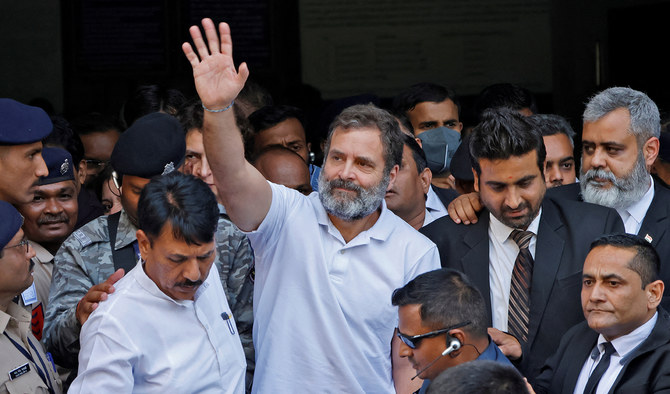
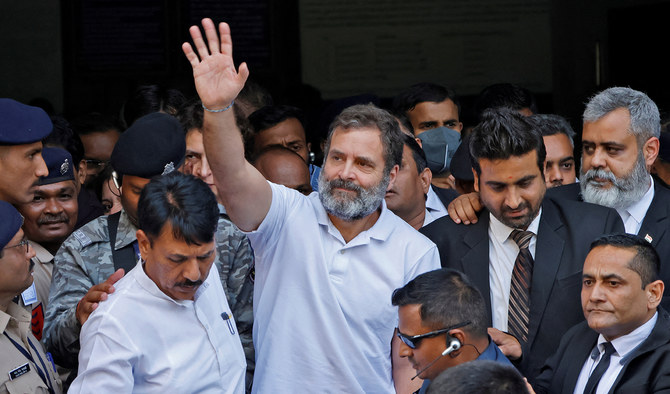
Rahul Gandhi, a senior leader of India's main opposition Congress party, waves as he leaves a court after he lodged an appeal against his conviction for defamation, in Surat in the western state of Gujarat, India, on April 3, 2023. (REUTERS)
Short Url
Updated 03 April 2023
Follow

India's opposition leader Rahul Gandhi to appeal defamation charge

  • Gandhi was ousted from parliament after court sentenced him to two years in prison
  • Gandhi's conviction has united Indian opposition, who accuse Modi of suppressing dissent

NEW DELHI: Indian opposition leader Rahul Gandhi arrived in a Gujarat court Monday to appeal a criminal conviction for mocking the prime minister's surname that saw Gandhi expelled from Parliament, dealing a huge blow to his Congress Party ahead of general elections next year.

Gandhi, a fierce critic of Prime Minister Narendra Modi and his main challenger in the 2024 polls, was ousted after a court sentenced him to two years in prison for defamation for a comment made in a 2019 election speech.

The case against Gandhi, the great-grandson of India's first prime minister and scion of the dynastic Congress party, were widely condemned by opponents of Modi as the latest assaults against democracy and free speech by a ruling government seeking to crush dissent. The speed of his removal from Parliament shocked political circles in India.

Gandhi flew from the capital, New Delhi, to Surat, a city in India's Gujarat state, today to appear in a local court where the opposition leader is expected to seek a suspension or temporary stay of his conviction, his lawyers told the Press Trust of India (PTI) news agency.

A man who shares the prime minister’s surname, which is common in his home state of Gujarat, accused Gandhi of defamation over a 2019 speech in which he asked, “Why do all thieves have Modi as their surname?” Gandhi then referred to three well-known, and unrelated Modis, in the speech: a fugitive Indian diamond tycoon, a cricket executive banned from the Indian Premier League, and the prime minister. The petitioner who filed the case is a member of Modi's Bharatiya Janata Party in Gujarat, but is not related to the prime minister or the other two Modis Gandhi invoked in his speech.

Gandhi was convicted on March 23 and expelled from Parliament the next day, sparking opposition lawmakers to rally to his defense and call his expulsion a new low for India’s constitutional democracy. Gandhi was given bail for 30 days.

Under Indian law, a criminal conviction with a prison sentence of two years or more is grounds for expulsion from Parliament. If Gandhi’s conviction is not suspended or overturned by a higher court, he could face prison and will likely not be able to contest national elections in 2024.

Modi’s critics say India’s democracy — the world’s largest with nearly 1.4 billion people — has been in retreat since he first came to power in 2014. They accuse his populist government of pursuing a Hindu nationalist agenda, a charge his administration has denied. Modi's government says its policies benefit all Indians.

Gandhi’s family, starting with his great-grandfather, Jawaharlal Nehru, has produced three prime ministers. Two of them — Rahul Gandhi's grandmother, Indira Gandhi, and father, Rajiv Gandhi — were assassinated.

Even though Gandhi is projected to be the main challenger to the Modi government, his Indian National Congress party has suffered humiliating defeats in the last two general elections. In a bid to woo voters, Gandhi has railed against Modi and his Bharatiya Janata Party in recent months, accusing them of corruption and of tarnishing India's democratic credentials.


As India claims fourth-largest economy spot, what it means on the ground

People gather to shop for clothes at a weekend market in Bengaluru, India, on Dec. 28, 2025. (AFP)
Updated 10 sec ago
Follow

As India claims fourth-largest economy spot, what it means on the ground

  • Indian government review says economy grew to $4.19 billion, overtaking Japan
  • Claim still needs IMF review as only organized sector counted, economist says

NEW DELHI: When Ramesh Chandra Biswal left his job as a space scientist in the US, he returned to eastern India and ran an agriculture startup on a promise of his country’s rapid economic growth.

Nine years on, as India positions itself as the world’s fourth largest economy, he is still waiting for the promise to come true.

India’s economy was the sixth largest in the world, valued at about $2.6 trillion in 2017, when Biswal launched his Villamart project in his home village in Odisha.

According to calculations in the Indian government’s end-of-year economic review, it has now grown to $4.19 trillion, overtaking Japan’s economy in terms of nominal Gross Domestic Product.

The review also projects that India will overtake Germany to become the world’s third-largest economy within the next three years, trailing only the US and China in economic weight.

But on the ground, Biswal was not sure what the projections meant because they had no impact on his life or business.

“The hype around India becoming the fourth largest economy is not grounded. People cannot relate to that,” he said.

“The number of people here in India is much more than Japan ... We have to improve the per capita income instead of telling the story of being the fourth largest economy.”

Over the years that he has been running his company, Biswal has not noticed much change, but hoped that the news of the country’s growth would at least create a positive hype and motivate everyone.

“People are trying. As an entrepreneur, we are also trying, struggling every day, trying to do something new,” he said.

“I’m getting some respect in society. That way, it is giving me the driving force.”

But not everyone was immediately optimistic. For Sarvesh Sau, a fruit seller in Delhi, it has been increasingly difficult to keep his family afloat.

“Rich people are getting rich, those who have resources ... but a low-income group person like me finds it difficult to manage a decent living despite putting in more than 12 hours of work every day.

“We are a big nation, and we will look big compared to others. Are we able to match Japan?”

The world’s most populous nation, India has about 1.46 billion people and a GDP per capita estimated by the World Bank to be about $2,700. It is about 12 times lower than Japan’s.

Yogendra Kumar, a plumber in Noida, said his income has been rising, but it is consistently outpaced by the cost of living, leaving him feeling poorer over time.

“I have heard that India has become the fourth largest economy, but I don’t know how to react to that. It does not make any difference to our lives. It sounds good that India is growing, but the matter of fact is that for people like me the struggle for survival is more acute now than before,” he said.

“Today I earn more but the inflation takes away all the money, and it makes it difficult to have a comfortable life,” he told Arab News. “Mustard oil was 50 rupees 10 years ago. It is now 200 rupees. A cooking gas cylinder used to cost 500 rupees — now it costs more than double. Everything is so expensive.”

While India’s claim of being the fourth-largest economy is still awaiting review by the International Monetary Fund, Prof. Arun Kumar, a development economist, does not expect it to be confirmed.

“Our GDP data, as the IMF has said, is suspect because it doesn’t include the informal sector ... According to my estimate, we are still the seventh largest economy, just ahead of Italy,” he told Arab News, also estimating India’s actual growth to be much lower than the government’s projection.

“Even though official data shows a 7 percent to 8 percent rate of growth, people realize that it’s not growing so well,” Prof. Kumar said.

“The rate of growth is only of the organized sector, not of the unorganized sector ... The unorganized sector is declining and that is where 94 percent of the employment is.”