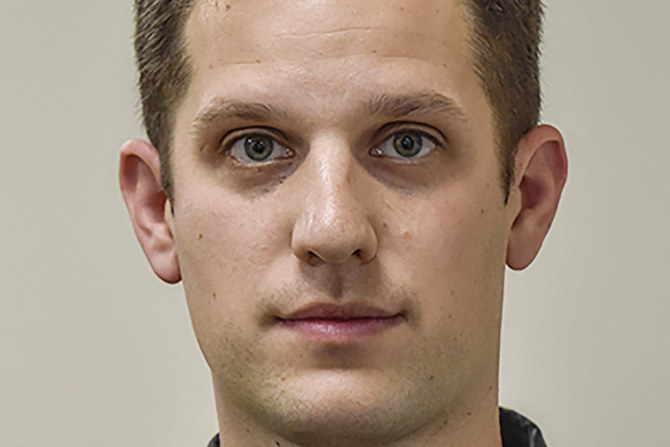
MOSCOW: A Nobel prize-winning Russian journalist said on Friday he did not believe that arrested American reporter Evan Gershkovich was a spy, and that he hoped diplomacy could bring about his quick release.
Dmitry Muratov told Reuters the case against Gershkovich — a Wall Street Journal reporter facing espionage charges that carry up to 20 years in jail — was part of a wider trend to make journalism a “dangerous profession” in Russia.
“I know Gershkovich. I’ve met him two or three times over the last year. I know the practice exists of using journalists as spies, intelligence officers and ‘illegals’ (undeclared spies) — this is not that kind of case,” Muratov said.
“He was no kind of so-called deep-cover operative — using being a journalist and his journalist’s accreditation as a cover for espionage ... Gershkovich was not a spy,” said Muratov, a co-winner of the Nobel Peace Prize in 2021 for his efforts to defend press freedom in Russia.
He was speaking outside a closed court hearing in Moscow on Friday in the case of Vladimir Kara-Murza, an opposition politician facing charges including state treason and spreading false information about the armed forces.
Muratov also cited the case of Ivan Safronov, a former journalist sentenced to 22 years in jail for treason last year.
“At every turn, we’re being charged with espionage and treason. It’s a trend — to show that journalism is a dangerous profession ... both for Russian and other journalists.”
Muratov was editor-in-chief of the independent newspaper Novaya Gazeta, which has seen several of its reporters killed in the last two decades, and had its registration revoked last year after Russia went to war in Ukraine. More than 260 publications have been closed, blocked or de-registered since then, he said.
“I don’t really understand how, given that trend and the lack of media competition, you can hold the elections that President Vladimir Putin announced for 2024,” he said.
“Does it mean they’ll go ahead without difficult topics, discussions, candidate programs? I’m starting not to understand how that can work.”
Muratov said he was aware of the “popular theory” that Gershkovich had been seized as a bargaining chip for Moscow to use in a prisoner exchange with the United States, though he did not say if he believed that himself.
He said he very much hoped that “through back-channel diplomacy,” Gershkovich would soon be freed.

Nobel-winning Russian editor: ‘I know Gershkovich, he’s no spy’
https://arab.news/5j3zv
Nobel-winning Russian editor: ‘I know Gershkovich, he’s no spy’
- Dmitry Muratov told Reuters the case against Gershkovich was part of a wider trend to make journalism a "dangerous profession" in Russia
- More than 260 publications have been closed, blocked or de-registered since then, he said
Foreign media group slams Israel for refusing to lift Gaza press ban
- Foreign Press Association expresses 'profound disappointment' with Israeli government’s response to a Supreme Court appeal
- Israel has barred foreign journalists from independently entering the devastated territory since the war started
JERUSALEM: An international media association on Tuesday criticized the Israeli government for maintaining its ban on unrestricted media access to Gaza, calling the move disappointing.
The government had told the Supreme Court in a submission late Sunday that the ban should remain in place, citing security risks in the Gaza Strip.
The submission was in response to a petition filed by the Foreign Press Association (FPA) — which represents hundreds of journalists in Israel and Palestinian territories — seeking immediate and unrestricted access for foreign journalists to the Gaza Strip.
“The Foreign Press Association expresses its profound disappointment with the Israeli government’s latest response to our appeal for full and free access to the Gaza Strip,” the association said on Tuesday.
“Instead of presenting a plan for allowing journalists into Gaza independently and letting us work alongside our brave Palestinian colleagues, the government has decided once again to lock us out” despite the ceasefire in the territory, it added.
Since the outbreak of the Gaza war in October 2023, triggered by an attack on Israel by the Palestinian militant group Hamas, the government has barred foreign journalists from independently entering the devastated territory.
Instead, Israel has allowed only a limited number of reporters to enter Gaza on a case-by-case basis, embedded with its military inside the blockaded Palestinian territory.
The FPA filed its petition in 2024, after which the court granted the government several extensions to submit its response.
Last month, however, the court set January 4 as a final deadline for the government to present a plan for allowing media access to Gaza.
In its submission, the government maintained that the ban should remain in place.
“This is for security reasons, based on the position of the defense establishment, which maintains that a security risk associated with such entry still exists,” the government submission said.
The government also said that the search for the remains of the last hostage held in Gaza was ongoing, suggesting that allowing journalists in at this stage could hinder the operation.
The remains of Ran Gvili, whose body was taken to Gaza after he was killed during Hamas’s 2023 attack, have still not been recovered despite the ceasefire.
The FPA said it planned to submit a “robust response” to the court, and expressed hope the “judges will put an end to this charade.”
“The FPA is confident that the court will provide justice in light of the continuous infringement of the fundamental principles of freedom of speech, the public’s right to know and free press,” the association added.
The Supreme Court is expected to issue a ruling on the matter, though it is unclear when a decision will be handed down.
An AFP journalist sits on the board of the FPA.


