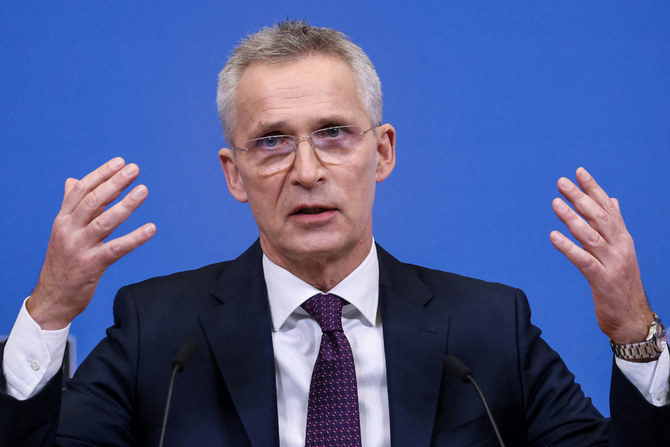
BRUSEELS: NATO chief Jens Stoltenberg said Friday that Finland would formally become a member within days, as he congratulated its president on clearing the final obstacle to joining.
“I look forward to raising Finland’s flag at NATO HQ in the coming days. Together we are stronger and safer,” Stoltenberg wrote on Twitter.
After months of delays, Turkiye’s parliament on Thursday removed the last hurdle for Finland by becoming the last member of the US-led military alliance to ratify its application.
Stoltenberg said in separate statement that “Finland has highly capable forces, advanced capabilities, and strong democratic institutions.”
“So Finland will bring a lot to our alliance,” he said.
NATO foreign ministers are meeting at the alliance’s headquarters in Brussels next week, when it is expected the membership could be formalized.
Russia’s invasion of Ukraine last year upended European security and pushed Finland and its neighbor Sweden to drop decades of non-alignment and seek to join NATO’s protective umbrella.
Stockholm application remains stuck, however, because of ongoing resistance from both Turkiye and Hungary.
But Stoltenberg insisted that “all allies agree that a rapid conclusion of the ratification process for Sweden will be in everyone’s interest,“
“I look forward to also welcoming Sweden as a full member of the NATO family as soon as possible,” he said.

NATO chief says Finland to become member ‘in coming days’
https://arab.news/j9bat
NATO chief says Finland to become member ‘in coming days’
- NATO chief says he looks forward to also welcoming Sweden as full member soon
Asylum applications drop to 40-year low in Sweden
- Asylum seekers and their family members accounted for just 6 percent of the total, compared with 31 percent in 2018, when total immigration was 133,000
STOCKHOLM: The number of people applying for asylum in Sweden dropped by 30 percent in 2025 to the lowest level since 1985, with the right-of-center government saying it planned to further tighten rules this year ahead of an election in September.
The ruling minority coalition, which is supported by the anti-immigration Sweden Democrats, has made cutting the number of asylum seekers a key policy platform since taking power in 2022. It blames a surge in gang crime on decades of loose asylum laws and failed integration measures under previous Social Democrat-led governments.
FASTFACT
The Swedish government has cracked down on asylum seekers, made it more difficult to gain residency and citizenship, and introduced financial incentives for immigrants to leave the country.
“The change is not just about numbers in terms of lower immigration, it’s also about the way that’s made up, who is coming to Sweden with the proportion from asylum at a record low,” said Immigration Minister Johan Forssell.
The number of immigrants, excluding refugees from Ukraine, fell to 79,684 last year from 82,857 in 2024, according to figures from the Migration Board.
Asylum seekers and their family members accounted for just 6 percent of the total, compared with 31 percent in 2018, when total immigration was 133,000.
The number of people either voluntarily returning to another country or being expelled by authorities was also up.
“This is an area which is a high priority for us,” Forssell said.
The government has cracked down on asylum seekers, made it more difficult to gain residency and citizenship, and introduced financial incentives for immigrants to leave the country since it came to power.
Forssell said the government planned to further tighten regulations in the coming year, including a new law to increase the number of returnees and stricter citizenship rules, among other measures.
Swedes will vote in what is expected to be a tight general election in September.
Meanwhile, Denmark’s strict immigration policies drove asylum admissions to a historic low in 2025, with 839 requests granted by the end of November, the government said.
“It is absolutely critical that as few foreigners as possible come to Denmark and obtain asylum. My main priority is to limit the influx of refugees,” said Immigration Minister Rasmus Stoklund in a press release.
According to the ministry, “there have been very few years when the annual total remained below 1,000 ... 2025 will be a year with a historically low number of residence permits granted on asylum grounds.”
Denmark registered 1,835 asylum requests by November 2025.
The country’s immigration approach has been influenced by far-right parties for more than 20 years, and Prime Minister Mette Frederiksen, leader of the Social Democrats, has pursued a “zero refugee” policy since taking office in 2019.
Copenhagen has, over the years, implemented a slew of initiatives to discourage migrants and make Danish citizenship harder to obtain.
In 2024, the country of 6 million people accepted some 860 of the 2,333 asylum requests lodged that year.


