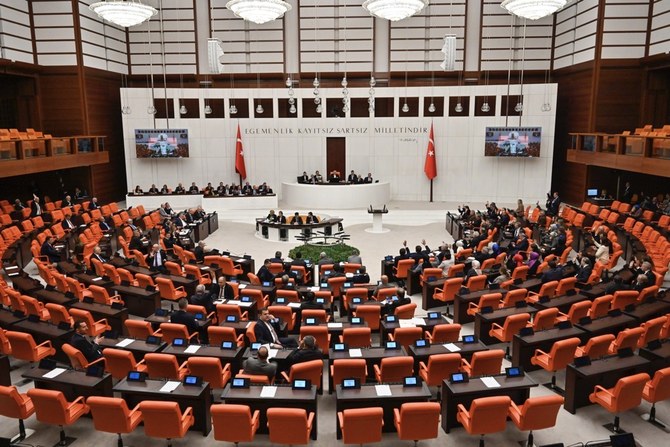
ANKARA, Turkiye: Turkiye’s parliament on Thursday ratified Finland’s application to join NATO, lifting the last hurdle in the way of the Nordic country’s long-delayed accession into the Western military alliance.
All 276 lawmakers present voted in favor of Finland’s bid, days after Hungary’s parliament also endorsed Helsinki’s accession.
“This will make the whole NATO family stronger & safer,” NATO Secretary General Jens Stoltenberg wrote on Twitter in welcoming Turkiye’s action.
Alarmed by Russia’s invasion of Ukraine a year ago, Finland and Sweden abandoned their decades-long policy of nonalignment and applied to join the alliance.
Full unanimity is required to admit new members into the 30-member alliance, and Turkiye and Hungary were the last two NATO members to ratify Finland’s accession.
Sweden’s bid to join the alliance, meanwhile, has been left hanging, with both Turkiye and Hungary holding out on giving it the green light despite expressing support for NATO’s expansion.
Turkiye’s government accuses Sweden of being too lenient toward groups it deems to be terrorist organizations and security threats, including militant Kurdish groups and people associated with a 2016 coup attempt.
More recently, Turkiye was angered by a series of demonstrations in Sweden, including a protest by an anti-Islam activist who burned the Qur’an outside the Turkish Embassy.
Hungary’s government contends some Swedish politicians have made derisive statements about the condition of Hungary’s democracy and played an active role in ensuring that billions in European Union funds were frozen over alleged rule-of-law and democracy violations.
Turkish officials have said that unlike Sweden, Finland fulfilled its obligations under a memorandum signed last year under which the two countries pledged to address Turkiye’s security concerns.
“As a NATO member, we naturally had some expectations and requests regarding the security concerns of our country,” Akif Cagatay Kilic, a legislator from President Recep Tayyip Erdogan’s governing party, told parliament before the vote. “I would like to underline the concrete steps and their implementation by Finland, which supported and shaped the decision we are taking here.”
Kilic added: “I’m aware that there is a large number of people watching us from Finland. ... We can say to them: ‘Welcome to NATO.’”
Some opposition parties were critical of the Turkish government’s position toward the two Nordic countries.
“Unfortunately, (Erdogan’s ruling party) turned the right to veto Finland and Sweden’s membership bids into a tool for blackmail and threat. We do not approve of it,” said Hisyar Ozsoy, a legislator from the pro-Kurdish party. “We find the bargaining process (to press for) the extradition of Kurdish dissident writers, politicians and journalists ... to be ugly, wrong and unlawful.”
Asked earlier this week about Sweden’s NATO membership, Erdogan told reporters: “There are certain things we expect of them. They must be fulfilled first.”
Sweden, which made constitutional changes to pass tougher anti-terrorism laws, has expressed hope that it will be able to join before NATO’s July summit in Vilnius, Lithuania.
“Sweden faces more significant obstacles in its bid,” Hamish Kinnear, Middle East and North Africa analyst at the risk intelligence company Verisk Maplecroft, wrote in emailed comments.
“Turkiye is unlikely to approve its acceptance into the alliance before the election in May. The Qur’an burning incident sparked popular rage in Turkiye and President Tayyip Recep Erdogan won’t want to risk angering his conservative base ahead of the polls,” Kinnear said.
The accession of Finland, which has a 1,340-kilometer (832-mile) border with Russia, has geographic and political importance for NATO, said Mai’a Cross, professor of political science at Northeastern University.
“Finland is at a very important strategic location and having that kind of shift from neutrality to respond to Russia’s aggression is bolstering the demonstration of the political will of NATO,” she said.
Cross added that the delay gave Finland more of a chance to prepare.
“Finland is already sitting in the meetings with NATO. It’s already revamping its armed forces,” she said. “So when it steps into NATO formally, it can actually hit the ground running.”


![]()

Turkiye’s parliament ratifies Finland’s membership in NATO
Short Url
https://arab.news/rbdbt
Turkiye’s parliament ratifies Finland’s membership in NATO


Latest updates


Recommended


© 2026 SAUDI RESEARCH & PUBLISHING COMPANY, All Rights Reserved And subject to Terms of Use Agreement.