VATICAN CITY: Pope Francis has a respiratory infection and will need to spend “a few days” in hospital for treatment, the Vatican said in a statement on Wednesday, amid concern for the 86-year-old’s condition.
The 86-year-old pontiff was taken to Rome’s Gemelli hospital after complaining of breathing difficulties over the past few days, the statement said. Tests showed he had the infection but did not have COVID-19, it said.
“Pope Francis is touched by the many messages received and expresses his gratitude for the closeness and prayer,” the Vatican said.
Francis, who this month marked 10 years as pope, is sometimes short of breath and generally more exposed to respiratory problems. He had part of one lung removed in his early 20s when training to be a priest in his native Argentina.
His latest hospitalization comes ahead of a Palm Sunday service on April 2 that marks the start of a hectic week of ceremonies leading to Easter Sunday on April 9, throwing into doubt whether he would be able to lead them as customary.
Francis’ health has attracted increased scrutiny in the past two years, during which he has undergone colon surgery and begun using a wheelchair or a walking stick due to chronic pain in one knee.
The Vatican had initially said the pope had gone to hospital on Wednesday for a scheduled check-up. But Italian media reported he arrived in an ambulance after canceling a television interview at the last minute.
Francis had attended his weekly general audience in St. Peter’s Square in the morning, appearing in good health.
In Argentina, the faithful offered prayers for the recovery of the pope, who has not returned to his homeland since leaving for the Vatican a decade ago.
“If the Pope could listen to us, I would tell him that we need him because the reform that he faced is not finished,” said Marcela Mazzini, a professor at Inmaculada Concepcion Seminary in Buenos Aires, where the pope, then called Jorge Mario Bergoglio, studied.
The son of Italian immigrants, the future pope lived modestly when he was archbishop of Buenos Aires, traveling by public transport and keeping a low profile when he visited the poor in shanty towns, where many still remember him.
The leader of the world’s nearly 1.4 billion Roman Catholics suffers from diverticulitis, a condition that can infect or inflame the colon, and was operated on at the Gemelli hospital in 2021 to remove part of his colon.
He said in January that the condition had returned and that it was causing him to put on weight, but that he was not overly concerned. He did not elaborate.
Francis said in an interview last year that he preferred not to have surgery on his troublesome knee because he did not want a repeat of long-term negative side effects from anesthesia that he suffered after the 2021 operation.
Last July, returning from a trip to Canada, Francis acknowledged that his advancing age and his difficulty walking might have ushered in a new, slower phase of his papacy.
But since then he has visited Kazakhstan and Bahrain and made a trip last month to Democratic Republic of Congo and South Sudan.
He has also committed to visiting Hungary in late April, Portugal in August and the French city of Marseille in September. He has said, if it can be arranged, he would want to then fly from Marseille to Mongolia.
After praising his late predecessor Benedict XVI’s historic decision to resign on health grounds in 2013, Francis has indicated he would follow the example only if he were gravely incapacitated.


![]()
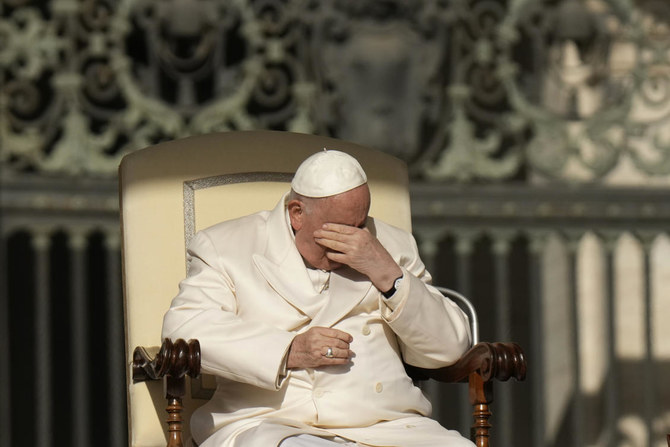
Pope Francis to spend ‘few days’ in hospital due to respiratory infection

Short Url
https://arab.news/9ypzj
Pope Francis to spend ‘few days’ in hospital due to respiratory infection
- The 86-year-old Argentine pontiff has the infection but did not have COVID-19
- Francis is sometimes short of breath and generally more exposed to respiratory problems


Latest updates


Recommended


© 2026 SAUDI RESEARCH & PUBLISHING COMPANY, All Rights Reserved And subject to Terms of Use Agreement.