


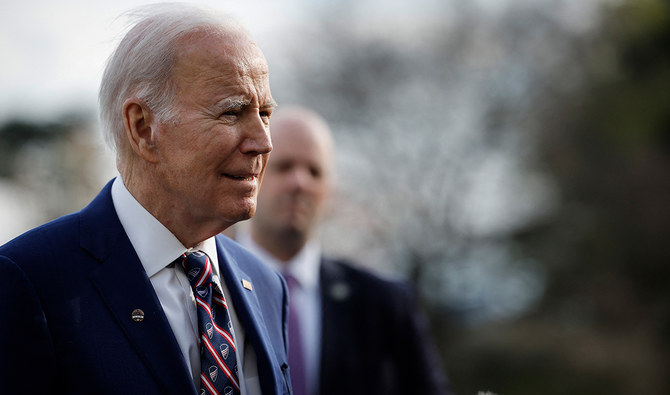
WASHINGTON: President Joe Biden is opening his second Summit for Democracy with a pledge for the US to spend $690 million bolstering democracy programs around the globe.
The Biden administration wants to use the two-day summit that begins Wednesday to zero in on making “technology work for and not against democracy,” according to a senior administration official. Some 120 global leaders have been invited to participate.
Biden frequently speaks of the US and like-minded allies being at a critical moment in which democracies need to demonstrate they can out-deliver autocracies. The summits, something Biden promised as a Democratic 2020 presidential candidate, have become an important piece of his administration’s effort to try to build deeper alliances and nudge autocratic-leaning nations toward at least modest reforms.
The new funding will focus on programs that support free and independent media, combat corruption, bolster human rights, advance technology that improves democracy, and support free and fair elections.
The official, who previewed the summit on the condition of anonymity, said the administration has also come to an agreement with 10 other nations on guiding principles for how the governments should use surveillance technology.
The surveillance tech agreement comes after Biden signed an executive order earlier this week restricting the US government’s use of commercial spyware tools that have been used to surveil human rights activists, journalists and dissidents around the world.
The world has had a tumultuous 15 months since Biden’s first democracy summit in December 2021. Countries emerged from the coronavirus pandemic, and Russia launched its invasion of Ukraine, the largest-scale war in Europe since World War II. Biden has also tangled with Beijing, speaking out repeatedly about China’s military and economic influence in the Indo-Pacific and beyond.
“Worldwide, we see autocrats violating human rights and suppressing fundamental freedoms; corrupting — and with corruption eating away at young people’s faith in their future; citizens questioning whether democracy can still deliver on the issues that matter most to their lives and to their livelihoods,” Secretary of State Antony Blinken said at a pre-summit virtual event on Tuesday.
The US hosted the last summit on its own. This time, it recruited four co-hosts — Costa Rica, the Netherlands, South Korea and Zambia — after ambassadors from China and Russia criticized the first summit and accused Biden of causing a global divide with a Cold War mentality.
Still, some countries would rather not get between Washington and Beijing.
Pakistan announced, as it did in 2021, that it received an invitation but would skip the summit, a move seen in part as an effort by the impoverished nation to assuage longtime ally China, which was not invited.
The Biden administration has also expanded its invitation list. Bosnia-Herzegovina, Gambia, Honduras, Ivory Coast, Lichtenstein, Mauritania, Mozambique and Tanzania were extended invitations to this year’s summit after being left off the list in 2021.
The first day of the summit will be a virtual format and will be followed on Thursday by hybrid gatherings in each of the host countries, with representatives from government, civil society and the private sector participating.
Costa Rica will focus on the role of youth in democratic systems. The Dutch are taking on media freedom. South Korea is looking at corruption. Zambia is centering on free and fair elections
The US is no stranger to the challenges facing democracies, including deep polarization and pervasive misinformation.
Lies spread about the 2020 presidential election by then-President Donald Trump and his supporters have convinced a majority of Republicans that Biden was not legitimately elected, normalized harassment and death threats against election officials, and been used to justify efforts in Republican-controlled legislatures to adopt new voting restrictions.
Later this year, the US Supreme Court will rule in a racial gerrymandering case from Alabama that voting rights advocates fear could virtually dismantle the nearly 60-year-old Voting Rights Act. Congressional efforts to shore up that federal law and increase voting access have failed.
More recently, Biden administration officials have been at odds with close Mideast ally Israel, as conservative Prime Minister Benjamin Netanyahu tries to push forward a far-reaching judicial overhaul that the administration worries will diminish Israel’s democracy.
Marti Flacks, the director of the Human Rights Initiative at the Center for Strategic and International Studies in Washington, said “there’s been a disconnect” between the Biden administration’s messaging and actions on human rights. The administration may get higher marks from allies for how it has approached stresses on democracy at home.
“The fact that the Biden administration has been very open and transparent about the challenges that the US is facing domestically on the democracy front has increased their credibility on these issues externally,” Flacks said, a State Department and National Security Council official during the Obama administration.
“Because one of the big questions that I think they faced coming in is how can you begin to talk about human rights and democracy overseas if you can’t address those problems here at home.”
Following his appearance at the plenary session of the summit, Biden will host President Alberto Fernández of Argentina for talks in the Oval Office.
Fernández, who was also taking part in the summit, is looking for backing from Biden as his country tries to renegotiate the country’s $44 billion lending program with the International Monetary Fund.
Argentina is asking the IMF to revise its requirements for release of the latest installment of the deal, arguing that it has been negatively impacted by a drought and by higher energy prices caused by Russia’s war in Ukraine.


