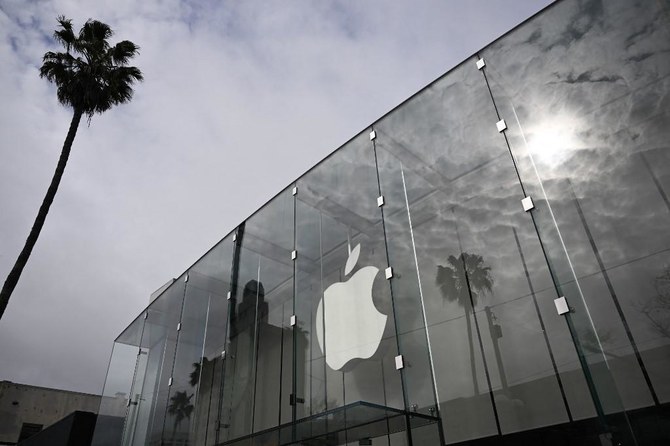
LONDON: Apple Inc. on Tuesday launched its “buy now, pay later” (BNPL) service in the United States, a move that threatens to disrupt the fintech sector dominated by firms like Affirm Holdings and Swedish payments company Klarna.
The service, Apple Pay Later, will allow users to split purchases into four payments spread over six weeks with no interest or fees, the company said. It will initially be offered to select users, with plans of a full roll-out in the coming months.
Users can get loans between $50 and $1,000 for online and in-app purchases made on iPhones and iPads with merchants that accept Apple Pay, according to the company.
More than 85 percent of US retailers accept Apple Pay, the company said.
“Apple Pay Later will absolutely wallop some of the other players. Other companies would’ve taken a look at Apple’s announcement today because they are an ubiquitous name. This will take a bite out of the market share of other players,” said Danni Hewson, head of financial analysis at AJ Bell.
BNPL firm Affirm’s shares fell more than 7 percent, while PayPal closed about 1 percent lower.
In 2020, pandemic-related lockdowns turned shoppers to online payment platforms, bolstering demand for fintech companies offering BNPL services, especially to millennials and Gen Z customers.
Digital payments behemoths including PayPal and Block Inc. have expanded into the sector through acquisitions, while Affirm went public in a multi-billion dollar listing.
The sector’s fortunes have since turned as rising interest rates and red-hot inflation dampened purchasing power and forced consumers to tighten their purse strings.
“We expect Apple to tread cautiously, especially in this macro environment,” said Christopher Brendler, analyst at D.A. Davidson, alluding to its decision to not use a partner and underwrite, fund, and collect on the loans directly.
Apple Pay Later is enabled through the Mastercard Installments program, the company said, adding that Goldman Sachs was the issuer of the Mastercard payment credential.


Apple launches ‘buy now, pay later’ service
https://arab.news/m2y8n
Apple launches ‘buy now, pay later’ service

- Apple Pay Later service will allow users to split purchases into four payments spread over six weeks with no interest or fees
- Apple said service is currently available to selected users in the US, full rollout coming soon


Riyadh panel unpacks media influence in digital era
- Arab News-led discussion at SMF examines the realities behind media power and sustainability
RIYADH: “We don’t shape narratives, they shape us,” Vincent Peyregne, former CEO of World Association of Newspapers and News Publishers, told a panel at the Saudi Media Forum in Riyadh on Monday.
Moderated by Arab News Editor-in-Chief Faisal Al-Abbas, the session titled “How do alliances shape global public opinion?” explored how media organizations navigate public opinion, commercial pressures, and the shift away from traditional revenue models. It challenged the notion that media outlets can control audience perception.
“In some part, we document the public opinion,” Peyregne added. “But I don’t see any reasonable publishers in our network saying, ‘I’m shaping the public opinion.’”
Al-Abbas described the idea of media shaping public opinion as an illusion when responding to questions about a “secret formula of success,” saying: “The perception that anybody can dominate public opinion is an illusion,” he said.
The session explored the evolving global media landscape, comparing traditional publishers with newer digital players and examining how alliances and platforms influence reach and sustainability.
A key theme was the decline of state support for private media. Peyregne argued that the era of subsidies is effectively over, stressing that editorial independence depends on financial self-sufficiency.
Ben Smith, cofounder and editor in chief of Semafor, echoed this view by noting that many traditional publishers mistakenly wait for the government to “give back” their audience or revenue.
Smith, who brings a different perspective to the session with a background at Politico and Buzzfeed, said, “There is a tendency among the traditional publishers to say, ‘We know how the world is meant to be organized and the new players are taking an audience that is meant for us.’”
He argued that media must adapt to the digital ecosystem rather than seeking government-mandated compensation as a primary survival strategy.
Peyregne added that publishers are increasingly moving away from the “victim mentality” or “blame game” and instead are taking responsibility for their own survival rather than relying on regulators or blaming platforms like Google and Facebook.
He outlined a three-pillar revenue model for sustainable media companies, moving away from 80 percent ad reliance toward a balanced mix of advertising, paid content, direct audience relationships, and diversification through events, data, and digital agencies.


