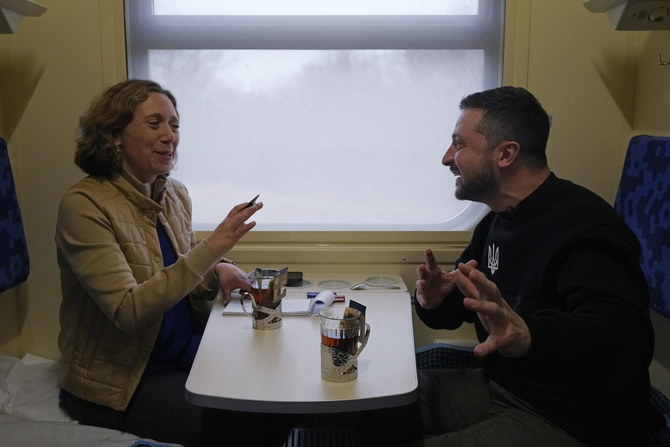
ON BOARD A TRAIN FROM SUMY TO KYIV, Ukraine: A team of journalists from the AP spent two days traveling by train with Ukrainian President Volodymyr Zelensky as he visited the southeastern city of Zaporizhzhia, which still faces regular shelling from Russian forces, and northern towns in the Sumy region that were liberated shortly after the war began a year ago.
The AP is the first news organization to travel extensively with Zelensky since the war began. Here are some takeaways from an interview with Zelensky as he returned to Kyiv late Tuesday.
WESTERN WEAPONS
Throughout much of the war, Ukraine’s military has been bolstered by billions of dollars of ammunition and weaponry from Western nations. Zelensky welcomed the help but said some of the promised weapons had not yet been delivered.
“We have great decisions about Patriots, but we don’t have them for real,” he said, referring to the US-made air defense system.
Ukrainian soldiers have received training in the US since January on how to use the Patriot system, but it hasn’t yet been deployed in Ukraine.
Ukraine needs 20 Patriot batteries to protect against Russian missiles, and even that may not be enough “as no country in the world was attacked with so many ballistic rockets,” Zelensky said.
Zelensky added that a European nation sent another air defense system to Ukraine, but it didn’t work and they “had to change it again and again.” He did not name the country.
Zelensky also reiterated his longstanding request for fighter jets, saying “we still don’t have anything when it comes to modern warplanes.” Poland and Slovakia have decided to give Soviet-era fighter jets to Ukraine, but no Western country so far has agreed to provide modern warplanes amid concern that it could escalate the conflict and draw them in deeper.
PUTIN’S ISOLATION
Zelensky was unsparing in his assessment of Russia’s Vladimir Putin, calling him an “informationally isolated person” who had “lost everything” over the last year of war.
“He doesn’t have allies,” Zelenskky said, adding that it was clear that even China — an economic powerhouse long favorable toward Moscow — was no longer willing to back Russia. Chinese President Xi Jinping recently visited Putin i n Russia but left without publicly announcing any overt support for Moscow’s campaign against Ukraine.
Zelensky suggested that Putin’s announcement shortly after Xi’s visit that he would move tactical nuclear weapons to Belarus, closer to NATO territory, was meant to deflect from the fact that the Chinese leader’s visit did not go well. Putin said the move was a counter to Britain’s decision to provide more depleted uranium ammunition to Ukraine.
Despite Putin’s nuclear provocations, Zelenskky said he does not believe the Russian leader is prepared to use the bomb.
“If a person wants to save himself, he really ... will use these,” he said. “I’m not sure he’s ready to do it.”
AVOIDING A NUCLEAR DISASTER
On Zelensky’s itinerary this week was a meeting with Rafael Mariano Grossi, the visiting head of the UN’s atomic energy agency. Grossi was in the region to take stock of the situation at the nearby Zaporizhizhia Nuclear Power Plant, which Russia took control of last year.
Fierce fighting around the plant, Europe’s largest, has put the facility and the broader region at significant risk. During his meeting with Zelensky on Monday, Grossi said the situation was not improving.
Grossi has called for a “protection zone” around the plant but has failed to come up with terms that would satisfy both Ukraine and Russia. Grossi told the AP on Tuesday he believed a deal was “close.” However, Zelensky, who opposes any plan that would legitimize Russia’s control over the facility, said he was less optimistic a deal was near. “I don’t feel it today,” he said.
THE FIGHT FOR BAKHMUT
The longest battle of the war is raging in the eastern city of Bakhmut, where Ukrainian and Russian forces have been locked in a grinding conflict for seven months.
Some Western military analysts have questioned why Ukraine is willing to suffer so many losses to defend the territory, arguing that the city is not of strategic significance. Zelensky argued otherwise, saying any loss in the war will give Russia an opening. He predicted that if Russia defeats Ukraine in Bakhmut, Putin would set out to “sell” a victory to the international community.
“If he will feel some blood, smell that we are weak, he will push, push, push,” Zelensky said, adding that the pressure would come not only from the international community but also from within his own country.
“Our society will feel tired,” he said. “Our society will push me to have compromise with them.”
Zelensky recently made traveled near Bakhmut for a morale-boosting visit with troops fighting in the hard-hit city.
CALLS FOR TOUGHER SANCTIONS
Western sanctions against Russia don’t go far enough, according to Zelensky, who called for more far-reaching measures against people in Putin’s inner circle.
More than 30 countries, representing more than half the world’s economy, have imposed sanctions on Russia, including price caps on Russian oil and restrictions on access to global financial transactions. The West has also directly sanctioned about 2,000 Russian firms, government officials, oligarchs and their families. More than $58 billion worth of sanctioned Russians’ assets have been blocked or frozen worldwide, according to a recent report from the US Treasury Department.
Zelensky said more should be done to target Putin’s enablers, who “have to know that they will lose all their money … all their real estate in Europe or in the world, their yachts everywhere.”
RIDING THE RAILS
Most of Zelensky’s travel in Ukraine is done by rail. There are few other options: Commercial air travel has been grounded and Ukraine’s expanse, as well as the unpredictability of life in a war-torn country, make road travel arduous.
The state railway system, however, has remained remarkably stable throughout the war and largely untouched by the constant barrage of Russian missiles. One notable exception: the April 2022 bombing of the crowded Kramatorsk train station that killed dozens of people.
Though Zelensky rides on a train set aside for him and his delegation, it is largely indistinguishable on the outside from the blue-and-yellow trains ferrying other people and goods across the country. Most Ukrainians barely looked up to acknowledge Zelensky’s train as it zipped through towns across the countryside, passing picturesque fields and the occasional bombed-out building or bridge.


![]()

Volodymyr Zelensky: Russia’s Vladimir Putin has ‘lost everything’ over the last year of war with Ukraine
Short Url
https://arab.news/neqt5
Volodymyr Zelensky: Russia’s Vladimir Putin has ‘lost everything’ over the last year of war with Ukraine
- Ukraine’s military has been bolstered by billions of dollars of ammunition and weaponry from Western nations
- Volodymyr Zelensky on Vladimir Putin: He is an ‘informationally isolated person’


Latest updates


© 2026 SAUDI RESEARCH & PUBLISHING COMPANY, All Rights Reserved And subject to Terms of Use Agreement.