

If Tunisia is not helped, Muslim Brotherhood may ‘create instability’: Italian FM

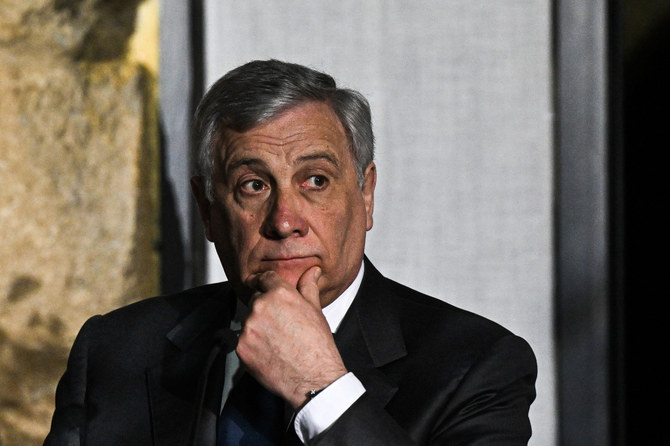
Italian Foreign Minister Antonio Tajani said his government has been working hard to ensure that IMF and World Bank help Tunisia. (File/AFP)
Short Url
Updated 28 March 2023
Follow

If Tunisia is not helped, Muslim Brotherhood may ‘create instability’: Italian FM

  • ‘We can’t afford the radicalization of the Mediterranean,’ Antonio Tajani tells conference attended by Arab News
  • Rome striving to ensure Tunisia ‘doesn’t become a failed state,’ pushing for IMF loan

ROME: The international community runs the risk of “having the Muslim Brotherhood create instability” in Tunisia if the country is not promptly granted “substantial financial help,” Italian Foreign Minister Antonio Tajani said at a conference attended by Arab News.

“We can’t afford the radicalization of the Mediterranean,” he added, saying Tunisia is on the verge of “economic collapse,” and negotiations for a loan of nearly $1.9 billion from the International Monetary Fund have “stalled” over President Kais Saied’s recent policies.

Elected in 2019, Saied dissolved Parliament in July 2021, reformed the country’s constitution to increase his presidential powers, and then held a referendum followed by parliamentary elections with a very low turnout.

At the beginning of this year he cracked down on dissent, arresting politicians, labor union members, judges and members of civil society.

The economic situation in Tunisia is dire, leading more and more people to try to reach Italy on small boats.

Tajani said Italy is “the most interested” in ensuring that “Tunisia solves its problems and doesn’t become a failed state.”

He added that the Italian government has been working hard to ensure that the IMF and the World Bank help Tunisia.

“But there’s a problem: The IMF, with the support of the US, says, ‘You first carry out reforms, and then we’ll give the money.’ On the other hand, the Tunisians say, ‘First the money and then the reforms’,” he said.

“This is why we propose that the IMF gives immediately a first tranche of money; the rest of the loan can be paid in line with the progress of reforms.”

Tajani said the international community “can’t afford to make the mistake of leaving Tunisia to the Muslim Brotherhood.”

Stefania Craxi, president of the Foreign Affairs and Defense Committee of the Italian Senate, told Arab News: “The Muslim Brotherhood will prosper if the grant doesn’t come and the economy keeps going down.”

She added: “It’s right for the IMF to ask for reforms, but they must grant the loan before the worst happens. That money must come now.”


Sudan PM heads to New York for UN talks

Updated 8 sec ago
Follow

Sudan PM heads to New York for UN talks

  • Sudan’s army chief Gen. Abdel Fattah Al-Burhan said last week he was ready to work with Trump to resolve the conflict

PORT SUDAN: Sudan’s Prime Minister Kamil Idris left for New York on Saturday to meet the UN chief and other officials and discuss humanitarian access and a possible ceasefire, two government sources said.
The trip comes as fighting between Sudan’s army and the Rapid Support Forces, which erupted in April 2023, intensifies in southern Kordofan, raising fears of new atrocities similar to those reported in the city of El-Fasher in late October.
Reports of mass killings, rape, and abductions followed the RSF’s capture of the army’s last stronghold in the western 
Darfur region.
A Sudanese government source said Idris was expected to meet UN Secretary-General Antonio Guterres to “put an end to the worsening humanitarian crisis” in Sudan.
Idris’ adviser, Mohammed Abdel Qader, also said the talks would focus on “facilitating aid access” and reaffirm the government’s commitment to a roadmap handed over to the UN, including a “conditional ceasefire linked to the withdrawal of the RSF from areas and cities it occupies.”
Earlier this month, Guterres said the United Nations was preparing talks with both sides in Geneva, but did not specify a date.
Renewed hopes for diplomacy emerged last month when US President Donald Trump pledged to help end the conflict.
Sudan’s army chief Gen. Abdel Fattah Al-Burhan said last week he was ready to work with Trump to resolve the conflict.
The RSF says it supports the international ceasefire plan, but heavy fighting continues, notably in Kordofan.
Egypt, a key ally of Sudan’s army, warned on Thursday that escalating violence “directly affects Egyptian national security” and stressed that preserving Sudanese state institutions remains a “red line.”
US Secretary of State Marco Rubio said the new year offered a chance for a humanitarian truce in Sudan and urged external countries to use leverage.
“Ninety-nine percent of our focus is this humanitarian truce and achieving that as soon as possible,” Rubio told a news conference.
“And we think that the new year and the upcoming holidays are a great opportunity for both sides to agree to that, and we’re really pushing very hard in that regard,” he said.
Rubio voiced alarm at new reports that humanitarian convoys have been struck.
“What’s happening there is horrifying. It’s atrocious,” he said.
“One day, the story of what’s actually happened there is going to be known, and everyone involved is going to look bad,” he added.
“We’re hopeful that we can make some progress on this, but we know that in order to make progress on this, it will require outside actors to use their leverage,” Rubio said.