Pakistan regulator bans coverage of rallies, gatherings ahead of ex-PM Khan court appearance

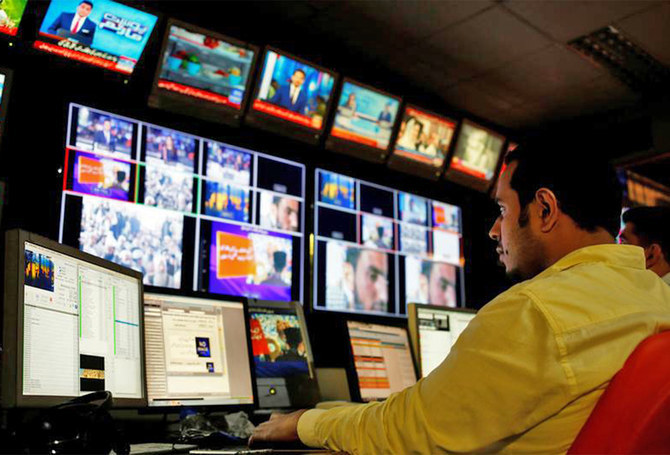
An employee works at the control room of a television channel in Karachi, Pakistan, on April 11, 2018. (REUTERS/File)
Short Url
Updated 27 March 2023
Follow

Pakistan regulator bans coverage of rallies, gatherings ahead of ex-PM Khan court appearance

  • Khan is scheduled to appear before an Islamabad court to seek pre-arrest bail in multiple cases
  • Regulator says footage of mobs, attacks on police aired live ‘created chaos and panic among viewers’

ISLAMABAD: The Pakistan Electronic Media Regulatory Authority (PEMRA) has barred television news channels from live and recorded coverage of rallies or public gatherings by any party, organization and individual in the Pakistani capital of Islamabad, the regulator said on Monday, ahead of a court appearance by former prime minister Imran Khan.

The court ban comes after Khan supporters clashed with police earlier this month outside his Zaman Park residence in Lahore as well as outside a judicial complex in Islamabad where the former premier had appeared before a judge. The scenes of violence and chaos were widely televised

On Monday, in an advisory titled “Prohibition order on live coverage under Section 27 of PEMRA Ordinance 2002,” the regulator said it had observed that satellite TV channels were showing live footage and images of violent mobs attacking police and law enforcement agencies.

PEMRA said such footage or images were broadcast on TV “without any editorial oversight” during a recent standoff between supporters of a political party and law enforcement agencies in Lahore and Islamabad, wherein a violent mob used petrol bombs, injured unarmed policemen and torched police vehicles.  

The live telecast of such footage on different satellite TV channels “created chaos and panic among the viewers and police,” the electronic media regulator said.

“The competent authority while exercising powers vested under Section 27(a) of the PEMRA Ordinance 2002, as amended by PEMRA (Amendment) Act 2007, hereby prohibits live/recorded coverage of any kind of rally, public gathering, procession by any party, organization and individual, etc. in Islamabad Capital Territory (ICT) for today i.e. March 27, 2023,” PEMRA said.

In case of non-compliance, the media watchdog said the license of the TV channel would be suspended under Section 30(3) of PEMRA Ordinance 2002 without any show-cause notice, along with other enabling provisions of law.

The development came ahead of Khan’s appearance before an Islamabad court today, Monday, to request pre-arrest bail in cases registered against him over March 18 clashes between his supporters and the police in the Pakistani capital.

On March 18, hundreds of Khan supporters clashed with police as the former premier led a motorized caravan to the Pakistani capital from the eastern city of Lahore to appear before an Islamabad district court in a graft case.  

Several people were injured on both sides during the clashes that forced the court to adjourn proceedings of the case, popularly known as the Toshakhana reference, until March 30.  

Prior to that, Khan supporters had clashed with police in Lahore, when law enforcers attempted to arrest the ex-PM following the issuance of his non-bailable warrants in the Toshakhana case.


Pakistan issues over $7 billion sukuk in 2025, nears 20 percent Shariah-compliant debt target

Updated 11 sec ago
Follow

Pakistan issues over $7 billion sukuk in 2025, nears 20 percent Shariah-compliant debt target

  • Finance Adviser Khurram Schehzad says this was the highest-ever Sukuk issuance in a single calendar year since 2008
  • Pakistan’s Federal Shariat Court ordered in 2022 the entire banking system to transition to Islamic principles by 2027

ISLAMABAD: Pakistan’s Finance Adviser Khurram Schehzad on Monday said the country achieved a landmark breakthrough in Islamic finance by issuing over Rs2 trillion ($7 billion) sukuk this year, bringing it closer to its 20 percent Shariah-compliant debt target by Fiscal Year 2027-28.

A sukuk is an Islamic financial certificate, similar to a bond, but it complies with Shariah law, which forbids interest. Pakistan’s Federal Shariat Court (FSC) had directed the government in April 2022 to eliminate interest and align the country’s entire banking system with Islamic principles by 2027.

Following the ruling, the government and the State Bank of Pakistan (SBP) have undertaken a series of measures, including legal reforms and the issuance of sukuk to replace interest-based treasury bills and investment bonds.

“In 2025, the Ministry of Finance (MoF) through its Debt Management Office, together with its Joint Financial Advisers (JFAs), successfully issued over PKR 2 trillion in Sukuk,” Schehzad said on X, describing it as “the highest-ever Sukuk issuance in a single calendar year since 2008 by Pakistan.”

Pakistan made a total of 61 issuances across one-, three-, five- and 10-year tenors, according to the finance adviser. The country also successfully launched its first Green Sukuk, a Shariah-compliant bond designed to fund environment-friendly projects.

He said the Green Sukuk was 5.4 times oversubscribed, indicating investor demand was more than five times higher than the amount the government planned to raise, which showed strong market confidence.

“The rising share of Islamic instruments in the government’s domestic securities portfolio (domestic debt) underscores strong momentum, growing from 12.6 percent in June 2025 to around 14.5 percent by December 2025, clearly positioning the MoF to achieve its 20 percent Shariah-compliant debt target by FY28,” Schehzad said.

“This milestone also reflects the structural deepening of Pakistan’s Islamic capital market, sustained investor confidence, and the strengthening of sovereign debt management.”

He said Pakistan was strengthening its government securities market by making it more resilient, diversified, and future-ready, supported by a stabilizing macroeconomic environment, a disciplined debt strategy, and a clear roadmap for Islamic finance.