UNITED NATIONS: The West’s steady criticism of Hungary on democratic and cultural issues makes the small European country’s right-wing government reluctant to offer support on practical matters, specifically NATO’s buildup against Russia, Hungary’s foreign minister said.
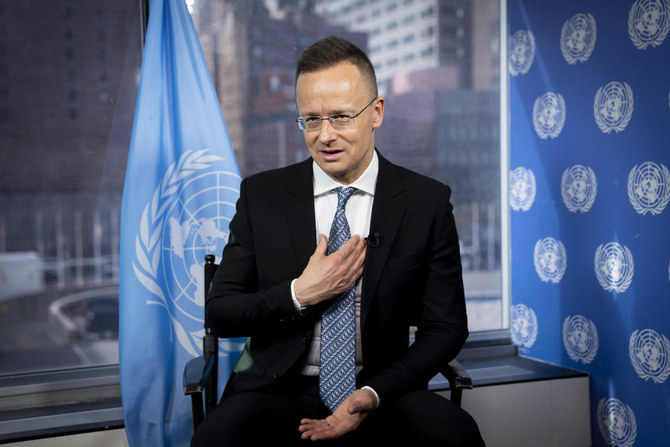
In an interview with AP, Hungarian Foreign Minister Péter Szijjártó also said Friday that his country has not voted on whether to allow Finland and Sweden to join NATO because Hungarian lawmakers are sick of those countries’ critiques of Hungarian domestic affairs.
Lawmakers from the governing party plan to vote Monday in favor of the Finnish request but “serious concerns were raised” about Finland and Sweden in recent months “mostly because of the very disrespectful behavior of the political elites of both countries toward Hungary,” Szijjártó said.
“You know, when Finnish and Swedish politicians question the democratic nature of our political system, that’s really unacceptable,” he said.
A vote on Sweden is harder to predict, Szijjártó said.
The EU, which includes 21 NATO countries, has frozen billions in funds to Budapest and accused populist Prime Minister Viktor Orban of cracking down on media freedom and other rights. Orban’s administration has also been accused of tolerating an entrenched culture of corruption and co-opting state institutions to serve the governing Fidesz party.
In a European Parliament resolution, EU lawmakers declared last year that Hungary had become “a hybrid regime of electoral autocracy” under Orban’s nationalist government and that its undermining of the bloc’s democratic values had taken Hungary out of the community of democracies.
That criticism raised objections within Hungary and made it hard for the government to support Finland and Sweden’s bids to join NATO, Szijjártó said. Skeptics insist that Hungary has simply been trying to win lucrative concessions.
When it comes to Russia’s invasion of Ukraine, Szijjártó said that his country’s advocacy of peace does not mean accepting that Russia would keep the territory it currently controls.
“You know, stopping the war and sitting around the table does not mean that you accept the status quo,” he said. “When the war stops and the peace talks start, it’s not necessary that the borders would be where the front lines are. We know this from our own history as well ... Cease-fire has to come now.”
As for relations with the United States, Szijjártó said they had a heyday under former President Donald Trump. His government found things more difficult under President Joe Biden.
In perfect, nearly unaccented English, Szijjártó explained that Hungary is “a clearly rightist, right-wing, Christian Democratic, conservative, patriotic government.” He then went on in terms that would be familiar to millions of Americans.
“So we are basically against the mainstream in any attributes of ours. And if you are against the liberal mainstream, and in the meantime, you are successful, and in the meantime, you continue to win elections, it’s not digestible for the liberal mainstream itself,” he said. “Under President Trump, the political relationship was as good as never before.”
Key to that relationship was Trump’s acceptance of Hungary’s policies toward its own citizens.
The law has been condemned by human rights groups and politicians from around Europe as an attack on Hungary’s pride community.
Szijjártó said Trump was more welcoming of such measures than the Biden administration.
“He never wanted to impose anything. He never wanted to put pressure on us to change our way of thinking about family. He never wanted us to change our way of thinking about migration. He never wanted us to change our way of thinking about social issues,” Szijjártó said.
He also said Trump’s attitude toward Russia would be more welcome by some parties today.
During Trump’s term in the White House, Russia did not start “any attack against anyone,” Szijjártó said.


![]()


Hungary: Criticism makes it hard to cooperate with West
Short Url
https://arab.news/maxgb
Hungary: Criticism makes it hard to cooperate with West
- “You know, when Finnish and Swedish politicians question the democratic nature of our political system, that’s really unacceptable,” Szijjártó said
- A vote on Sweden is harder to predict, he said


Venezuela interim leader sacks industry minister, a Maduro ally
CARACAS: Venezuela’s interim president on Friday dismissed businessman Alex Saab, a close ally of deposed leader Nicolas Maduro, from his post as minister of industry.
In a Telegram message, Delcy Rodriguez announced the ministry would be combined with a commerce ministry and thanked Saab — a Colombian-born Venezuelan — “for his service to the Homeland; he will be taking on new responsibilities.”
The change comes amid pressure from Washington following the January 3 US military raid that ousted Maduro.
Saab, released in 2023 as part of a prisoner exchange with the United States, was appointed to office in 2024 by Maduro.
He had been arrested in Cape Verde in 2020 due to an Interpol notice over accusations he had served as a money launderer for the socialist leader.
He was subsequently extradited to the US, where he and his business partner Alvaro Pulido were charged with running a network that exploited food aid destined for Venezuela.
Saab’s dismissal is among the latest key changes to Venezuela’s government by Rodriguez since the US capture of Maduro and his wife Cilia Flores.
Venezuelan opposition leader Maria Corina Machado meanwhile said her country is starting a “true transition” to democracy and will become free with support from the United States and President Donald Trump.
Trump however has sidelined Nobel laureate Machado and backed former vice president Rodriguez as interim leader of the oil-rich country following the seizure of Maduro.
“We are definitely now into the first steps of a true transition to democracy,” Machado said during an event in Washington, adding that this will have an “immense impact in the lives of all Venezuelans” as well as around the region and the world.
“Venezuela is going to be free, and that’s going to be achieved with the support of the people of the United States and the president, Donald Trump,” Machado said.
Her party has presented evidence that Maduro stole the 2024 election — claims supported by Washington and much of the international community.
But Trump has said that Machado does not have enough support among Venezuelans, and opted to stick with Rodriguez so long as she toes the line on US access to Venezuela’s vast oil reserves.
Machado said Friday that Rodriguez is “following orders” rather than acting of her own will.
The opposition leader’s remarks came a day after US Central Intelligence Agency chief John Ratcliffe met Rodriguez in Caracas.
Ratcliffe traveled to Venezuela to “deliver the message that the United States looks forward to an improved working relationship,” a US administration official said on condition of anonymity.
- Nobel medal -
In an indication of that improved relationship, a US deportation flight carrying 231 Venezuelans landed in Caracas on Friday, the first since Maduro’s overthrow.
Trump has made cracking down on undocumented immigrants a major part of his second term, carrying out sweeping immigration raids and deporting migrants.
Machado, 58, on Thursday presented her Nobel Peace Prize medal to Trump in a bid to win over the US president.
“He deserves it,” she said. “And it was a very emotional moment, I decided to present the Nobel Peace Prize medal on behalf of the people of Venezuela.”
It was not immediately clear if Trump — who said Friday that he and Machado will “be talking again” — kept the award following their White House lunch. The Norwegian Nobel committee says its prizes cannot be transferred.
Trump had campaigned hard to win last year’s prize, falsely claiming that he stopped eight wars since taking office, but it went to Machado instead.
Trump and Rodriguez had their first telephone call on Wednesday and the White House said he “likes what he’s seeing” from her.
Rodriguez said however that her government will stand up to Washington.
“We know they are very powerful... we are not afraid to confront them diplomatically, through political dialogue,” she said Thursday.
Rodriguez was delivering Maduro’s state of the nation address to parliament while the long-time authoritarian leader is in a New York jail facing drug trafficking charges.
By contrast Machado, who campaigned for years to end leftist Maduro’s rule, was greeted by jubilant supporters in Washington.
In a Telegram message, Delcy Rodriguez announced the ministry would be combined with a commerce ministry and thanked Saab — a Colombian-born Venezuelan — “for his service to the Homeland; he will be taking on new responsibilities.”
The change comes amid pressure from Washington following the January 3 US military raid that ousted Maduro.
Saab, released in 2023 as part of a prisoner exchange with the United States, was appointed to office in 2024 by Maduro.
He had been arrested in Cape Verde in 2020 due to an Interpol notice over accusations he had served as a money launderer for the socialist leader.
He was subsequently extradited to the US, where he and his business partner Alvaro Pulido were charged with running a network that exploited food aid destined for Venezuela.
Saab’s dismissal is among the latest key changes to Venezuela’s government by Rodriguez since the US capture of Maduro and his wife Cilia Flores.
Venezuelan opposition leader Maria Corina Machado meanwhile said her country is starting a “true transition” to democracy and will become free with support from the United States and President Donald Trump.
Trump however has sidelined Nobel laureate Machado and backed former vice president Rodriguez as interim leader of the oil-rich country following the seizure of Maduro.
“We are definitely now into the first steps of a true transition to democracy,” Machado said during an event in Washington, adding that this will have an “immense impact in the lives of all Venezuelans” as well as around the region and the world.
“Venezuela is going to be free, and that’s going to be achieved with the support of the people of the United States and the president, Donald Trump,” Machado said.
Her party has presented evidence that Maduro stole the 2024 election — claims supported by Washington and much of the international community.
But Trump has said that Machado does not have enough support among Venezuelans, and opted to stick with Rodriguez so long as she toes the line on US access to Venezuela’s vast oil reserves.
Machado said Friday that Rodriguez is “following orders” rather than acting of her own will.
The opposition leader’s remarks came a day after US Central Intelligence Agency chief John Ratcliffe met Rodriguez in Caracas.
Ratcliffe traveled to Venezuela to “deliver the message that the United States looks forward to an improved working relationship,” a US administration official said on condition of anonymity.
- Nobel medal -
In an indication of that improved relationship, a US deportation flight carrying 231 Venezuelans landed in Caracas on Friday, the first since Maduro’s overthrow.
Trump has made cracking down on undocumented immigrants a major part of his second term, carrying out sweeping immigration raids and deporting migrants.
Machado, 58, on Thursday presented her Nobel Peace Prize medal to Trump in a bid to win over the US president.
“He deserves it,” she said. “And it was a very emotional moment, I decided to present the Nobel Peace Prize medal on behalf of the people of Venezuela.”
It was not immediately clear if Trump — who said Friday that he and Machado will “be talking again” — kept the award following their White House lunch. The Norwegian Nobel committee says its prizes cannot be transferred.
Trump had campaigned hard to win last year’s prize, falsely claiming that he stopped eight wars since taking office, but it went to Machado instead.
Trump and Rodriguez had their first telephone call on Wednesday and the White House said he “likes what he’s seeing” from her.
Rodriguez said however that her government will stand up to Washington.
“We know they are very powerful... we are not afraid to confront them diplomatically, through political dialogue,” she said Thursday.
Rodriguez was delivering Maduro’s state of the nation address to parliament while the long-time authoritarian leader is in a New York jail facing drug trafficking charges.
By contrast Machado, who campaigned for years to end leftist Maduro’s rule, was greeted by jubilant supporters in Washington.
Latest updates


© 2026 SAUDI RESEARCH & PUBLISHING COMPANY, All Rights Reserved And subject to Terms of Use Agreement.