

’Everything wiped away’: Tornado kills at least 26 in Mississippi

1 / 2
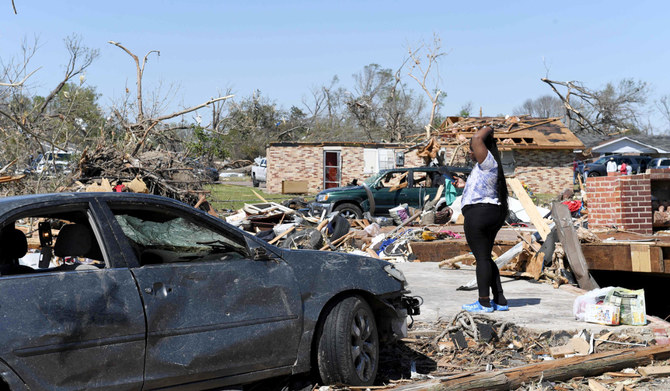
Kenterica Sardin, 23, stands where her bedroom once was after being damaged from a series of powerful storms and at least one tornado on March 25, 2023 in Rolling Fork, Mississippi. (AFP)
2 / 2
The National Weather Service confirmed a tornado caused damage about 96 kilometers northeast of Jackson, Mississippi. (Twitter)
Short Url
Updated 26 March 2023
Follow

’Everything wiped away’: Tornado kills at least 26 in Mississippi

  • Tornado continued sweeping northeast at 70 mph without weakening
  • Tens of thousands of people in Mississippi, Alabama and Tennessee remained without power

ROLLING FORK, Mississippi: Rescuers raced Saturday to search for survivors and help hundreds of people left homeless after a powerful tornado cut a devastating path through Mississippi, killing at least 25 people, injuring dozens, and flattening entire blocks as it carved a path of destruction for more than an hour. One person was killed in Alabama.
The tornado devastated a swath of the Mississippi Delta town of Rolling Fork, reducing homes to piles of rubble, flipping cars on their sides and toppling the town’s water tower. Residents hunkered down in bath tubs and hallways during Friday night’s storm and later broke into a John Deere store that they converted into a triage center for the wounded.
“There’s nothing left,” said Wonder Bolden, holding her granddaughter, Journey, while standing outside the remnants of her mother’s now-leveled mobile home in Rolling Fork. “There’s just the breeze that’s running, going through — just nothing.”
The Mississippi Emergency Management Agency announced late Saturday afternoon in a tweet that the death toll had risen to 25 and that dozens of people were injured. Four people previously reported missing had been found.
Other parts of the Deep South were digging out from damage caused by other suspected twisters. One man died in Morgan County, Alabama, the sheriff’s department there said in a tweet.
Throughout Saturday, survivors walked around dazed and in shock as they broke through debris and fallen trees with chain saws, searching for survivors. Power lines were pinned under decades-old oaks, their roots torn from the ground.

Mississippi Gov. Tate Reeves issued a State of Emergency and vowed to help rebuild as he headed to view the damage in an area speckled with wide expanses of cotton, corn and soybean fields and catfish farming ponds. President Joe Biden also promised federal help, describing the damage as “heartbreaking.”
The damage in Rolling Fork was so widespread that several storm chasers — who follow severe weather and often put up livestreams showing dramatic funnel clouds — pleaded for search and rescue help. Others abandoned the chase to drive injured people to the hospital.
It didn’t help that the community hospital on the west side of town was damaged, forcing patients to be transferred. The tornado also mangled a cotton warehouse and ripped the steeple off a Baptist church.
Sheddrick Bell, his partner and two daughters crouched in a closet of their Rolling Fork home for 15 minutes as the tornado barreled through. Windows broke as his daughters cried and his partner prayed.

Perrilloux said preliminary findings are that the tornado began its path of destruction just southwest of Rolling Fork before continuing northeast toward the rural communities of Midnight and Silver City, then moving toward Tchula, Black Hawk and Winona.
The supercell that produced the deadly twister also appeared to produce tornadoes that caused damage in northwest and north-central Alabama, said Brian Squitieri, a severe storms forecaster with the weather service’s Storm Prediction Center in Norman, Oklahoma.
In northern Alabama’s Morgan County, a 67-year-old man who became trapped beneath a trailer that flipped over during severe overnight storms was rescued by first responders, but he died later at a hospital, AL.com reported.
Even as survey teams work to assess how many tornadoes struck and their severity, the Storm Prediction Center warned of the potential for hail, wind and possibly a few tornadoes Sunday in parts of Mississippi and Louisiana.
Cornel Knight waited at a relative’s home in Rolling Fork for the tornado to strike with his wife and 3-year-old daughter. Despite the darkness, its path was visible.
“You could see the direction from every transformer that blew,” he said. Just a cornfield away from where he was, the twister struck another relative’s home, collapsing a wall and trapping several people.
Royce Steed, the emergency manager in Humphreys County where Silver City is located, likened the damage to Hurricane Katrina in 2005.
“It is almost complete devastation,” he said after crews finished searching buildings and switched to damage assessments. “This little old town, I don’t know what the population is, it is more or less wiped off the map.”
In the town, the roof had torn off Noel Crook’s home.
“Yesterday was yesterday and that’s gone – there’s nothing I can do about it,” Crook said. “Tomorrow is not here yet. You don’t have any control over it, so here I am today.”
The tornado looked so powerful on radar as it neared the town of Amory, about 25 miles (40 kilometers) southeast of Tupelo, that one Mississippi meteorologist paused to say a prayer after new radar information came in.
“Oh man,” WTVA’s Matt Laubhan said on the live broadcast. “Dear Jesus, please help them. Amen.”
Now that town is boiling its water, and a curfew is in effect. Three shelters in the state are feeding the throngs of displaced people.
“It’s a priceless feeling to see the gratitude on people’s faces to know they’re getting a hot meal,” said William Trueblood, of the Salvation Army, as he headed to the area, picking up supplies along the way.
Despite the damage, there were signs of improvement. Power outages, which at one point were affecting more than 75,000 customers in Tennessee, Mississippi and Alabama, had been cut by a third by midafternoon Saturday, according to poweroutage.us.
Meteorologists saw a big tornado risk coming for the general region as much as a week in advance, said Northern Illinois University meteorology professor Walker Ashley.
Tornado experts like Ashley have been warning about increased risk exposure in the region because of people building more.
“You mix a particularly socioeconomically vulnerable landscape with a fast-moving, long-track nocturnal tornado, and, disaster will happen,” Ashley said in an email.


The shootings in Minneapolis are upending the politics of immigration in Congress

Updated 5 sec ago
Follow

The shootings in Minneapolis are upending the politics of immigration in Congress

WASHINGTON: The shooting deaths of two American citizens during the Trump administration’s deportation operations in Minneapolis have upended the politics of immigration in Congress, plunging the country toward another government shutdown.
Democrats have awakened to what they see as a moral moment for the country, refusing funds for the Department of Homeland Security’s military-style immigration enforcement operations unless there are new restraints. Two former presidents, Barack Obama and Bill Clinton, have broken from retirement to speak out.
At the same time, Republicans who have championed President Donald Trump’s tough approach to immigration are signaling second thoughts. A growing number of Republicans want a full investigation into the shooting death of Alex Pretti and congressional hearings about US Immigration and Customs Enforcement operations.
“Americans are horrified & don’t want their tax dollars funding this brutality,” Sen. Chris Van Hollen, D-Md., wrote on social media. “Not another dime to this lawless operation.”
The result is a rapidly changing political environment as the nation considers the reach of the Trump administration’s well-funded immigration enforcement machinery and Congress spirals toward a partial federal shutdown if no resolution is reached by midnight Friday.
“The tragic death of Alex Pretti has refocused attention on the Homeland Security bill, and I recognize and share the concerns,” said Sen. Susan Collins of Maine, the GOP chair of the Appropriations Committee, in brief remarks Monday.
Still, she urged colleagues to stick to the funding deal and avoid a “detrimental shutdown.”
Searching for a way out of a crisis
As Congress seeks to defuse a crisis, the next steps are uncertain.
The White House has indicated its own shifting strategy, sending Trump’s border czar Tom Homan to Minneapolis to take over for hard-charging Border Patrol Commander Gregory Bovino, which many Republicans see as a potential turning point to calm operations.
“This is a positive development — one that I hope leads to turning down the temperature and restoring order in Minnesota,” Senate Majority Leader John Thune posted about Homan.
Behind the scenes, the White House is reaching out to congressional leaders, and even individual Democratic senators, in search of a way out of another government shutdown.
At stake is a six-bill government funding package, not just for Homeland Security but for Defense, Health and other departments, making up more than 70 percent of federal operations.
Even though Homeland Security has billions from Trump’s big tax break bill, Democrats are coalescing around changes to ICE operations. “We can still have some legitimate restriction on how these people are conducting themselves,” said Sen. Ruben Gallego, D-Arizona
But it appears doubtful the Trump administration would readily agree to Democrats’ demands to rein in immigration operations. Proposals for unmasking federal agents or limiting their reach into schools, hospitals or churches would be difficult to quickly approve in Congress.
White House press secretary Karoline Leavitt said that while conversations are underway, Trump wants to see the bipartisan spending package approved to avoid the possibility of a government shutdown.
“We absolutely do not want to see that funding lapse,” Leavitt said.
Politics reflect changing attitudes on Trump’s immigration agenda
The political climate is a turnaround from just a year ago, when Congress easily passed the Laken Riley Act, the first bill Trump signed into law in his second term.
At the time, dozens of Democrats joined the GOP majority in passing the bill named after a Georgia nursing student who was killed by a Venezuelan man who had entered the country illegally.
Many Democrats had worried about the Biden administration’s record of having allowed untold immigrants into the country. The party was increasingly seen as soft on crime following the “defund the police” protests and the aftermath of the death of George Floyd at the the hands of law enforcement.
But the Trump administrations tactics changed all that.
Just 38 percent of US adults approve of how Trump is handling immigration, down from 49 percent in March, according to an AP-NORC poll conducted in January, shortly after the death of Renee Good, who was shot and killed by a ICE officer in Minnesota.
Last week, almost all House Democrats voted against the Homeland Security bill, as the package was sent the Senate.
Then there was the shooting death of Pretti over the weekend in Minneapolis.
Rep. Tom Suozzi of New York, who was among the seven Democrats who had voted to approve the Homeland Security funds, reversed course Monday in a Facebook post.
“I hear the anger from my constituents, and I take responsibility for that,” Suozzi wrote.
He said he “failed to view the DHS funding vote as a referendum on the illegal and immoral conduct of ICE in Minneapolis.”
Voting ahead as shutdown risk grows
Senate Democratic Leader Chuck Schumer said Monday the responsibility for averting another shutdown falls to Republicans, who have majority control, to break apart the six-bill package, removing the homeland funds while allowing the others to go forward.
“We can pass them right away,” Schumer said.
But the White House panned that approach and House Speaker Mike Johnson, who has blamed Democrats for last year’s shutdown, the longest in history, has been mum. The GOP speaker would need to recall lawmakers to Washington to vote.
Republicans believe they will be able to portray Democrats as radical if the government shuts down over Homeland Security funds, and certain centrist Democrats have warned the party against strong anti-ICE language.
A memo from centrist Democratic group Third Way had earlier warned lawmakers against proposals to “abolish” ICE as “emotionally satisfying, politically lethal.” In a new memo Monday it proposed “Overhauling ICE” with top-to-bottom changes, including removing Homeland Security Secretary Kristi Noem from her job.
GOP faces a divide on deportations
But Republicans also risk being sideways with public opinion over Trump’s immigration and deportation agenda.
Republicans prefer to keep the focus on Trump’s ability to secure the US-Mexico border, with illegal crossings at all-time lows, instead of the military-style deportation agenda. They are particularly sensitive to concerns from gun owners’ groups that Pretti, who was apparently licensed to carry a firearm, is being criticized for having a gun with him before he was killed.
GOP Sen. Rand Paul, the chairman of the Homeland Security and Government Oversight Committee, demanded that acting ICE director Todd Lyons appear for a hearing — joining a similar demand from House Republicans over the weekend.
At the same time, many GOP lawmakers continue to embrace the Trump administration’s deportation strategy.
“I want to be very clear,” said Sen. Rick Scott, R-Fla., in a post. “I will not support any efforts to strip DHS of its funding.”
And pressure from their own right flank was bearing down on Republicans.
The Heritage Foundation chastised those Republicans who were “jubilant” at the prospect of slowing down ICE operations. “Deport every illegal alien,” it said in a post. “Nothing less.”