

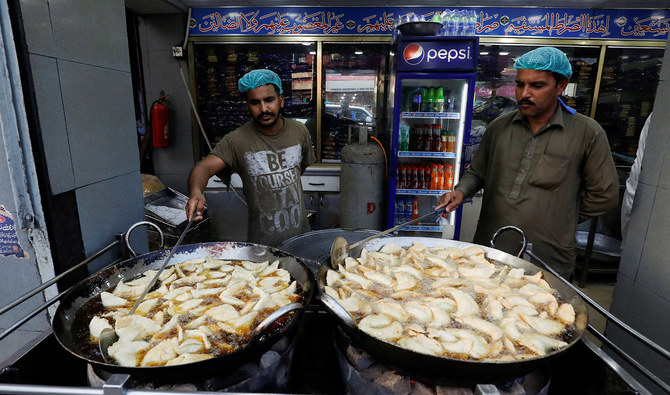

KARACHI: Enraged citizens took to the streets in anger on Thursday to protest against gas supply disruptions during Sehri, Iftar times in the Golimar area of Pakistan's southern port city of Karachi.
According to a report prepared by Pakistan's Petroleum Division last year, the South Asian country has already utilized 66.6% of its total gas reserves, leaving only 33.4% untouched.
Pakistan needs 4.1 billion cubic feet per day (bcfd) of gas, with demand during the winter season peaking to around 4.5 bcfd against a local production of 3.22 bcfd. The shortfall is bridged through LNG imports.
Reportedly, misery piled on for residents living in Karachi's North Nazimabad, New Karachi, Nagin Chowrangi, Gulshan-e-Iqbal, and other areas of the city as they geared up to observe the first fast of Ramadan on Thursday but found little to no gas to light stoves.
Angry protestors blocked a main road at Golimar that connects southern and central Karachi, burning tyres, shouting angry slogans and causing traffic congestion.
Speaking to Arab News, Imran Rao, a resident of the city's Gulshan-e-Hadeed neighborhood in the eastern part of the city, said the low gas pressure was not enough for him to cook food.
“There is a gas crisis in our area, and our relatives living in Gulistan-e-Jauhar said they were also getting very low [gas] pressure," he said. "The gas is not enough to light the stove,” Rao added.
The government-owned Sui Southern Gas Company's (SSGC) Head of Corporate Communications, Salman Ahmed Siddiqui, admitted there was an “issue of gas supply” in the city.
“Today was the first Sehri, there might have been a few issues in some areas,” Siddiqui told Arab News, adding that the SSGC was trying to manage the load.
“We are trying our best to manage the load in the context of the overall shortage in the system due to annual depletion of gas reserves,” he added.
The power supply company, in a statement issued on Thursday, said gas pressure would remain low from 8:00 a.m. to 2:30 p.m. as it was facing a shortfall of 250 million mmBtu.
“Hopefully from tomorrow onwards all supplies will be streamlined as per the given schedule,” the SSGC said in its statement, adding that supply during Sehar and Iftar hours would be ensured.
"Every year, there is an evident shortfall in the supply of gas system of Sui Southern Gas due to an annual decrease of eight to ten percent in the country's gas reservoirs," the statement said.
On Wednesday, the Pakistan’s power ministry announced uninterrupted power supply during Sehri, Iftar and Taraweeh prayer times throughout the country in Ramadan.
However, a resident also said his neighborhood was subjected to power outage during Sehri time.
“Our area plunged into darkness during Sehri despite announcements that there would be no load-shedding during these hours,” Muhammad Younus, a resident of Karachi's Steel Town area, told Arab News.
The city's main power supply company, K-Electric, did not respond to Arab News' request for comment.


