

Pakistan cricket team arrives in UAE for Afghanistan T20 series 

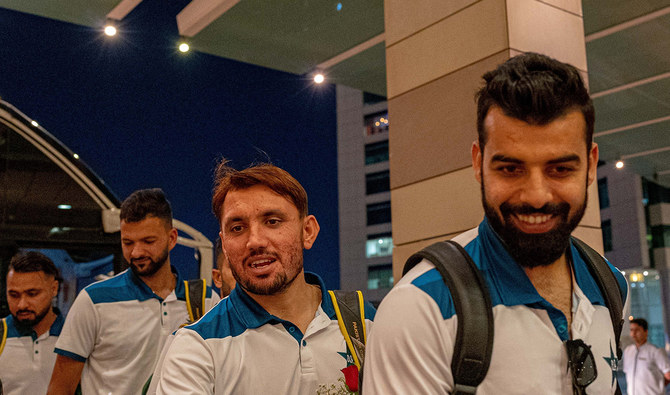
Pakistan cricket team headed by Shahdab khan (L) reaches UAE ahead of the T20I series against Afghanistan on March 22, 2023. (Photo courtesy: PCB/Twitter)
Short Url
Updated 23 March 2023
Follow

Pakistan cricket team arrives in UAE for Afghanistan T20 series 

  • Pakistan play Afghanistan on Friday at Sharjah in first of three T20 matches 
  • Skipper Shadab Khan will lead a young Pakistan side in Babar Azam’s absence

ISLAMABAD: The Pakistan cricket team arrived in the United Arab Emirates (UAE) on Wednesday evening for a three-match T20 series against Afghanistan scheduled to kick off later this week, the Pakistan Cricket Board (PCB) confirmed. 

PCB chief Najam Sethi announced last month that Pakistan would play the series to “compensate” Afghanistan after Australia called off its tour in Afghanistan. 

Australia were scheduled to play a one-day international series in the UAE against Afghanistan in March. However, the Aussies pulled out in protest over the Taliban government’s strict laws barring Afghan women from education and work in the country. 

“Pakistan men’s team arrived in the United Arab Emirates today to play Afghanistan in three T20 Internationals at Sharjah Cricket Stadium on 24, 26 and 27 March,” the PCB said in a statement. 

The cricket board said skipper Shadab Khan would address a press conference on Thursday before the Pakistan team trains ahead of its first clash against Afghanistan, scheduled to take place on Friday. 

Pakistan announced earlier this month they were resting all-format captain Babar Azam among several other senior players for the tour. Sethi said the board wanted to give a chance to Pakistan’s younger cricketers to “groom” them for the future by performing against Afghanistan. 

In Azam’s place, Sethi appointed Khan as skipper for the T20 series. The leg-spinner will lead a team of young players that will not include the likes of Pakistan’s regular playing XI squad such as Shaheen Shah Afridi, Muhammad Rizwan, Haris Rauf, and Fakhar Zaman.

Pakistan squad for Afghanistan series:

Shadab Khan (captain), Imad Wasim, Mohammad Wasim Jr.., Tayyab Tahir, Ihsanullah, Azam Khan, Shan Masood, Naseem Shah, Mohammad Nawaz, Mohammad Haris, Saim Ayub, Zaman Khan, Abdullah Shafique, Faheem Ashraf, Iftikhar Ahmed

Reserves:

Haseebullah Khan, Usama Mir, Abrar Ahmed


Pakistan, Malaysia discuss halal food, energy and tourism to boost cooperation

Updated 47 min 44 sec ago
Follow

Pakistan, Malaysia discuss halal food, energy and tourism to boost cooperation

  • Bilateral trade between both countries stands at about $1.4 billion a year
  • In Oct., both countries announced a new $200 million halal meat trade quota

ISLAMABAD: Pakistan and Malaysian officials have held talks on halal food, green energy and tourism sectors as part of renewed efforts to expand ties between the two Muslim-majority nations, the Pakistani High Commission in Malaysia on Monday.

The discussions took place during a meeting between Pakistan’s High Commissioner to Malaysia, Syed Ahsan Raza Shah and Tun Pehin Sri Dr. Wan Junaidi Tuanku Jaafar, governor of Malaysia’s Sarawak state.

Bilateral trade between the two countries stands at about $1.4 billion a year, according to official data from both governments. In Oct., both countries announced a new $200 million halal meat trade quota.

“Constructive talks on Pakistan-Malaysia ties in halal [food], palm oil, green energy, rice, labor, tourism, culture & sustainable development,” the Pakistani High Commission in Malaysia said on X.

Malaysia’s exports to Pakistan are led by palm oil and other vegetable fats, followed by machinery, rubber products and organic chemicals. Pakistan’s main exports to Malaysia include rice, textiles, seafood and minerals.

The two countries have also traded under the Malaysia-Pakistan Closer Economic Partnership Agreement since 2008, which provides preferential market access for goods and services.

Pakistan has been rapidly growing its green energy, halal food, and tourism sectors. Its halal food industry is attracting global buyers with Shariah-compliant products, while tourism is leveraging the country’s natural beauty, heritage sites and cultural attractions to draw international visitors.