Shamima Begum’s former friend who inspired her to join Daesh ridicules her as ‘non-believer’

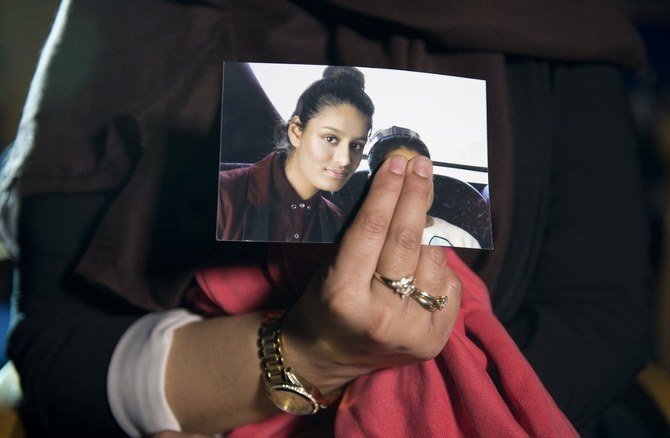
Shamima Begum said Sharmeena played a big role in influencing her to run away to Syria to join the extremist “caliphate.” (File/AFP)
Short Url
Updated 22 March 2023
Follow

Shamima Begum’s former friend who inspired her to join Daesh ridicules her as ‘non-believer’

  • BBC tracked Sharmeena Begum after escaping from Syria’s Camp Hol
  • Former London schoolgirl discovered to be raising money to help Daesh regroup

LONDON: Shamima Begum’s best friend, whom she claims inspired her to join Daesh, was tracked down by the BBC after escaping from a Syrian detention camp. 

Sharmeena Begum, no relation, was Shamima Begum’s schoolmate in Bethnal Green, east London. In December 2014, she fled to join Daesh in Syria, with Shamima and two other friends following her two months later.

The BBC tracked Sharmeena down after she escaped from Camp Hol prison for women who were with Daesh and their children.

A journalist from the “Shamima Begum Story” podcast, posing as a sympathizer, contacted Sharmeena online after receiving a tip-off about a social media account she was using.

In her exchanges with the BBC, Sharmeena ridiculed Shamima as a failure and a non-believer, claiming she had tainted the reputation of the women who had joined Daesh. 

Sharmeena also said her former friend was “just another individual, living off the benefits” who did not contribute at all.

Sharmeena, still in Syria, is in hiding and going by a different identity.

A former Daesh member told the BBC that she is fanatical even according to the extremist group’s standards. 

When asked if she regretted joining Daesh, Sharmeena dodged the question, saying only that she did not want to return to the UK and be sent to prison. 

The BBC also discovered Sharmeena illegally fundraising for Daesh members while in hiding. She has been posting about detention camp conditions on social media while appealing for cryptocurrencies. 

Although it is unclear how much money she has raised in total, one account revealed 29 transactions totaling $3,000. 

The commander of the Syrian Democratic Forces who guards detainees at Camp Hol expressed concern that money like this is assisting Daesh in regrouping, purchasing weapons, and planning escapes and attacks. 

“If we...look at the camps, there are little children who are a few years old and are being raised on the ideology of how to kill,” Gen. Newroz Ahmed told the BBC, saying that her people are among those being targeted and killed.

Camp Hol hosts over 65,000 people of 57 different nationalities. Guards say they have discovered grenades, guns and explosive belts smuggled in and that 50 people have been murdered there over the last six months, the BBC reported.

For her part, Shamima said Sharmeena played a big role in influencing her to run away to Syria to join the extremist “caliphate.” 

Shamima told the BBC: “I was being manipulated into thinking this was the right thing to do and I was being manipulated with lies about where I would be going and what I would be doing. 

“I mean, in my opinion, even though Sharmeena probably is still radical, I will say she was also a victim of (Daesh),” she added.


Indian farmers, unions strike against new trade deal with US

Updated 7 sec ago
Follow

Indian farmers, unions strike against new trade deal with US

  • India agreed to eliminate or reduce tariffs on US industrial goods, wide range of farm, food products
  • Commerce minister says farmers will not suffer ‘any harm’ as deal is ‘fair, equitable, and balanced’

NEW DELHI: Indian farmers took part in nationwide trade union protests on Thursday, saying they fear the implications of New Delhi’s new trade pact with the US, which will result in American products gaining duty-free access to the Indian market.

Agriculture provides livelihoods for more than 40 percent of India’s 1.4 billion population, and opening the sector to foreign competition has long been politically sensitive.

India signed an interim framework of the US trade deal last week, with the formal pact being expected to be finalized by March. The US cut its 50 percent duty on Indian goods to 18 percent, while India agreed to eliminate or reduce tariffs on all US industrial goods and a wide range of farm and food products.

While details of the agreement have not yet been announced, farmers fear being undercut by cheap, subsidized American products which will threaten their livelihood.

Rakesh Tikait, national spokesman for the Bharatiya Kisan Union (Indian Farmers’ Union) said the government had not held discussions with farmers before agreeing to the deal.

The BKU and other rural platforms have joined a broader strike held across India by major trade unions opposed to new labor codes — which have been criticized for weakening workers’ rights and reducing job security — as they saw common cause with other workers.

“We are protesting against the US–India trade deal, which we fear goes against the larger interests of Indian farmers. If US farm goods, fishery products, and dairy products hit the Indian market, Indian farmers cannot withstand this onslaught and would be ruined,” Tikait told Arab News from a protest site in Western Uttar Pradesh.

“We want this deal to be changed and made pro-farmer. Otherwise we will oppose it tooth and nail.”

According to Rajveer Singh Jadaun, president of the farmers’ union in Uttar Pradesh, the agriculture sector is facing an “existential threat” in a country that historically imposes tariffs of 30–150 percent on imports to protect farmers.

With tariffs reduced or eliminated and those imposed on Indian products higher than before, protesting farmers are convinced there is no level playing field.

“The deal is giving a zero percent tariff to the US’ agricultural and other products and we are charged 18 percent, which is higher than the 3 percent in the past,” Jadaun said.

“American farmers are celebrating the deal — that means there is something fishy … The government is speaking in many voices and that creates further confusion. I would like the government to clarify the stand and make everything clear.”

Prices of Indian corn and soybean have already fallen by 4 percent and 10 percent respectively, following the deal’s announcement.

P. Krishna Prasad, finance secretary of the All India Farmers’ Union, predicted that prices of other products may soon fall, too.

“They are bringing fresh and processed fruits. If apples are being brought at 75 rupees ($1) per kilo to India from America, then the apple economy of Jammu and Kashmir and Himachal Pradesh will collapse,” he said.

“In America, there are only 1.7 million farmers, but in India there are 166 million farmer households. And in America, one farmer household is getting a 60 lakh rupees ($73,000) subsidy per year. In India, that is nearly 27,000 rupees ($330) per year. There is no level playing field. Indian farmers cannot compete with these highly motorized or mechanized farms of America.”

While Commerce Minister Piyush Goyal has addressed the protesters — saying that they “will not suffer any harm” as the trade deal is “fair, equitable, and balanced” —  Prasad warned they were prepared to stage a strike similar to the 2020-21 protest, in which they opposed three farm acts that sought to open the sector to corporations.

The strike, that lasted nearly 18 months, involved millions of protesters and was India’s largest and longest in recent times. It forced the government to repeal the contested legislation.

“America will dictate Indian policy, so the sovereignty of the Indian people and the country is totally being compromised,” Prasad said.

“We feel this is a total surrender of Indian farmers and Indian agriculture to imperialist, multinational corporations. We cannot accept it. We will stop it. We will come to the streets and build this agitation bigger than the 2021 farmers’ agitation.”