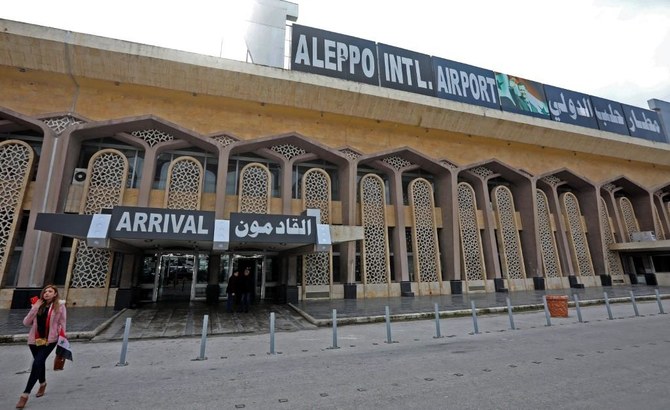
Syria says Israel attacked Aleppo airport, no casualties

Israel has carried out hundreds of strikes on targets inside government-controlled parts of Syria in recent years, including attacks on the Damascus and Aleppo airports. (AFP file photo)
Short Url
Updated 22 March 2023
Follow

Syria says Israel attacked Aleppo airport, no casualties

  • Attack causes material damage in the second attack on the facility this month
  • Airport has been one of the main channels for the flow of aid into the country after the Feb. 6 earthquake

DAMASCUS: An Israeli airstrike early Wednesday targeted the international airport of the northern Syrian city of Aleppo, causing material damage in the second attack on the facility this month, state media report.
State news agency SANA, quoting an unnamed military official, did not mention if the strike caused any deaths or injuries. It said warplanes fired the missiles toward Aleppo, Syria’s largest city and once commercial center, while flying over the Mediterranean.
The airport has been one of the main channels for the flow of aid into the country after the Feb. 6 earthquake hit Turkiye and Syria, killing over 50,000 people, including more than 6,000 in Syria.
On March 7, an Israeli airstrike put the airport out of service for several days and flights were rerouted to two other airports in the war-torn country until the damage was fixed.
Israel has carried out hundreds of strikes on targets inside government-controlled parts of Syria in recent years, including attacks on the Damascus and Aleppo airports, but it rarely acknowledges or discusses the operations.
Israel has acknowledged, however, that it targets bases of Iran-allied militant groups, such as Lebanon’s Hezbollah, which has sent thousands of fighters to support Syrian President Bashar Assad’s forces.
Israel has targeted airports and seaports in the government-held parts of Syria in an apparent attempt to prevent arms shipments from Iran to militant groups backed by Tehran, including Lebanon’s Hezbollah.


UN says 3.3 million war-displaced Sudanese return home

Updated 5 sec ago
Follow

UN says 3.3 million war-displaced Sudanese return home

  • International Organization for Migration reports that three-quarters of those returning came from internal displacement sites
  • At its peak, the war has displaced around 14 million people both internally and across borders
KHARTOUM: More than three million Sudanese people displaced by nearly three years of war have returned home, the United Nations migration agency said on Monday, even as heavy fighting continues to tear through parts of the country.
Since April 2023, Sudan has been locked in a devastating war pitting the regular army against the paramilitary Rapid Support Forces (RSF).
The conflict has killed tens of thousands of people and created what the UN describes as the world’s largest displacement and hunger crisis. At its peak, the war had displaced around 14 million people both internally and across borders.
In a report released on Monday, the International Organization for Migration (IOM) said an estimated 3.3 million displaced Sudanese had made their way back home by November of last year.
The rise in returns follows a sweeping offensive launched by the Sudanese army in late 2024 to retake central regions seized earlier in the conflict by the RSF.
The campaign culminated in the recapture of Khartoum in March 2025, prompting many displaced families to try to go back.
According to the IOM, more than three-quarters of those returning came from internal displacement sites, while 17 percent traveled back from abroad.
Khartoum saw the largest number of returns — around 1.4 million people — followed by the central state of Al-Jazira, where roughly 1.1 million have gone back.
Earlier this month, the army-backed government announced plans to return to the capital after nearly three years of operating from the Red Sea city of Port Sudan in the country’s east.
Reconstruction work in Khartoum has been underway since the army retook the city.
Although Khartoum and several army-held cities in central and eastern Sudan have seen a relative lull in fighting, the RSF has continued to launch occasional drone strikes, particularly targeting infrastructure.
Elsewhere, violence remains intense.
In the country’s south, RSF forces have pushed deeper into the Kordofan region after seizing the army’s final stronghold in Darfur last October.
Reports of mass killings, rape, abductions and looting emerged after El-Fasher’s paramilitary takeover, and the International Criminal Court launched a formal investigation into “war crimes” by both sides.