


BEIRUT: Brig. Gen. Elias Baissari, Lebanon’s acting director-general of General Security, on Monday spoke about what he called “a disturbing issue for the state and the Lebanese.”
On the matter of Syrian refugees in Lebanon, Baissari stressed that the GS would continue its efforts to organize voluntary and safe trips back to Syria, which it has been doing since 2017. Coordination is also underway with UN High Commissioner for Refugees to resettle the refugees in a third country.
“I hope we can reach quick solutions given the negative repercussions of this issue on Lebanon,” Baissari said.
A few days ago, Hermel Bashir Khoder, the governor of Baalbek, addressed the representative of the Syrian refugees in Lebanon during a meeting held at Dar Al-Fatwa in Baalbek, saying: “You are displaced people, not refugees. This is your legal definition in the Lebanese state, and you have to respect the country that hosts you and respect its laws.”
Khoder added: “This is not a discriminatory stance, but the Lebanese have had enough.”
The coordinator of camps for displaced Syrians in the border town of Arsal, which hosts the largest number of camps in Lebanon, demanded increased contributions for the displaced and held Khoder responsible for their difficult conditions.
Khoder’s angered response to these demands was widely shared on social media and received praise from many Lebanese.
“I, as a governor, occupy one of the highest administrative jobs in the Lebanese state, and my salary is less than what one displaced Syrian in Lebanon gets,” he said. “The benefits that the displaced get are much greater than what the Lebanese employees get.”
The audience applauded Khoder, who objected to accusations that the Lebanese were discriminatory.
“We are one people in two countries, not one people in one country. The time limit for the displaced has extended to 12 years, and displacement is not forever. We are hurting. You are our brothers, and we will never abandon you, but we have nothing more to offer you. Lebanese wages are way too low and we are carrying all the burden. We are not able to carry more responsibilities on our shoulders.”
Khoder told Arab News: “Not one official concerned with the affairs of Syrian refugees has ever contacted me.
“I simply expressed the pain experienced by every Lebanese, particularly those working in the public sector.”
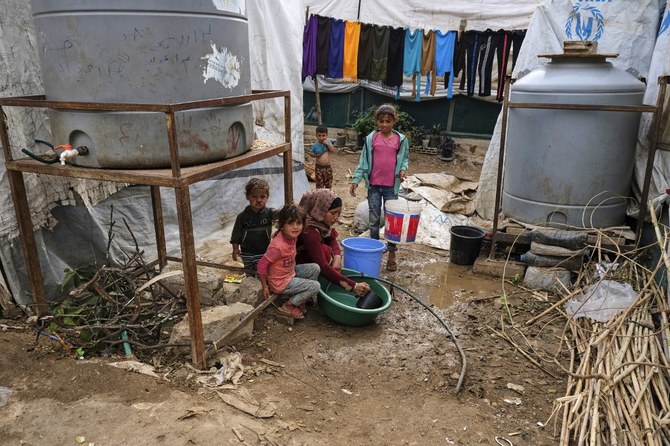
He also expressed concerns about the issue of infrastructure within refugee camps.
“A foreign NGO asked me to allow it to establish extensions for a sewage network in one of the Bekaa camps. But we cannot accept the establishment of infrastructure in the camps. It may later lead to the construction of rooms instead of tents, and this is out of the question,” he noted.
According to the latest statistics announced in December by retired Maj. Gen. Abbas Ibrahim, the former director-general of the GS, there are currently 2,80,000 Syrian refugees in Lebanon, while only 540,000 Syrians have voluntarily returned to their country since 2017.
Over 1 million Syrian refugees in Lebanon “do not wish to return to their country,” Ibrahim said.
A recent field survey conducted by the Deir Al-Ahmar Municipalities in cooperation with a statistical team revealed a significant increase in the percentage of births within the Syrian refugee camps in the region.
The survey included a statistical sample of 655 tents, with the total number of refugees occupying them amounting to 3,728, including 1,782 refugees under the age of 15, which constitutes 48 percent. This is, according to the survey, “much more than Lebanese families.”
The Lebanese state fears that attractive donations from international organizations to refugees have encouraged them to have children, remain in Lebanon and not return for fear of being stripped of international assistance.
The Lebanese government previously estimated that the refugees consume daily 500,000 bundles of bread and 5 million gallons of water. The funds the state has spent on refugees have amounted to $30 billion over the course of 11 years.
The statistical bulletin on the official website of the Ministry of Health indicates that in the year 2021, 100,000 births were recorded in Lebanon, 40 percent of which were Syrians. The statistics do not account for births that take place outside hospitals.
A UNHCR report stated: “In 2021, the vast majority of refugees continued to resort to negative coping strategies to survive, such as begging, borrowing money, not sending their children to school, reducing health expenses, or not paying rent.”
These “privileges” that the Lebanese believe that Syrian refugees enjoy in Lebanon have prompted many Lebanese, with the approaching month of Ramadan, to object to sharing aid with Syrian refugees.
“This year we will give aid to the Lebanese first, and what remains we will give to the Syrians,” a mosque employee told Arab News.


