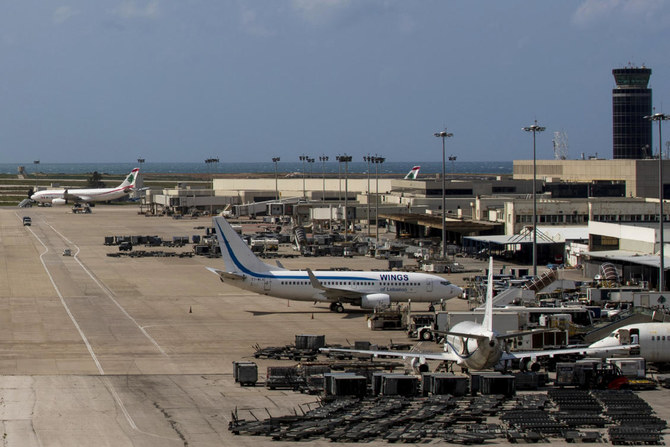
BEIRUT: Lebanon will construct a $122 million terminal at Beirut’s Rafik Hariri International Airport to be operated by a leading Irish airport company when it’s completed in four years, officials said Monday.
Lebanon’s only international airport had a major facelift after the country’s 1975-90 civil war and has been working at full capacity for years. The airport has not undergone an expansion since 1998.
Caretaker Minister of Public Works and Transport Ali Hamie said Terminal 2 will bring in private sector investments worth $122 million and will handle 3.5 million passengers annually when operations begin in 2027. It will add six docking stands as well as remote ones, he said in a ceremony at government headquarters to announce the launch of the new terminal.
Terminal 2 will be built where the airport’s old cargo building used to stand, according to Hamie.
The project comes as Lebanon is in the throes of its worst economic and financial crisis in its modern history, rooted in decades of corruption and mismanagement by the country’s political class.
“The project opens more horizons for air aviation between Lebanon and the world,” caretaker Prime Minister Najib Mikati said. He added that it will help in solving several problems, including crowding at the current terminal.
The project will create 500 direct jobs and 2,000 related jobs, Hamie said, adding that Terminal 2 will be for chartered and low-cost flights.
Hamie said once Terminal 2 is ready it will be operated by leading European company daa International, an airport company in Ireland.
Ireland’s Minister of State James Browne attended Monday’s ceremony in Beirut and was quoted in a statement released by the Lebanese prime minister’s office as saying that the contract signed will deepen business relations between the two countries.
The airport currently handles 8 million passengers a year, and the plans are to reach 20 million in 2030, according to the website of national carrier Middle East Airlines.
Lebanon’s economic crisis that began in October 2019 has left three quarters of the country’s 6 million people, including 1 million Syrian refugees, in poverty. The Lebanese pound has lost more than 95 percent of its value.

Lebanon to construct new terminal at Beirut airport
Short Url
https://arab.news/vcsdq
Lebanon to construct new terminal at Beirut airport
- Lebanon’s only international airport had a major facelift after the country’s 1975-90 civil war and has been working at full capacity for years
- The airport has not undergone an expansion since 1998
MSF calls Israeli ban a ‘grave blow’ to Gaza aid
- Doctors Without Borders is among 37 foreign humanitarian organizations banned from the territory
- The group, which has hundreds of staff in Gaza, says: 'Denying medical assistance to civilians is unacceptable'
JERUSALEM: International charity Doctors Without Borders Friday condemned a “grave blow to humanitarian aid” after Israel revoked the status it needs to operate in Gaza for refusing to share Palestinian staff lists.
Israel on Thursday confirmed it had banned access to the Gaza Strip to 37 foreign humanitarian organizations for refusing to share lists of their Palestinian employees.
Doctors Without Borders (MSF), which has 1,200 staff members in the Palestinian territories, the majority of them in Gaza, said in a statement that “denying medical assistance to civilians is unacceptable under any circumstances.”
The medical organization argued that it had “legitimate concerns” over new Israeli requirements for foreign NGO registration, specifically the disclosing of personal information about Palestinian staff.
It pointed to the fact that 15 MSF staff had been “killed by Israeli forces,” and that access to any given territory should not be conditional on staff list disclosure.
“Demanding staff lists as a condition for access to territory is an outrageous overreach,” the charity said.
MSF also denounced “the absence of any clarity about how such sensitive data will be used, stored, or shared,” charging that Israeli forces “have killed and wounded hundreds of thousands of civilians” in Gaza during the course of the war.
It also charged that Israel had “manufactured shortages of basic necessities by blocking and delaying the entry of essential goods, including medical supplies.”
Israel controls and regulates all entry points into Gaza, which is surrounded by a wall that began to be built in 2005.
Felipe Ribero, MSF head of mission in the Palestinian territories, told AFP that all of its operations were still ongoing in Gaza.
“We are supposed to leave under 60 days, but we don’t know whether it will be three or 60 days” before Israeli authorities force MSF to leave, he said.
Prominent humanitarian organizations hit by the Israeli ban include the Norwegian Refugee Council (NRC), World Vision International and Oxfam, according to an Israeli ministry list.
The ban, which came into effect on December 31, 2025 at midnight, has triggered widespread international condemnation.
Israel says the new regulation aims to prevent bodies it accuses of supporting terrorism from operating in the Palestinian territories.
MSF says it currently supports one in five hospital beds in Gaza and assists one in three mothers in the territory, and urged the Israeli authorities to meet to discuss the ban.
Israel on Thursday confirmed it had banned access to the Gaza Strip to 37 foreign humanitarian organizations for refusing to share lists of their Palestinian employees.
Doctors Without Borders (MSF), which has 1,200 staff members in the Palestinian territories, the majority of them in Gaza, said in a statement that “denying medical assistance to civilians is unacceptable under any circumstances.”
The medical organization argued that it had “legitimate concerns” over new Israeli requirements for foreign NGO registration, specifically the disclosing of personal information about Palestinian staff.
It pointed to the fact that 15 MSF staff had been “killed by Israeli forces,” and that access to any given territory should not be conditional on staff list disclosure.
“Demanding staff lists as a condition for access to territory is an outrageous overreach,” the charity said.
MSF also denounced “the absence of any clarity about how such sensitive data will be used, stored, or shared,” charging that Israeli forces “have killed and wounded hundreds of thousands of civilians” in Gaza during the course of the war.
It also charged that Israel had “manufactured shortages of basic necessities by blocking and delaying the entry of essential goods, including medical supplies.”
Israel controls and regulates all entry points into Gaza, which is surrounded by a wall that began to be built in 2005.
Felipe Ribero, MSF head of mission in the Palestinian territories, told AFP that all of its operations were still ongoing in Gaza.
“We are supposed to leave under 60 days, but we don’t know whether it will be three or 60 days” before Israeli authorities force MSF to leave, he said.
Prominent humanitarian organizations hit by the Israeli ban include the Norwegian Refugee Council (NRC), World Vision International and Oxfam, according to an Israeli ministry list.
The ban, which came into effect on December 31, 2025 at midnight, has triggered widespread international condemnation.
Israel says the new regulation aims to prevent bodies it accuses of supporting terrorism from operating in the Palestinian territories.
MSF says it currently supports one in five hospital beds in Gaza and assists one in three mothers in the territory, and urged the Israeli authorities to meet to discuss the ban.
© 2026 SAUDI RESEARCH & PUBLISHING COMPANY, All Rights Reserved And subject to Terms of Use Agreement.