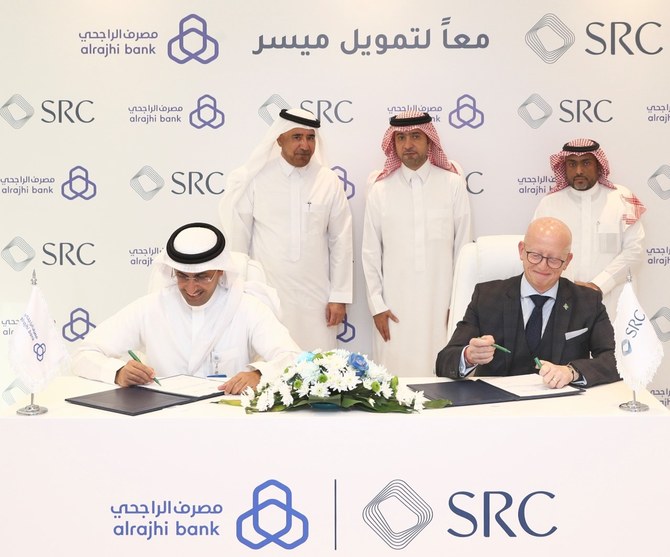
PIF-owned Saudi Real Estate Refinance Co. signs ‘largest-of-its-kind’ deal with Al Rajhi Bank

The agreement was signed in the presence of the Saudi Minister of Municipal and Rural Affairs and Housing, Majid Al-Hogail. Supplied
Short Url
Updated 19 March 2023
Follow

PIF-owned Saudi Real Estate Refinance Co. signs ‘largest-of-its-kind’ deal with Al Rajhi Bank

RIYADH: The Saudi Real Estate Refinance Co., wholly owned by the Public Investment Fund, on Sunday signed an agreement with Al Rajhi Bank to refinance more than worth SR5 billion ($1.33 billion) real estate financing portfolio.

The deal is the largest of its kind in the Saudi banking industry, according to a statement issued by SRC.

The agreement was signed in the presence of the Saudi Minister of Municipal and Rural Affairs and Housing, Majid Al-Hogail. 

SRC CEO Fabrice Susini described the deal as a milestone in the company’s “strategic approach to support the housing market in the Kingdom by providing flexible mortgage solutions to citizens.”

The agreement comes within SRC's strategic partnerships with financing agencies, including banks and real estate finance companies, with the aim of establishing an active and strong secondary market for residential real estate financing, and providing the local market with the necessary liquidity.

Waleed Abdullah Almoqbel, CEO of Al Rajhi Bank, said: “The deal with SRC strategically enhances our mortgage solutions and supports our established capabilities to address the needs of a broad customer base and the increasing demand for home ownership in the Kingdom.”




RLC Global Forum 2026 opens, leading the agenda for transformation in retail industry

Updated 5 sec ago
Follow

RLC Global Forum 2026 opens, leading the agenda for transformation in retail industry

RIYADH: The RLC Global Forum 2026 opened in Riyadh on Feb. 3, aiming to shape the future of retail and consumer-facing industries by bringing together the most influential leaders from across the sector.

Addressing the opening session, Panos Linardos, chairman of RLC Global Forum, said: “We meet at a moment that feels fundamentally different from just a few years ago. Growth today is no longer linear. It is no longer evenly distributed. And it is no longer guaranteed. 

“We find ourselves at what we call a growth crossroads, a moment where traditional models are under pressure, geopolitical dynamics are reshaping trade and investment, and leadership choices carry longer-lasting consequences.”

He added that at the 2025 event, the discussions were focused on trust and collaboration in a time of disruption. 

“This year, the environment is more fragmented, more volatile, and more urgent,” he said, explaining that supply chains are shifting, consumer expectations are moving faster than organizations, and capital is more selective.

Linardos also stated that the boundaries between retail, real estate, technology, policy, and culture “are increasingly blurred.”

At a growth crossroads, progress is a shared responsibility requiring clarity, coordination, and balanced leadership, he said adding over the next two days, the forum will bring together global CEOs, retailers, and real estate leaders, as well as policymakers, academics, investors, and innovators.

“The purpose is clear: to examine how growth is being rebuilt, where it is being redefined, and what leadership looks like in this new context,” the forum chairman said.

Linardos set out details of the NextGen retail challenge, which is developed with the Innovation and Entrepreneurship Center at Princess Nourah bint Abdulrahman University and Monsha’at.

Vice Minister of Economy and Planning Ammar Nagadi used his opening remarks to put his perspective on how economic choices translate into competitiveness and long-term value is especially timely for the discussions ahead.

The 2026 forum is exploring six defining themes that capture the transformation reshaping global trade, consumption, and leadership: Growth in a Reordered World, AI and the Power of Multipliers, Global South as Growth Engine, Experience as Growth Infrastructure, Future Consumer Order, and Leadership Beyond Resilience.