

Pakistan calls for mutual recognition of educational degrees among OIC states

Participants speak during a panel discussion session at the Vice Chancellors Forum 2023 in Islamabad on March 19, 2023. (Photo courtesy: Twitter/VCForum2023)
Short Url
Updated 19 March 2023
Follow

Pakistan calls for mutual recognition of educational degrees among OIC states

  • Over 200 vice chancellors, including 40 from 20 OIC member states, attend two-day conference in Islamabad
  • Participants emphasize on need for academia to develop critical thinkers to keep pace with technological advancements

ISLAMABAD: Pakistan’s education minister Rana Tanveer Hussain on Sunday stressed the need to develop a framework for mutual recognition of degrees among the Organization of Islamic Cooperation (OIC) countries to facilitate “greater movement of skilled manpower” among the Islamic world.

Hussain said this during a two-day Vice Chancellors’ (VC) Forum of Islamic countries in Pakistan’s capital, Islamabad. Over 200 vice chancellors, including 40 from the 20 OIC countries’ universities that are participating in the forum, attended the event.

The goal of the fifth edition of the forum is to share experiences, pool resources, foster collaborations, strengthen networks, and encourage dialogue on the future of higher education in the Islamic World.

The VC Forum is being jointly organized by the Higher Education Commission (HEC) Pakistan — the statutory education body in Pakistan — the Islamic World Educational, and Scientific and Cultural Organization (ICESCO), Pakistani Ministry of Federal Education and Professional Training, COMSATS University Islamabad (CUI), and the British Council Pakistan.

“There is a need to develop a framework for mutual recognition of degrees among OIC member countries, which would facilitate greater movement of skilled manpower among them and increase collaborative research,” Hussain said at the event.

He stressed on the need to develop the youth’s skills, adding that universities needed to respond more effectively to the rapidly developing realities of professional development.

“All Muslim countries need to pool their resources and expertise to benefit the entire Muslim world,” the minister added.
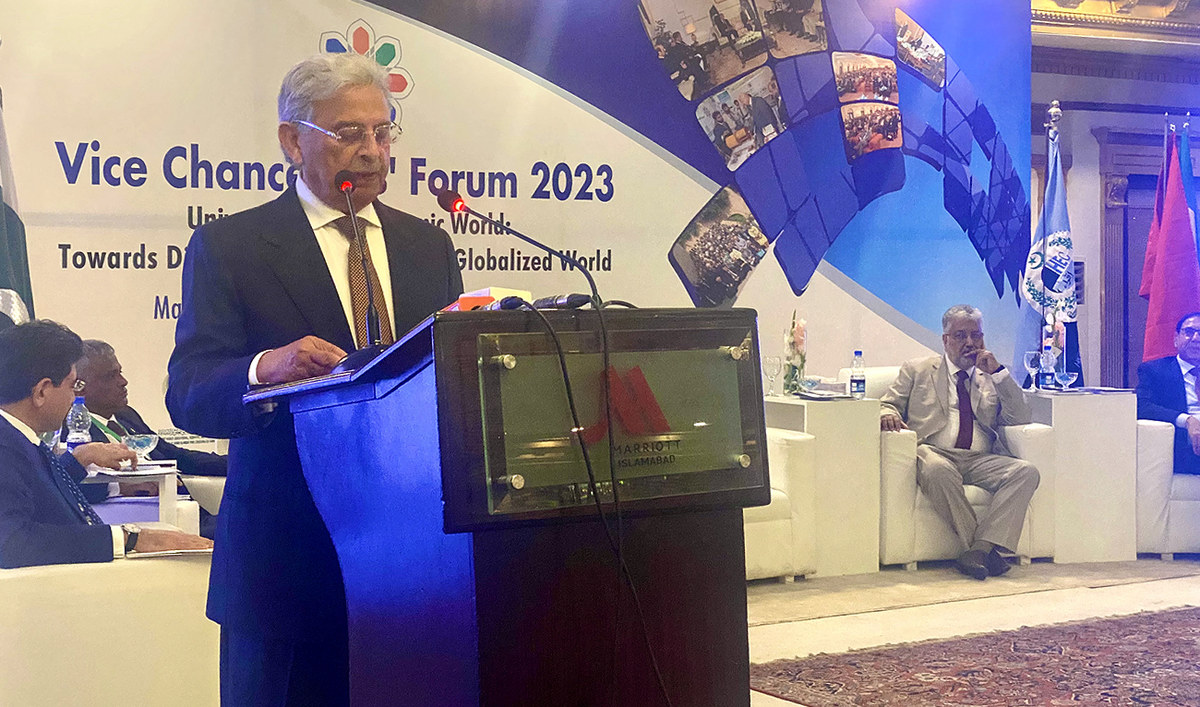


Pakistan’s Federal Minister for Education, Rana Tanveer Hussain, addresses participants of the VC's Forum of Islamic countries in Islamabad, Pakistan on March 19, 2023. (AN Photo)

In his video message to the audience, Pakistan’s President Dr. Arif Alvi urged the forum to chalk out a strategy to promote the practice of adopting modern education and technology among the Muslim youth.

“The Muslims were slow to adapt to technological advancements and this needed to change,” he said, adding that in the last 10 years, sectors focusing on natural resources were overtaken by technological companies such as Amazon and Google.

These companies, he said, represented intellectual capital and pointed toward the need for greater access to online education.

Dr. Salim M. Al-Malik, director general of ICESCO, said development of robotics would make 97 million jobs obsolete and in the next 10 years, 375 million people would have to switch jobs, causing immense disruption worldwide and hence increase the digital divide.

“There is a great need to recreate the glorious Islamic heritage in science and ICSESCO would create 100 science researchers in top universities of the member countries by 2025,” he added.

Dr. Mukhtar Ahmed, the HEC’s chair, said this forum posed an immense challenge for academia to rethink its role beyond conferring degrees on developing critical thinkers who could adapt and respond to fast-changing global trends with agility and creating lifelong learners with relevant skill sets.

“This forum will help higher education institutions in the Islamic world keep pace with rapid developments in science and technology,” he said. Ahmed hoped that at the end of the two-day activities of the Forum, participants would come up with tangible initiatives for enhanced collaboration and would help bring excellence in higher education systems.
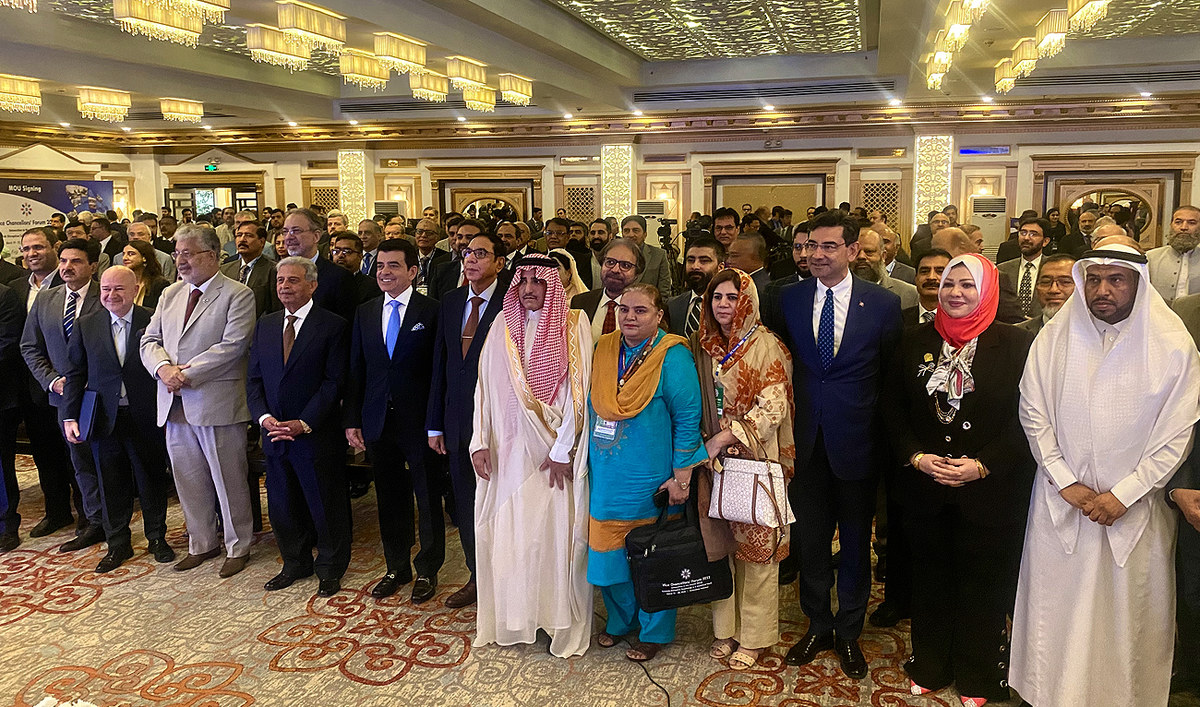


Vice chancellors from OIC member states pose for a group photo during the VC's Forum of Islamic countries in Islamabad, Pakistan on March 19, 2023. (AN Photo)

Speaking to Arab News, Professor Dr. Alyaa Ali Al-Attar, president of the Northern Technical University in Iraq, expressed her delight in attending the conference. She said it had provided a valuable opportunity to engage with leading academics from the Islamic world.

“The conference has provided us an opportunity to interact with top academicians from the Islamic world and exchange ideas for the advancement of higher education in the Muslim world,” she told Arab News.

She said the conference provided a platform for exploring various avenues of future collaboration among the participating higher education institutions.

“We are looking forward to discussing different ways and means of future collaborations between different higher education institutions whose heads are participating in this conference,” she added.

Maria Rehman, the country director of the British Council Pakistan, said there was an immense need to bridge the gap between universities and the industry to improve the quality of skilled education.

“There is a need of reforming the educational system, building partnerships for increasing access to quality learning, which is quite a challenge,” she added.
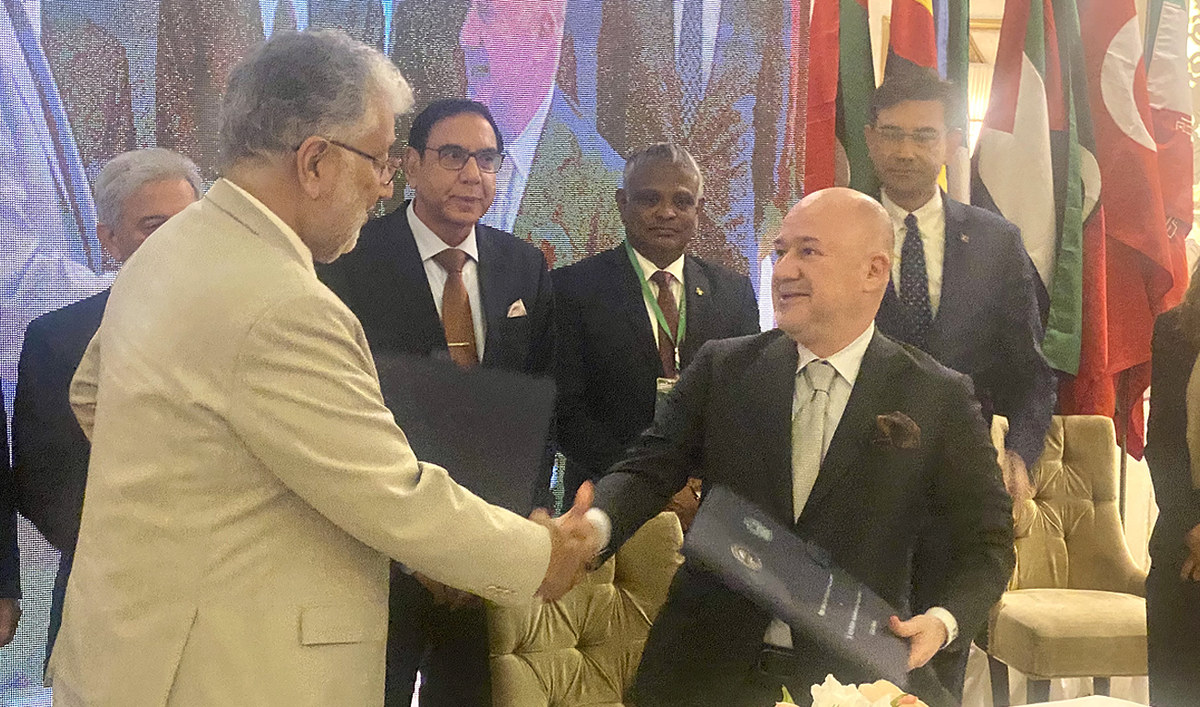


The officials of Pakistani Higher Education Commission and World Business Angels Investment Forum sign MOU for cooperation in higher education sectors in Islamabad, Pakistan on March 19, 2023. (AN Photo)


Chinese giant Hoymiles enters Pakistani market to provide high-tech energy storage solutions

Updated 6 sec ago
Follow

Chinese giant Hoymiles enters Pakistani market to provide high-tech energy storage solutions

  • The development comes after Pakistan emerges as one of world’s fastest-growing solar markets, importing nearly 50GW of solar panels
  • Hoymiles entry will address long-hour backup and energy storage challenges facing Pakistan’s growing solar sector, local partner says

KARACHI: Renowned Chinese inverter manufacturer Hoymiles has entered Pakistan to provide high-tech, long-duration energy storage solutions for residential, commercial and industrial buildings by utilizing solar systems for electricity consumption, its Pakistani partner said on Monday.

Over the past few years, a large number of Pakistani industrial, commercial and residential electricity consumers have shifted to solar power systems to address frequent power outages and the rising cost of electricity. Reports indicate that net-metering capacity currently stands at 6,000 megawatts (MWs), while off-grid solar capacity has increased to 12,000 MWs in Pakistan by the end of 2025.

Hoymiles has formed strategic partnerships with Superstar, a renowned name in Pakistan’s automotive industry, and Harisun Energy, a new entrant in the energy solutions sector, to explore the Pakistani market, which is witnessing rapid growth in solar power adoption. In this regard, launch events were held simultaneously in Karachi and Lahore, unveiling multiple storage solutions produced by Hoymiles under the brands of Harisun Energy and Superstar.

Speaking as the chief guest at the Hoymiles launching ceremony in Karachi, Ali Rashid, advisor to Sindh chief minister on science and information technology (IT), said the provincial government appreciates foreign investors, particularly Chinese companies, establishing their industries, assembly, and distribution units in Karachi to meet the demand of the local market as well as export solutions to other countries.

“The government is working rigorously to facilitate foreign investors and companies to enhance their business and commercial activities, mainly in the technology and renewable energy sectors, to improve the living standards of the public and boost economic activity within the country and the province of Sindh,” he said.

The Sindh government is currently collaborating with various Chinese companies across different sectors, including logistics and renewable energy, and it welcomes further cooperation between the private and public sectors, according to Rashid.

The provincial government is considering establishing its own regulatory authority and transmission company, aimed at setting up a separate electricity grid system at the provincial level, which could provide affordable electricity to the masses and enhance connectivity to remote areas, preferably through renewable energy resources.

According to a report by the International Energy Agency (IEA), Pakistan has emerged as one of the world’s fastest-growing solar markets, importing approximately 50 GW of solar panels amid falling prices and widespread adoption across sectors in the first half of the year. This surge has made Pakistan the third-largest market for Chinese solar panels, a growth that has attracted global attention.

Superstar Solar Energy and Harisun Energy are introducing Hoymiles’ innovative range of solar inverters, energy storage solutions, and smart energy management systems to the Pakistani market. These solutions are designed to deliver reliable, efficient, and sustainable energy, empowering individuals and businesses to harness solar power as a clean and green energy source.

“Pakistan’s growing solar sector is facing a major challenge related to long-hour backup and energy storage solutions, which will soon be addressed with the entry of a global leader in energy solutions,” said Haris Jamsheed, CEO of Harisun Energy.

“Our partnership with the Chinese company will provide innovative energy storage solutions for residential, commercial, and industrial solar systems, enabling uninterrupted electricity supply at workplaces, factories, and homes during nighttime hours.”

Solarization has continued to expand across the country on a large scale due to prolonged load-shedding in remote areas and the high cost of electricity, which has become unaffordable for many households and industrial units, particularly in recent years.

“We have vowed to bring an energy revolution to Pakistan through innovative storage solutions, as the industrial and commercial sectors can enhance productivity with low-cost electricity backup systems,” said Saleem Umar, Chairman of Superstar.

“Affordable electricity will reduce operational costs at the domestic level, enabling exporters to compete more effectively in global markets.”