

Ex-PM Khan’s party to file contempt case against police for raiding Lahore residence

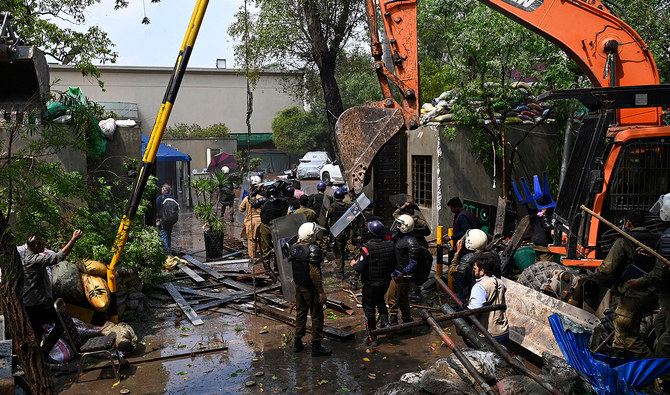
Policemen use heavy machinery to enter Pakistan’s former prime minister Imran Khan's residence in Lahore on March 18, 2023, after Khan left for Islamabad to appear in a court. (Photo courtesy: AFP)
Short Url
Updated 18 March 2023
Follow

Ex-PM Khan’s party to file contempt case against police for raiding Lahore residence

  • The raid took place when the former premier was traveling to Islamabad to attend a court hearing
  • Government says the operation was launched to clear a “no-go area” around his Lahore residence

ISLAMABAD: Former prime minister Imran Khan’s Pakistan Tehreek-e-Insaf (PTI) party said on Saturday it would file a contempt case against top Punjab police officials after they raided the residence of its leader in the eastern Lahore city to clear a “no-go area” around it and claimed to have seized inflammable material.

Khan’s residence recently became the site of clashes between the police and his supporters after an Islamabad district and sessions court issued non-bailable arrest warrants against him in a case involving the sale of state gifts.

The Lahore High Court instructed the police to stand down after two days of intense clashes, as PTI leaders said Khan would assure his presence in the district court on March 18. The Islamabad High Court also suspended the arrest warrants after hearing a PTI petition.

However, police decided to remove encroachments and a blockade created by Khan’s supporters on Saturday and were resisted in the process. According to a senior police officer, Suhail Sukhera, the operation intensified after a man on the roof of Khan’s residence opened fire.

The police broke open the main door of the former prime minister’s residence where they said “illegal structures” had been erected to shelter those who had been involved in attacks on law enforcement personnel. The raid came at a time when Khan was on his way to Islamabad to appear before the district court.

“Police entered Imran Khan’s house today by breaking a gate and tortured the employees there,” Chaudhary Fawad Hussain, a close Khan aide, said during a press briefing. “Khan’s wife Bushra Bibi was alone in the house along with the employees when the operation was carried out. This was a violation of privacy.”

Hussain said that ex-PM, following the orders of the court, was on his way to Islamabad for the hearing when the police made “a mockery of the high court’s decision.”

“We will file a contempt of court case against Punjab’s inspector-general (IG) of police for violating the court order,” he said, adding that the top police official was launched the raid on the behest of the government.

Earlier in the day, Pakistan’s Interior Minister Rana Sanaullah said that the operation to clear the “no-go area” was carried out by Punjab’s caretaker government and the police in view of the “violent situation there.”

“All the terrorists present there had been arrested, and a case has been filed against them,” Sanaullah told Pakistan’s Geo News channel.

“A case will be registered against some people today too. The arms, petrol bombs, bomb-making equipment, and other things have been recovered from there, and you will see it in a bit. So, Imran Khan, and some senior journalists who had been managing the matter, a case will be filed against them and against the violent people arrested from there.”

Sanaullah said there was no example of such opposition to the law in the past and any group resorting to such tactics was not a political party.

Khan questioned the legality of the raid and described it as part of a deeper conspiracy.

“Punjab police have led an assault on my house in Zaman Park where Bushra Begum is alone,” he said on Twitter.


Pakistan plans 3,000 EV charging stations as green mobility push gathers pace

Updated 14 January 2026
Follow

Pakistan plans 3,000 EV charging stations as green mobility push gathers pace

  • Roadmap unveiled by energy efficiency regulator and a private conglomerate amid early-stage EV rollout
  • New EV Policy and related plans aim to install 3,000 EV stations by 2030, including 240 stations in current fiscal year

ISLAMABAD: Pakistan’s energy efficiency regulator and a private conglomerate have unveiled an approved roadmap to establish 3,000 electric vehicle (EV) charging stations across the country, state-run Associated Press of Pakistan (APP) reported on Tuesday.

The announcement comes as Pakistan looks to build out basic EV charging infrastructure, which remains limited and unevenly distributed, largely concentrated in major cities. Despite policy commitments to promote electric mobility as part of climate and energy-efficiency goals, the absence of a nationwide charging network has slowed broader EV adoption.

Pakistan’s EV ecosystem is still at a formative stage, with progress constrained by regulatory approvals, grid connectivity issues and coordination challenges among utilities, regulators and fuel retailers. Expanding charging infrastructure is widely seen as a prerequisite for scaling electric transport for both private and commercial use.

According to APP, the roadmap was presented during a meeting between Malik Group Chief Executive Officer Malik Khuda Baksh and National Energy Efficiency and Conservation Authority Managing Director and Additional Secretary Humayon Khan.

“Baksh ... in a meeting with Khan, unveiled the approved roadmap for establishing 3,000 electric vehicle charging stations across Pakistan,” APP reported. “Khan reaffirmed the authority’s full institutional backing and pledged to expand the initiative to 6,000 EV charging stations nationwide.”

The discussion reviewed hurdles delaying the rollout, including EV charger imports, customs duties, regulatory documentation and inter-agency coordination.

APP said Khan welcomed the proposal and sought recommendations for “internationally compliant EV charger brands,” while asking for a detailed “issue-and-solutions report within three days” to facilitate timely implementation of the national green mobility initiative.

Despite the issuance of 13 licenses by NEECA and the arrival of five EV charging units at designated sites, progress has been slowed by procedural bottlenecks, officials said. These include delays in electricity connections, prolonged installation of separate meters and pending no-objection certificates from power distribution companies and oil marketing firms, which continue to stall operational readiness.

Pakistan’s electric vehicle ecosystem is still in its early stages, with charging infrastructure far behind levels seen in more advanced markets. The government’s New Energy Vehicle Policy and related plans aim to install 3,000 EV charging stations by 2030, including 240 stations planned in the current fiscal year, but actual deployment remains limited and uneven, mostly clustered in major cities and along key urban corridors.

Despite regulatory backing, including the 2024 Electric Vehicles Charging Infrastructure and Battery Swapping Stations framework, progress has been slow. Many proposed stations have yet to become operational due to delays in grid connections and approvals, and public maps of nationwide charging coverage are not yet available.

Private players are beginning to install more chargers, and there are over 20 public EV charging points reported in urban centers, offering both slower AC chargers and faster DC options. However, such infrastructure is still sparse compared with the growing number of electric vehicles and the government’s long-term targets.