Pressure mounts on Macron after unrest grows over pensions

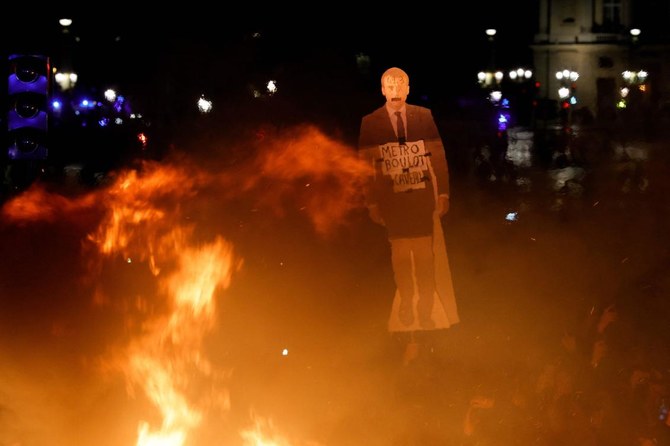
An effigy of French President Emmanuel Macron is held up near a fire during a demonstration in Paris on Mar. 17, 2023, the day after the French government pushed a pensions reform using the article 49.3 of the constitution. (AFP)
Short Url
Updated 17 March 2023
Follow

Pressure mounts on Macron after unrest grows over pensions

  • A new demonstration got underway in Paris on Friday evening, as protesters gathered in the city's Place de la Concorde
  • Demonstrators started off a fire burning in Place de la Concorde on Friday as they faced up to a line of riot police, with some chanting "Macron, Resign!"

PARIS: French President Emmanuel Macron on Friday faced the gravest challenge to his authority since the so-called Yellow Vest protests after his decision to push through a contested pension overhaul without a vote prompted a wave of protests.
A new demonstration got underway in Paris on Friday evening, as protesters gathered in the city’s Place de la Concorde, near the Assemblee Nationale parliament building, following demonstrations on Thursday which were marred by violence.
Demonstrators started off a fire burning in Place de la Concorde on Friday as they faced up to a line of riot police, with some chanting “Macron, Resign!“
“Something fundamental happened, and that is that, immediately, spontaneous mobilizations took place throughout the country,” hard-left leader Jean-Luc Melenchon said. “It goes without saying that I encourage them, I think that’s where it’s happening.”
The pension overhaul raises France’s retirement age by two years to 64, which the government says is essential to ensure the system does not go bust.
Unions, and most voters, disagree.
The French are deeply attached to keeping the official retirement age at 62, which is among the lowest in OECD countries.
More than eight out of 10 people are unhappy with the government’s decision to skip a vote in parliament, and 65 percent want strikes and protests to continue, a Toluna Harris Interactive poll for RTL radio showed.
Going ahead without a vote “is a denial of democracy...a total denial of what has been happening in the streets for several weeks,” 52-year-old psychologist Nathalie Alquier said in Paris. “It’s just unbearable.”
A broad alliance of France’s main unions said they would continue their mobilization to try and force a U-turn on the changes. Protests are planned for this week, with a new day of nationwide industrial action is scheduled for Thursday.
Teachers’ unions called for strikes next week, which could disrupt the emblematic Baccalaureate high-school exams.
While eight days of nationwide protests since mid-January, and many more local industrial actions, had so far been largely peaceful, the unrest on Thursday was reminiscent of the Yellow Vest protests that erupted in late 2018 over high fuel prices and forced Macron into a partial U-turn on a carbon tax.

’MAYHEM’
Interior Minister Gerald Darmanin said some 310 people had been arrested by police and promised to crack down on troublemakers.
“Opposition is legitimate, protests are legitimate but causing mayhem is not,” he told RTL radio.
Left-wing and centrist opposition lawmakers filed a motion of no-confidence in parliament on Friday afternoon.
But, even though Macron lost his absolute majority in the lower house of parliament in elections last year, there was little chance this would go through — unless a surprise alliance of MPs from all sides is formed, from the far-left to the far-right.
The leaders of the conservative Les Republicains party have ruled out such an alliance. None of them had sponsored the first motion of no confidence filed on Friday. The far-right was expected to file another later in the day.
Individual LR lawmakers have said they could break ranks, but the no confidence bill would require all of the other opposition MPs and half of LR’s 61 lawmakers to go through, which is a tall order.
“So far, French governments have usually won in such votes of no confidence,” said Berenberg chief economist Holger Schmieding.
He expected it would be the same again this time even if “by trying to by-pass parliament, Macron has already weakened his position.”
Votes in parliament were likely to take place over the weekend or on Monday.
Macron will want to turn the page quickly, with government officials already preparing more socially minded reforms. He can also choose, at some point, to fire Prime Minister Elisabeth Borne, who has been at the forefront of the pension debate.
But either or both moves may do little to quell anger on the streets. Neither of them had made public comments on Friday.


London police using withdrawn powers to clamp down on pro-Palestine rallies: Probe

Updated 5 sec ago
Follow

London police using withdrawn powers to clamp down on pro-Palestine rallies: Probe

  • ‘Cumulative disruption’ cited to ban, reroute rallies but power granted by concept withdrawn by Court of Appeal in May
  • Network for Police Monitoring: This demonstrates ‘ongoing crackdown on protest’ that has reached ‘alarming point’

LONDON: London’s Metropolitan Police have used powers that have been withdrawn to clamp down on pro-Palestine rallies in the capital, legal experts have said.

The Guardian and Liberty Investigates obtained evidence that police officers had imposed restrictions on at least two protests based on the principle of “cumulative disruption.” But that power was withdrawn by the Court of Appeal in May, according to legal experts.

All references to cumulative disruption have been removed from relevant legislation, yet the Home Office and the Met continue to insist that police officers retain the power to consider the concept when suppressing protests.

On May 7, five days after the powers were withdrawn, the Met banned a Jewish pro-Palestine group from holding its weekly rally in north London, citing the cumulative impact on the neighborhood’s Jewish community.

Last month, the Met forced the Palestine Coalition to change the route of its rally on three days’ notice, highlighting the cumulative impact on businesses during Black Friday weekend.

Raj Chada, a partner at Hodge, Jones & Allen and a leading criminal lawyer, said: “There is no reference to cumulative disruption in the original (legislation). The regulations that introduced this concept were quashed in May 2025, so I fail to see how this can still be the approach taken by police. There is no legal basis for this whatsoever.”

The Met appeared “not to care” if it was acting within the law, the Network for Police Monitoring said, adding that the revelation surrounding “cumulative disruption” demonstrated an “ongoing crackdown on protest” that had reached an “alarming point” by police in London.

Home Secretary Shabana Mahmood announced plans in October to reintroduce the power to consider cumulative impact in toughened form.

But Nick Glynn, a retired senior officer from Leicestershire Police, said: “The police have too many protest powers already and they definitely don’t need any more. If they are provided with them, they not only use them (but) as in this case, they stretch them.

“They go beyond what was intended. The right to protest is sacrosanct and more stifling of protest makes democracy worth less.”

Cumulative disruption was regularly considered and employed in regulations if protests met the threshold of causing “serious disruption to the life of the community.”

The Court of Appeal withdrew the power following a legal challenge by human rights group Liberty.

Ben Jamal, the Palestine Solidarity Campaign’s director, was reportedly told by Alison Heydari, the Met’s deputy assistant commissioner, that her decision on imposing protest regulations “will be purely around the cumulative effect of your protests.”

She reportedly added that “this is not just about Saturday’s protest but it’s a combination of all the impacts of all the processions so far,” referencing “serious disruption” to the business community.

“You’ve used this route in November 2024, and you’ve used it a few times before then as well. So, there is an impact.”

The repeated disruption to PSC-hosted marches, the largest pro-Palestine events in London, was a “demobilizer,” Jamal said.

It also caused confusion about march starting points and led to protesters being harassed by police officers who accused them of violating protest conditions, he added.

A Met spokesperson told The Guardian: “The outcome of the judicial review does not prevent senior officers from considering the cumulative impact of protest on the life of communities.

“To determine the extent of disruption that may result from a particular protest, it is, of course, important to consider the circumstances in which that protest is to be held, including any existing disruption an affected community is already experiencing.

“We recognise the importance of the right to protest. We also recognise our responsibility to use our powers to ensure that protest does not result in serious disorder or serious disruption. We use those powers lawfully and will continue to do so.”