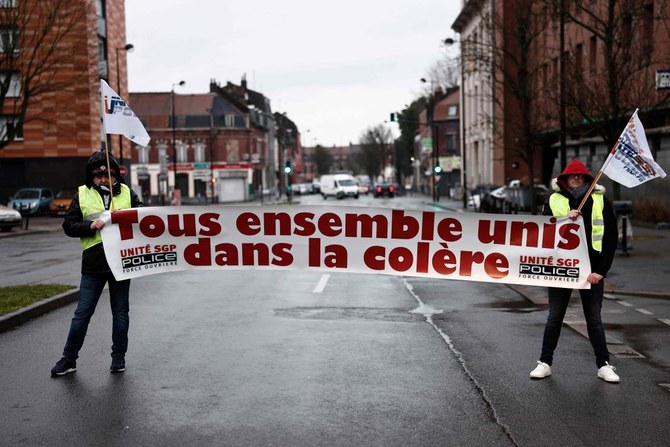
PARIS: France’s trade unions headed for a crucial face-off against President Emmanuel Macron on Tuesday, with fresh strikes and protests planned against a controversial pensions reform that would push back the retirement age for millions.
Unions have vowed to bring the country to a standstill over the proposed changes, which include raising the minimum retirement age to 64 from 62 and increasing the number of years people have to make contributions for a full pension.
“I call on all the country’s employees, citizens and retirees who are against the pensions reform to come out and protest en masse,” the head of the CFDT union Laurent Berger told the France Inter radio station Monday.
“The president cannot remain deaf” to the protests, he added.
Macron put the plan at the center of his re-election campaign last year, and his cabinet says the changes are essential to prevent the pensions system from falling into deficit in coming years.
But they face fierce resistance from both parliament and the street, with almost two in three people across the country supporting protests against it, according to a poll by the Elabe survey group published Monday.
“They’re right to be striking,” said Ali Toure, a 28-year-old construction worker, as he waited for a delayed RER suburban train at a station north of Paris.
“Manual labor is hard. It’s no big deal if I arrive late for a month, my boss will wait!” he said.
The hard-line CGT union said fuel deliveries from refineries across France had been blocked from Tuesday morning, which could see petrol stations running short if the protests continue as unions hope.
“The strike has begun everywhere... with deliveries blocked from all the refineries this morning,” said Eric Sellini, branch coordinator for the CGT.
Unions have warned of rolling strikes on public transport that could paralyze parts of the country for weeks on end.
Police expect 1.1 million to 1.4 million people to hit the streets Tuesday in more than 260 locations nationwide, a source has told AFP on condition of anonymity.
The upper limit of that range would mean stronger opposition than during the five previous days of rallies that have taken place since mid-January.
On the biggest day of demonstrations so far, 1.27 million people demonstrated on January 31, according to official figures.
Demonstrations were already forming early Tuesday morning, with the public road information service reporting that a national road in the city of Rennes had been blocked by around 100 protesters since 1 am.
In the lead-up to Tuesday, unions had promised to bring the country “to a standstill.”
Only one in five regional and high-speed trains are expected to run, while a leading trade unionist representing refinery workers has vowed to bring the French economy “to its knees.”
School teachers are also to stage walkouts.
Prime Minister Elisabeth Borne told French television Monday that while she respected the right to protest, a nationwide standstill would primarily penalize “the most fragile” among the population.
The government has argued that the changes are crucial to keep France’s pensions system from falling into deep deficts in the coming years.
“If we want to keep this system going, we need to work longer,” Macron said last month.
But unions contest that conclusion and say small increases in contributions could keep it solvent. They also argue that the proposed measures are unfair and would disproportionately affect low-skilled workers in tiring jobs who start their careers early.
According to an Elabe survey, 56 percent of respondents said they supported rolling strikes, and 59 percent backed the call to bring the country to a standstill.
The bill is now being debated in the upper house of parliament, after two weeks of heated debate in the lower house that ended without even reaching a vote on raising the retirement age.
Monday’s Senate debate dragged on until after 3 am Tuesday morning, with the body’s right-leaning majority shooting down alternative proposals for funding the pensions system fielded by the left. Debate is slated to resume at 2:30 pm.
The centrist government is hoping to push through the reform in parliament with help from the right, without resorting to a controversial mechanism that would bypass a parliamentary vote but risk fueling more protests.


![]()

France faces ‘standstill’ in protests against pensions overhaul
Short Url
https://arab.news/reurf
France faces ‘standstill’ in protests against pensions overhaul
- Unions vowed to bring France to a standstill over pension changes, which include raising the minimum retirement age to 64
- Cabinet says the changes are essential to prevent the pensions system from falling into deficit in coming years


Latest updates





© 2026 SAUDI RESEARCH & PUBLISHING COMPANY, All Rights Reserved And subject to Terms of Use Agreement.