

Turkish FM to visit Egypt as countries end decade-long split

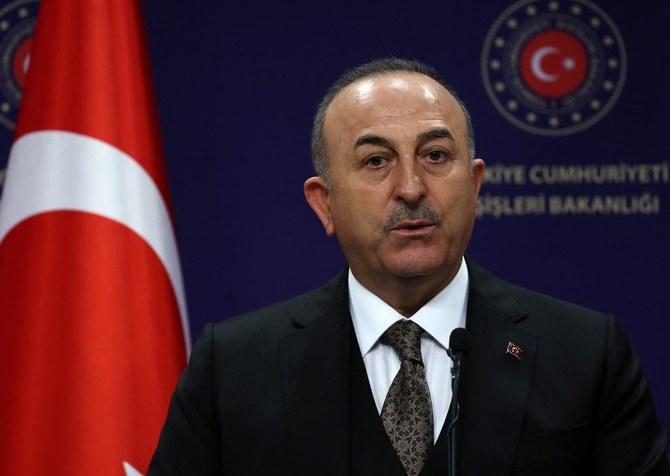
Turkish foreign minister Mevlut Cavusoglu, above, will hold talks with his Egyptian counterpart Sameh Shoukry. (AFP)
Short Url
Updated 17 March 2023
Follow

Turkish FM to visit Egypt as countries end decade-long split

  • Mevlut Cavusoglu’s trip follows his Egyptian counterpart’s visit to Turkiye’s earthquake-hit region last month

ISTANBUL: Turkish foreign minister Mevlut Cavusoglu will visit Egypt, his ministry announced Friday, the first such high-level trip in more than a decade as the countries repair relations damaged in the wake of the 2011 Arab Spring.

A statement from the Turkish foreign ministry said Cavusoglu will go to Egypt on Saturday at the invitation of his Egyptian counterpart, Sameh Shoukry. The ministers will discuss bilateral relations as well as regional and international issues.

Cavusoglu’s trip follows Shoukry’s visit to Turkiye’s earthquake-hit region last month.

Diplomatic relations between Ankara and Cairo have been frosty for almost a decade. Turkish President Recep Tayyip Erdogan was a close ally of Egypt’s previous Islamist president, Muhammad Mursi, who was ousted by the military amid widespread protests in 2013.

Turkiye in recent years abandoned its critical approach to Egyptian president Abdel Fattah El-Sisi’s government, as it tried to repair the frayed ties. In November, Erdogan and El-Sisi were photographed shaking hands during the World Cup in Qatar.


Syrian government vows to protect Kurds in Aleppo, accuses SDF of planting explosives

Updated 4 sec ago
Follow

Syrian government vows to protect Kurds in Aleppo, accuses SDF of planting explosives

  • Kurdish-led group targeting neighborhoods with mortars, machine guns, Ministry of Defense says
  • Army declares Ashrafieh, Sheikh Maqsoud ‘closed military zone’ after hundreds of civilians evacuated

LONDON: The Syrian government on Wednesday affirmed its commitment to protect all citizens, including Kurds, as armed tensions in Aleppo between the Syrian army and the Kurdish-led Syrian Democratic Forces continued for a fourth day.

The Ministry of Defense accused the SDF of planting explosives on roads and setting booby traps in the Sheikh Maqsoud and Ashrafieh neighborhoods, and bombarding them with mortar shells and heavy machine gun fire.

The army designated the two neighborhoods a “closed military zone” after the Syrian Arab Red Crescent evacuated 850 civilians from the area.

The government said in a statement that the SDF played no role in the city’s security and military affairs.

“This confirms that the exclusive responsibility for maintaining security and protecting residents falls upon the Syrian state and its legitimate institutions, in accordance with the constitution and applicable laws,” it said.

Protecting all citizens, including Kurds, was a non-negotiable responsibility upheld without discrimination based on ethnicity or affiliation, it said.

It also rejected any portrayal of its security measures as targeting a specific community, according to the Syrian Arab News Agency.

“The authorities concerned stress that those displaced from areas of tension are exclusively civilians, all of them Kurdish citizens who left their neighborhoods out of fear of escalation,” the statement said.

“They sought refuge in areas under the control of the state and its official institutions, which clearly demonstrates the trust of Kurdish citizens in the Syrian state and its ability to provide them with protection and security and refutes claims alleging that they face threats or targeted actions.”

The government called for the withdrawal of armed groups from Aleppo.

At least three civilians and a Syrian soldier have been killed and dozens more injured in Aleppo since Tuesday. Authorities have accused the SDF of targeting medical and educational facilities.

The escalation in violence has dealt a blow to an agreement between the two sides that was meant to be implemented by the end of last year.

The Syrian government reached an agreement with the SDF in March that included plans to integrate the group’s military, territory and natural resources, including oil fields, into the new government in Damascus.