

Pakistan says PIA sale will trigger ‘investor interest’ for privatization of power companies

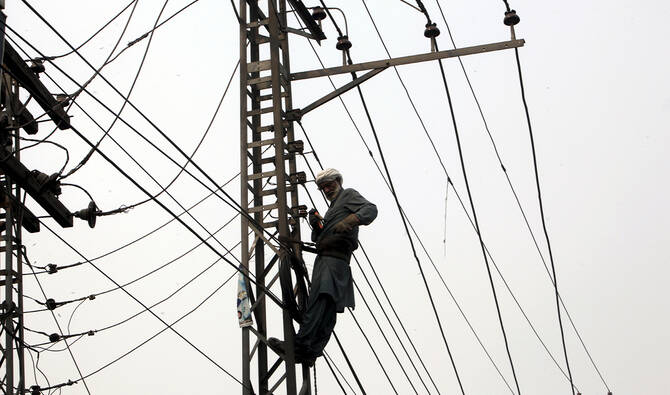
A power company employee works on power lines in Lahore, Pakistan, November 6, 2015. (REUTERS/File)
Short Url
Updated 09 January 2026
Follow

Pakistan says PIA sale will trigger ‘investor interest’ for privatization of power companies

  • Pakistan to next focus on privatizing Islamabad, Gujranwala and Faisalabad electric supply companies, says state minister
  • Pakistan’s power sector has drained its public finances due to high losses, inefficiencies and mounting subsidies over the years

ISLAMABAD: State Minister for Finance Bilal Azhar Kayani this week said the government’s move to successfully sell its stake in the state-owned Pakistan International Airlines (PIA) will trigger greater investor interest in Islamabad’s privatization program. 

In December, a consortium led by the Arif Habib Group won the bid for a 75 percent controlling stake in Pakistan’s flag carrier by offering Rs 135 billion ($482 million).

Pakistan’s government has undertaken the drive to privatize or restructure its loss-making state-owned enterprises (SOEs) at the International Monetary Fund’s (IMF) insistence.

In an interview with the state-run Pakistan TV on Thursday, Kayani said the government will next focus on privatizing electricity distribution companies (DISCOs) such as the Islamabad Electric Supply Company (IESCO), Gujranwala Electric Supply Company (GESCO) and Faisalabad Electric Supply Company (FESCO).

“The momentum created by the PIA deal will help generate greater investor and advisory interest going forward for the privatization program,” Kayani was quoted as saying by Pakistan TV. 

“The next phase of privatization is focused on electricity distribution companies, including IESCO, GEPCO and FESCO.”

The power sector has drained Pakistan’s public finances due to high losses, inefficiencies and mounting subsidies, making it a central focus of Pakistan’s reform agenda under the IMF program.

Pakistan’s Privatization czar Muhammad Ali last month announced the government plans to issue Expressions of Interest (EoIs) for the privatization of state-owned DISCOs in January. 

Pakistan’s government owns or controls much of the power infrastructure. It is also grappling with ballooning “circular debt,” or unpaid bills and subsidies, that have choked the power sector and weighed on the economy.


Pakistani students stuck in Afghanistan permitted to go home

Updated 12 January 2026
Follow

Pakistani students stuck in Afghanistan permitted to go home

  • The border between the countries has been shut since Oct. 12
  • Worries remain for students about return after the winter break

JALALABAD: After three months, some Pakistani university students who were stuck in Afghanistan due to deadly clashes between the neighboring countries were “permitted to go back home,” Afghan border police said Monday.

“The students from Khyber Pakhtunkhwa (northwest Pakistan) who were stuck on this side of the border, only they were permitted to cross and go to their homes,” said Abdullah Farooqi, Afghan border police spokesman.

The border has “not reopened” for other people, he said.

The land border has been shut since October 12, leaving many people with no affordable option of making it home.

“I am happy with the steps the Afghan government has taken to open the road for us, so that my friends and I will be able to return to our homes” during the winter break, Anees Afridi, a Pakistani medical student in eastern Afghanistan’s Nangarhar province, told AFP.

However, worries remain for the hundreds of students about returning to Afghanistan after the break ends.

“If the road is still closed from that side (Pakistan), we will be forced to return to Afghanistan for our studies by air.”

Flights are prohibitively expensive for most, and smuggling routes also come at great risk.

Anees hopes that by the time they return for their studies “the road will be open on both sides through talks between the two governments.”