LONDON: Russian Defense Minister Sergei Shoigu has presented awards to the pilots of two Su-27 fighter planes that intercepted a US drone near the airspace around Russia’s military campaign in Ukraine, his ministry said on Friday.
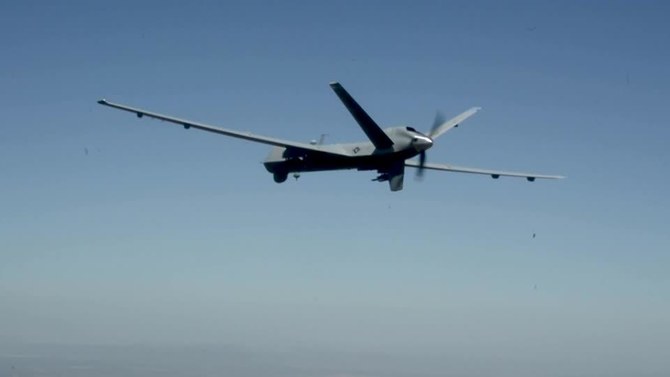
The drone crashed into the Black Sea on Tuesday after being intercepted by Russian jets, in the first known direct military encounter between Russia and the United States since Russia invaded Ukraine a year ago.
Announcing the awards, the ministry repeated Russia’s version of events — disputed by Washington — that the Russian planes did not make physical contact with the drone.
“As a result of sharp maneuvering around 9:30 a.m. (Moscow time), the MQ-9 unmanned aerial vehicle went into uncontrolled flight with a loss of altitude and collided with the water surface,” it said.
It said the drone had been flying with its transponders turned off and violating airspace restrictions that Russia had made public in connection with what it calls its special military operation in Ukraine.
The US military had said the Russian fighter planes approached its MQ-9 Reaper drone during a reconnaissance mission over the Black Sea in international airspace. It said the fighters harassed the drone and sprayed fuel on it in an encounter lasting 30-40 minutes before one clipped the drone’s propeller, causing it to crash into the sea.
The Pentagon on Thursday released a 40-second edited video showing a Russian fighter jet coming close to a US military drone in the air, dumping fuel near it, and a damaged propeller in the aftermath. The top US general said the incident demonstrated Moscow’s increasingly aggressive behavior.


Russian defense minister decorates pilots for downing US drone
https://arab.news/6ah8b
Russian defense minister decorates pilots for downing US drone

- MQ-9 unmanned aerial vehicle crashed into the Black Sea on Tuesday after being intercepted by Russian jets


NATO wants ‘automated’ defenses along borders with Russia: German general
- That zone would act as a defensive buffer before any enemy forces advanced into “a sort of hot zone,” said Lowin
- The AI-guided system would reinforce existing NATO weapons and deployed forces, the general said
FRANKFURT: NATO is moving to boost its defenses along European borders with Russia by creating an AI-assisted “automated zone” not reliant on human ground forces, a German general said in comments published Saturday.
That zone would act as a defensive buffer before any enemy forces advanced into “a sort of hot zone” where traditional combat could happen, said General Thomas Lowin, NATO’s deputy chief of staff for operations.
He was speaking to the German Sunday newspaper Welt am Sonntag.
The automated area would have sensors to detect enemy forces and activate defenses such as drones, semi-autonomous combat vehicles, land-based robots, as well as automatic air defenses and anti-missile systems, Lowin said.
He added, however, that any decision to use lethal weapons would “always be under human responsibility.”
The sensors — located “on the ground, in space, in cyberspace and in the air” — would cover an area of several thousand kilometers (miles) and detect enemy movements or deployment of weapons, and inform “all NATO countries in real time,” he said.
The AI-guided system would reinforce existing NATO weapons and deployed forces, the general said.
The German newspaper reported that there were test programs in Poland and Romania trying out the proposed capabilities, and all of NATO should be working to make the system operational by the end of 2027.
NATO’s European members are stepping up preparedness out of concern that Russia — whose economy is on a war footing because of its conflict in Ukraine — could seek to further expand, into EU territory.
Poland is about to sign a contract for “the biggest anti-drone system in Europe,” its defense minister, Wladyslaw Kosiniak-Kamysz, told the Gazeta Wyborcza daily.
Kosiniak-Kamysz did not say how much the deal, involving “different types of weaponry,” would cost, nor which consortium would ink the contract at the end of January.
He said it was being made to respond to “an urgent operational demand.”


