

King Abdullah Economic City management team set out the advantages of partnering with PIF

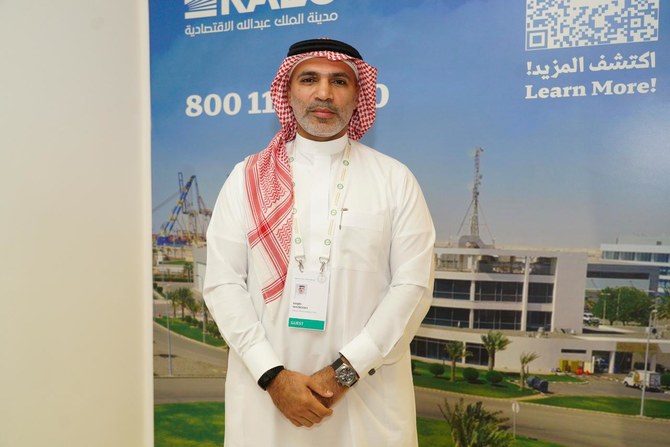
Majid Abdullah Matbouly, head of Industrial Valley at King Abdullah Economic City. (Huda Bashatah)
Short Url
Updated 29 March 2023
Follow

King Abdullah Economic City management team set out the advantages of partnering with PIF

RIYADH: Speaking to Arab News on the sidelines of the Public Investment Fund Private sector Forum in Riyadh, Majid Abdullah Matbouly, head of Industrial Valley at King Abdullah Economic City, and Cyril Piaia CEO of master developer Emaar, the Economic City shed the light on the city's growth and how partnering with PIF has added great value.

Matbouly said that KAEC started as a public real estate company, and today it has PIF as shareholders.

“Previously, we have had several other engagements that included private sector and PIF companies, such as Lucid Ceer, and some others are in the pipeline.”


Piaia said: “It is actually part of our strategy and aligned with our strategy to involve third-party developers third-party investors and third-party operators in the development of the city. Previously, actually, the city was closed, we have been as a new strategy opening up the door to the third party and obviously engaging with the private sector is essential for us to enable local content and develop jobs in the city.”

The city partnership with PIF which happened last year strengthened its status in several ways.

“I think what we have today in the city is a model that can be expanded and later replicated in other places, and that is not only focused on industrial, so our strategy is to focus on the industrial piece of the land. But also there is the tourism and all the byproducts that support that growth.” Matbouly said.

Piaia added: “We want to welcome all those initiatives from Vision 2030 to the city, and allow the private sector and both the government for those initiatives to leverage our primary infrastructure that is a world-class type of infrastructure, and use it as a platform to develop that initiative into the city.”


Matbouly leverages his deep industry knowledge and expertise across multiple sectors to drive the growth and development of the 55 sq. km industrial and logistics hub.

“I think the beauty today of private sector or other companies or partners would be if that you have a vision that's so clear, and you always look at it and start to link yourself to that vision and reverse engineering to achieve certain KPIs for the vision and for the city.

"Today for the industrial, we have an adjacent within KAEC, we have the ports, the second-largest sports, and the growth and the growth of that port. And the growth of the industrial Valley will support the different vision initiatives related to local content related to export and at that diversification of income aside from the oil, that is one part.

"Then you have the other side of the quality of life and so on that, it happens in for the rest of the city. So I think it is a great platform.” Matbouly said

In 2021, KAEC was ranked second among the most efficient container ports in the world, according to the Container Port Performance Index published by The World Bank and IHS Markit.

“We are trying to anchor the city around two main positionings. One is about industrial and our port, which is one of the best ports in the world in terms of efficiency, the other anchor is all about tourism and leisure” Piaia said.

To support the goals of the Kingdom’s vision 2030 and the growth of tourism occurring in the country, KAEC initiated many projects to attract more visitors to its shores including the Rixos Emerald Shores project which is also supported by the Tourism Development Fund.

Piaia said: “The Kingdom of Saudi Arabia is going big time on opening up to tourism. So we are following that lead, and we are integrating ourselves into vision 2030 to reach that objective of developments of tourism. We are right now adding an anchor project in KAEC, which is the Rixos project. It's a massive result 546 rooms with a waterpark directly on the Red Sea. And that will act as an anchor for tourism.”

He added: “We are working with the full ecosystem with the Saudi Tourism authority and the Red Sea authority to make sure that KAEC is actually a nest for developing this initiative from Vision 2030.”

KAEC have also multiple initiatives that support SMEs, as in 2020 KAEC signed an SR10 million ($2.2 million) MoU to support entrepreneurs.

“We are engaged with a number of SMEs and we try to give all the incentives and all the capabilities into the city to welcome them so that they can grow for example, we have a success story with hope which is a mobility company, it was born and grown in KAEC and is now expanding in many other projects around the kingdom.”

Hopon offers smart transportation solutions such as e-kick scooters, manual and electric bikes, electric cargo bikes, electric wheelchairs, and solar and regular stations.


Red Sea’s oxygen balance under strain, experts warn

Updated 13 February 2026
Follow

Red Sea’s oxygen balance under strain, experts warn

  • Scientists say warming waters, nutrient runoff and coastal development could quietly erode coral resilience

RIYADH: The Red Sea may not have dead zones, but its fragile ecosystem is vulnerable to oxygen depletion — a quiet decline that can undermine coral health and disrupt marine life.

Sea dead zones are hypoxic or low-oxygen pockets that form most often when nutrient pollution — especially nitrogen and phosphorus from farm runoff and wastewater — fuels blooms that ultimately strip oxygen from the water.

Experts say the risk is not inevitable, but it depends on earlier detection and tighter control of the conditions that drain oxygen from coastal waters.

A sea that relies on its own “breathing” is also a sea shaped by geography.

FASTFACT

DID YOU KNOW?

  • The Red Sea is naturally low in oxygen because of its warm waters and high salinity — making it especially vulnerable to further oxygen decline.
  • The Red Sea’s narrow Bab Al-Mandab strait limits deepwater exchange, meaning the basin largely depends on its own internal circulation to ‘replenish’ oxygen.
  • Saudi Arabia’s coastline features steep underwater drop-offs, allowing deep, oxygen-poor water to move closer to coral reefs near shore.

Matheus Paiva, a senior oceanographer, told Arab News that “the Red Sea’s shallow Bab Al-Mandab choke point limits deepwater exchange,” meaning oxygen replenishment depends heavily on internal overturning circulation.

He said this circulation is driven as surface waters flow north, cool, become denser and sink, helping ventilate deeper layers through vertical mixing.

Paiva said the Saudi coastline’s underwater topography makes the risk more immediate close to shore.

Coral reefs along Saudi Arabia’s Red Sea coast, where scientists say warm, salty waters and limited deep-water exchange can leave ecosystems vulnerable to low-oxygen stress. (Unsplash.com)

“Unlike regions with wide, gradual shelves, our coast features narrow fringing reefs that drop sharply into deep water via steep underwater cliffs and canyons,” he said.

“This ‘step-and-drop’ topography brings deep oxygen-poor water close to shore.”

Paiva said warming at the surface can intensify stratification and reduce vertical mixing. He said that can allow low-oxygen water to creep upslope and affect shallower reef zones.

How oxygen gets consumed faster than it’s replaced is where human pressure can tip the balance.

Carlos Duarte, executive director or the Coral Research and Development Accelerator Program at KAUST, told Arab News that the Red Sea’s baseline conditions create vulnerability. “Because of its warm waters and high salinity, the Red Sea is inherently low in oxygen and, therefore, vulnerable to processes that decline oxygen further.”

He said algal blooms and heat waves raise biological oxygen demand, linking low oxygen to coral mortality.

Duarte said human-driven nutrient and organic inputs can intensify these declines.

He said poorly managed urban development and aquaculture operations can contribute nutrient and organic loads that fuel algal blooms.

Coral reefs along Saudi Arabia’s Red Sea coast, where scientists say warm, salty waters and limited deep-water exchange can leave ecosystems vulnerable to low-oxygen stress. (Unsplash.com)

Duarte said that as bloom material decomposes, it strips oxygen from the water and can lead to hypoxia.

The Red Sea’s celebrated clarity reflects a naturally nutrient-poor system. “The risk is amplified because the Red Sea is naturally oligotrophic. It is nutrient-poor and crystal clear,” Paiva said.

He added that wastewater releases and heavy rain events that trigger flash floods can push large nutrient loads into coastal waters in a short time.

In turn, those pulses can threaten biodiversity and the marine environment that underpins tourism investments along the Kingdom’s Red Sea coast.

Seeing low oxygen coming — rather than reacting after the fact — is the promise of new monitoring and analytics.

Paiva said high-accuracy oxygen data still relies on direct measurements collected during vessel surveys.

Carlos Duarte, executive director or the Coral Research and Development Accelerator Program at KAUST.

“We still depend heavily on classic vessel surveys,” he said. Teams deploy multiparameter sondes to profile the water column and collect water samples to establish a baseline.

“This ‘water-truthing’ remains the industry standard for high-accuracy data,” he said.

Saeed Al-Zahrani, general manager for Saudi Arabia at NetApp, said continuous data can help teams intervene earlier. “Oxygen depletion is rarely sudden; it tends to build over time when conditions line up,” he said.

Al-Zahrani said AI can flag anomalies, learn what “normal” looks like in specific locations, and generate short-horizon risk forecasts.

He added that it creates a decision window — guidance on when to increase sampling, where to focus response efforts, and when to tighten controls around discharges.

Coastal development that reduces oxygen risk starts, Duarte said, with what never reaches the sea.

Duarte said Saudi Arabia’s west coast investments have an advantage compared with older coastal destinations: the opportunity to design sustainability into projects from the outset rather than trying to retrofit after degradation becomes evident.

Duarte said nutrient control is a direct lever to reduce oxygen-depletion risk. “Achieve circular economies where organic products and nutrients are recycled and reused in the system to avoid discharging nutrients to the marine environment,” he said.

Al-Zahrani said wastewater and environmental systems produce huge volumes of information, but fragmentation can slow decisions.

He said connecting data in near real time can help detect problems earlier and anticipate load spikes tied to rainfall, tourism peaks, or industrial activity.

Reef resilience depends on reducing stress before heat and low oxygen overlap.

Duarte told Arab News: “Coral reefs are extremely vulnerable to oxygen depletion.” He added that it can contribute to bleaching and mortality in a warmer ocean.

He said marine heat waves can worsen oxygen stress by reducing oxygen solubility and limiting ventilation of subsurface waters, while increasing oxygen demands of organisms.

Duarte said reducing nutrient inputs and managing reefs to avoid excessive growth of seaweed can build resistance.

He also said models that account for how waves and currents interact with reef topography — work he said is being developed at KAUST — can help guide restoration toward sites more likely to remain oxygenated during heat stress.