UN Commission of Inquiry on Syria documents failure to protect country’s civilians

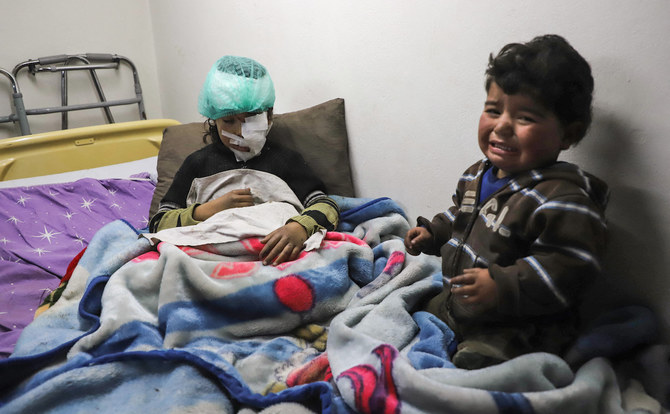
Ten-year-old Syrian child Mariam Othman, after being rescued from the rubble of a building hit by reported regime bombardment. (File/AFP)
Short Url
Updated 13 March 2023
Follow

UN Commission of Inquiry on Syria documents failure to protect country’s civilians

  • Syrian government, international community failed to deliver aid through available route within the first week following recent earthquakes, report reveals
  • Commission chairman cited Israeli attack on Aleppo International Airport, which serves as a conduit for humanitarian aid

LONDON: The UN Independent International Commission of Inquiry on Syria released its latest report documenting ongoing human rights violations throughout the country over the last six months of 2022.

The commission also said that the response to the recent massive earthquakes that struck the country was characterized by the failures of the Syrian government and international community to secure the delivery of urgent and life-saving aid to the northwest part of the country.

The commission highlighted that parties to the Syrian conflict, including the UN, failed to reach an agreement on an immediate cessation of hostilities and the facilitation of humanitarian aid through any available route in the critical first week following the earthquake.

“Syrians now need a comprehensive ceasefire that is fully respected, for civilians — including aid workers — to be safe. Incomprehensibly, due to the cruelty and cynicism of parties to the conflict, we are now investigating fresh attacks even in the very areas devastated by the earthquakes,” Paulo Pinheiro, chair of the commission, said.

Pinheiro cited last week’s reported Israeli attack on Aleppo International Airport, which serves as a conduit for humanitarian aid.

“We are currently investigating several allegations of parties to the conflict deliberately obstructing humanitarian aid to the affected communities,” said Commissioner Hanny Megally.

“As aid is now finally increasing, it is more important than ever that they consent to impartial humanitarian relief being delivered unimpeded to those in need, whether through cross-border or cross-line modalities,” he added.

Entire communities have been destroyed, with the UN estimating that some five million people require basic shelter and non-food assistance in the Syrian part of the earthquake zone. Already before the Feb. 6 earthquakes, over 15 million Syrians — more than at any point since the start of the conflict — needed humanitarian assistance.

In government-controlled areas, the report documented rising insecurity in Dara’a, Suwayda and Hama, as well as continued arbitrary detention, torture, ill-treatment, and enforced disappearances. Seizures, auctions, and restrictions on access to property were examples of property rights violations.

Civilians in the earthquake-affected northwest have been particularly vulnerable to deadly attacks in recent months.

Government forces used cluster munitions to strike densely populated displacement camps in Idlib governorate inside the opposition-held area in November, killing seven civilians and injuring at least 60 more.

Furthermore, the commission discovered that conditions for safe and dignified return are still lacking. During the reporting period, some Syrians were denied return outright, while others were arbitrarily arrested or barred from returning to government-controlled areas.


Israel’s Netanyahu agrees to join Trump’s Board of Peace

Updated 4 sec ago
Follow

Israel’s Netanyahu agrees to join Trump’s Board of Peace

  • Prime Minister Benjamin Netanyahu of Israel says he’s agreed to join Trump’s Board of Peace. Netanyahu made the announcement Wednesday from his office
  • The announcement came after Israel said the makeup of the Board’s Gaza executive body did not align with Israel’s interests
JERUSALEM: Prime Minister Benjamin Netanyahu of Israel said Wednesday he had agreed to join US President Donald Trump’s Board of Peace, after his office earlier criticized makeup of the board’s executive committee.
The board, chaired by Trump, was originally envisioned as a small group of world leaders overseeing the Gaza ceasefire plan. The Trump administration’s ambitions have appeared to balloon into a more sprawling concept, with Trump extending invitations to dozens of nations and hinting it will soon broker global conflicts.
Netanyahu’s office had previously said the executive committee — which includes Turkiye, a key regional rival — wasn’t coordinated with the Israeli government and “is contrary to its policy,” without clarifying its objections. Israel’s far-right finance minister, Bezalel Smotrich, has criticized the board and called for Israel to take unilateral responsibility for Gaza’s future.
Others who have joined the board are the UAE, Morocco, Vietnam, Belarus, Hungary, Kazakhstan and Argentina. Others, including the UK, Russia and the executive arm of the European Union, say they have received invitations but have not yet responded.
It came as Trump traveled to the World Economic Forum meeting in Davos, Switzerland, where he is expected to provide more details about the board. There are many unanswered questions. It was not immediately clear how many or which other leaders would receive invitations.
When asked by a reporter Tuesday if the board should replace the UN, Trump said, “It might.” He asserted that the world body “hasn’t been very helpful” and “has never lived up to its potential” but also said the UN should continue ”because the potential is so great.”
That has created controversy, with some saying Trump is trying to replace the UN French Foreign Minister Jean-Noel Barrot said Tuesday, “Yes to implementing the peace plan presented by the president of the United States, which we wholeheartedly support, but no to creating an organization as it has been presented, which would replace the United Nations.”
Told late Monday that French President Emmanuel Macron was unlikely to join, Trump said, “Well, nobody wants him because he’s going to be out of office very soon.” A day later, Trump called Macron “a friend of mine” but reiterated that the French leader is “not going to be there very much longer.”
The executive board’s members include US Secretary of State Marco Rubio, Trump envoy Steve Witkoff, Trump’s son-in-law Jared Kushner, former British Prime Minister Tony Blair, Apollo Global Management CEO Marc Rowan, World Bank President Ajay Banga, and Trump’s deputy national security adviser Robert Gabriel.
The White House also announced the members of another board, the Gaza Executive Board, which, according to the ceasefire, will be in charge of implementing the tough second phase of the agreement. That includes deploying an international security force, disarming Hamas and rebuilding the war-devastated territory.
Nickolay Mladenov, a former Bulgarian politician and UN Mideast envoy, is to serve as the Gaza executive board’s representative overseeing day-to-day matters. Additional members include: Witkoff, Kushner, Blair, Rowan, Turkish Foreign Minister Hakan Fidan; Qatari diplomat Ali Al-Thawadi; Hassan Rashad, director of Egypt’s General Intelligence Agency; Emirati minister Reem Al-Hashimy; Israeli businessman Yakir Gabay; and Sigrid Kaag, the Netherlands’ former deputy prime minister and a Mideast expert.
The board also will supervise a newly appointed committee of Palestinian technocrats who will be running Gaza’s day-to-day affairs.