Social Development Bank plans to support SMEs with $6bn financing over next 3 years 

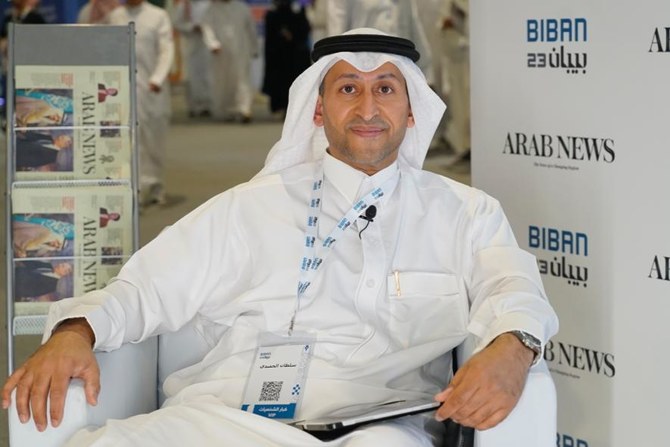
Sultan Al-Hamidi, Chief Business Officer of SDB. (AN Photo)
Short Url
Updated 12 March 2023
Follow

Social Development Bank plans to support SMEs with $6bn financing over next 3 years 

RIYADH: Saudi Arabia’s Social Development Bank aims to support small and medium-sized enterprises with SR24 billion ($6.3 billion) financing over the next three years, as the Kingdom steadily diversifies its economy in line with the goals outlined in Vision 2030, revealed a top official.  

In an interview with Arab News on the sidelines of the Biban 2023 conference, Sultan Al-Hamidi, Chief Business Officer of SDB said that the bank provided SR5 billion of financing to some 9,000 SMEs in 2022 alone.  

He said they see big growth in SMEs, and the bank has reacted to that. “Of course, we have a plan for the coming three years...we will deploy around SR24 billion.” 

In 2008, SDB started a segment of SMEs and micro-SMEs. “From that date until today, we successfully deployed around SR16 billion to 40,000 SMEs. And how do we help them? We start with them from idea until expansion,” said Al-Hamidi.  

Al-Hamidi added that SDB is providing financing to SMEs after a thorough screening process. The bank will provide money in installments, also making sure that entrepreneurs are executing business plans properly.  

“We start with them from the idea. We interview them, and we make sure that they have very good training for two weeks to make sure that they can do a feasibility study.”  

The bank also has a center called Dulani which was launched in 2016. “It is considered a clinic for SMEs, both for startups and even in the mid-age of the SME,” he added.  

As the feasibility study gets completed, the bank will issue the loan, but it will not be deployed completely.  

“We give the entrepreneur 25 percent, and then we visit. Then we deploy another 25 percent after six months. So, over two years, we have four interactions with the entrepreneur to make sure that the plan which was submitted is really executed,” explained the bank executive.  

According to Al-Hamidi, Saudi Arabia offers a strong growth opportunity for SMEs, as the Kingdom has a higher success rate average among entrepreneurs compared to global figures.  

“We did a very good job to make sure that what we are doing is right and correct. And we went with the help of GASTAT (General Authority for Statistics) to see what has happened to the SMEs that we have already financed. And luckily, we have seen a growth in Saudization, growth in employment; 81,000 jobs have been created out of these SMEs,” said Al-Hamidi.  

He further pointed out that 30 percent of these employees were women, which indicates that the gender gap is reducing due to the growth of SMEs in the Kingdom.  

Some of the goals outlined in Vision 2030 include lowering the unemployment rate from 11.6 percent to 7 percent, increasing women’s participation in the workforce from 22 percent to 30 percent, and expanding SME contribution to 35 percent of gross domestic product by the end of this decade. 


Arab food and beverage sector draws $22bn in foreign investment over 2 decades: Dhaman 

Updated 28 December 2025
Follow

Arab food and beverage sector draws $22bn in foreign investment over 2 decades: Dhaman 

JEDDAH: Foreign investors committed about $22 billion to the Arab region’s food and beverage sector over the past two decades, backing 516 projects that generated roughly 93,000 jobs, according to a new sectoral report. 

In its third food and beverage industry study for 2025, the Arab Investment and Export Credit Guarantee Corp., known as Dhaman, said the bulk of investment flowed to a handful of markets. Egypt, Saudi Arabia, the UAE, Morocco and Qatar attracted 421 projects — about 82 percent of the total — with capital expenditure exceeding $17 billion, or nearly four-fifths of overall investment. 

Projects in those five countries accounted for around 71,000 jobs, representing 76 percent of total employment created by foreign direct investment in the sector over the 2003–2024 period, the report said, according to figures carried by the Kuwait News Agency. 

“The US has been the region's top food and beverage investor over the past 22 years with 74 projects or 14 projects of the total, and Capex of approximately $4 billion or 18 percent of the total, creating more than 14,000 jobs,” KUNA reported. 

Investment was also concentrated among a small group of multinational players. The sector’s top 10 foreign investors accounted for roughly 15 percent of projects, 32 percent of capital expenditure and 29 percent of newly created jobs.  

Swiss food group Nestlé led in project count with 14 initiatives, while Ukrainian agribusiness firm NIBULON topped capital spending and job creation, investing $2 billion and generating around 6,000 jobs. 

At the inter-Arab investment level, the report noted that 12 Arab countries invested in 108 projects, accounting for about 21 percent of total FDI projects in the sector over the past 22 years. These initiatives, carried out by 65 companies, involved $6.5 billion in capital expenditure, representing 30 percent of total FDI, and generated nearly 28,000 jobs. 

The UAE led inter-Arab investments, accounting for 45 percent of total projects and 58 percent of total capital expenditure, the report added, according to KUNA. 

The report also noted that the UAE, Saudi Arabia, Egypt, and Qatar topped the Arab ranking as the most attractive countries for investment in the sector in 2024, followed by Oman, Bahrain, Algeria, Morocco, and Kuwait. 

Looking ahead, Dhaman expects consumer demand to continue rising. Food and non-alcoholic beverage sales across 16 Arab countries are projected to increase 8.6 percent to more than $430 billion by the end of 2025, equivalent to 4.2 percent of global sales, before exceeding $560 billion by 2029. 

Sales are expected to remain highly concentrated geographically, with Egypt, Saudi Arabia, Algeria, the UAE and Iraq accounting for about 77 percent of the regional total. By product category, meat and poultry are forecast to lead with sales of about $106 billion, followed by cereals, pasta and baked goods at roughly $63 billion. 

Average annual per capita spending on food and non-alcoholic beverages in the region is projected to rise 7.2 percent to more than $1,845 by the end of 2025, approaching the global average, and to reach about $2,255 by 2029. Household spending on these products is expected to represent 25.8 percent of total expenditure in 13 Arab countries, above the global average of 24.2 percent. 

Arab external trade in food and beverages grew more than 15 percent in 2024 to $195 billion, with exports rising 18 percent to $56 billion and imports increasing 14 percent to $139 billion. Brazil was the largest foreign supplier to the region, exporting $16.5 billion worth of products, while Saudi Arabia ranked as the top Arab exporter at $6.6 billion.