UK Gulf War veterans to launch compensation claims after letter discovery

1 / 2
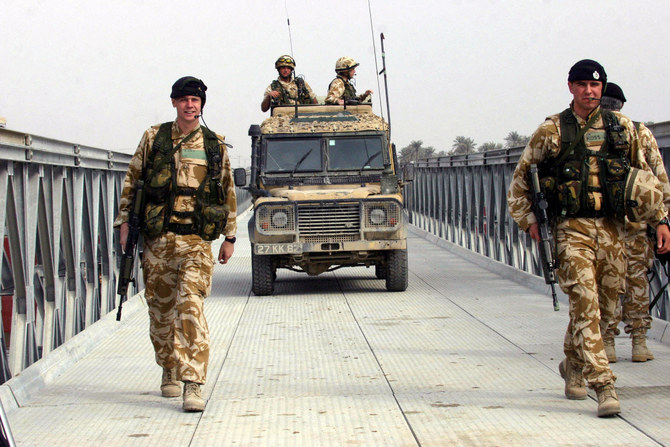
British soldiers are seen during the inaugural opening of a bridge on January 17, 2005, in Iraq's southern city of Basra, 500 km south of Baghdad. (AFP/file photo)
2 / 2
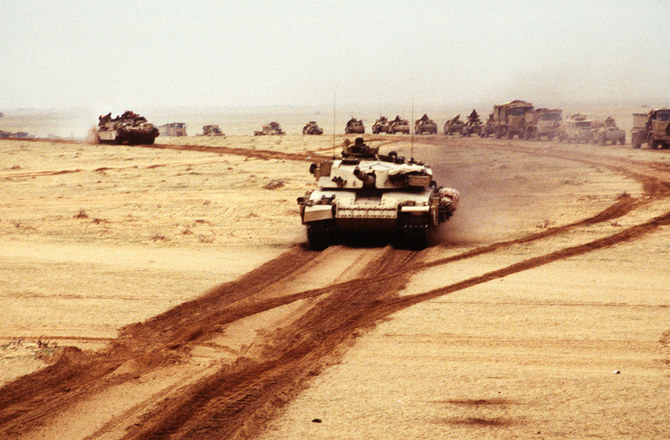
A British Challenger 1 main battle tank moves along with other Allied armor during Operation Desert Storm in Iraq in 1991. (Wikimedia Commons)
Short Url
Updated 11 March 2023
Follow

UK Gulf War veterans to launch compensation claims after letter discovery

  • Third of surveyed personnel report lifelong symptoms associated with Gulf War Syndrome
  • Uncovered government letter states no time limit on legal claims

LONDON: British veterans of the Gulf War suing the government over alleged anti-chemical weapons vaccine side effects have discovered a letter that could grant them the legal right to launch a major lawsuit against the UK Ministry of Defence, the Daily Telegraph reported on Saturday.

Members of the veteran group say they continue to suffer from so-called Gulf War Syndrome, which causes chronic fatigue, joint pain, headaches and memory loss, among other symptoms.

About 17,000 of the 51,000 UK personnel who served in the conflict have suffered symptoms associated with the syndrome, which veterans say began after they were administered vaccines designed to lessen the effects of chemical and biological weapons.

The veterans have sought to launch legal action against the government since the end of the war in 1991.

In 2004, more than 2,000 veterans launched a case for millions of pounds in compensation for Gulf War Syndrome, but the case collapsed due to a lack of scientific evidence surrounding the disorder.

However, the newly uncovered letter by advisers to former Prime Minister John Major’s government could give the green light to new legal action.

The letter states that no time limit was to be placed on any court case launched following the conflict.

Several retired civil servants who served in Whitehall at the time of the war are also coming forward to help the veterans group launch the legal action.

The veterans’ legal team, led by Hilary Meredith-Beckham, founder of Hilary Meredith Solicitors, is set to file more than 200 compensation claims.

Meredith-Beckham, who has represented Gulf War veterans since the end of the conflict, discovered the letter in her own archives.

She told the Telegraph: “We have a letter from the treasury solicitor dating back to 1997 in which they confirm that limitation — a legally specified period beyond which an action may be defeated — will not be raised as a defense.

“A legal remedy for those affected so long ago and still suffering is long overdue. It is time for the Ministry of Defence to honor its responsibilities to those who gave so much.”

She added that the aid of the retired civil servants was needed to help in the compensation claims.

“Over time, those involved in decision making have retired from post and perhaps reflected on their role in the Gulf War and the legacy issues caused as a result,” she said.

“We sent men and women into a highly toxic environment without understanding how to adequately protect them.”

A spokesperson for the Ministry of Defence said: “We cannot comment on ongoing litigation. We are however indebted to all those who served our country in the Gulf wars and have already sponsored significant research into the effects of this conflict on veterans.”


Guatemalans enter state of siege over surge in gang violence

Updated 2 sec ago
Follow

Guatemalans enter state of siege over surge in gang violence

GUATEMALA CITY: Streets were half-empty Monday in the capital city of Guatemala, where outrage and fear lingered during the first day of the 30-day state of emergency decreed by the government in response to the murder of nine police officers and riots in several prisons.
On Sunday, suspected members of the notorious Barrio 18 gang carried out a wave of attacks on the police after security forces put down a prison mutiny.
Eight officers were killed on Sunday and a ninth died of his injuries on Monday.
President Bernardo Arevalo declared a 30-day emergency on Sunday over the violence, which caused deep shock among Guatemalans.
On Monday, he presided over a memorial ceremony for the slain police officers at the interior ministry.
The streets of the capital Guatemala City were semi-deserted and private schools, courts and universities remained shuttered.
Sitting on a bench in the historic center of Guatemala City, an octogenarian told AFP that he believed the only way to stamp out criminal gangs was by “burning them.”
“A criminal caught, a criminal killed, because there’s no other way...It’s like a tree; if you don’t pull out the roots, it will sprout again,” the man, who gave only his last name, Espana, said.
He called for Guatemala’s government to emulate the iron-fisted policies of President Nayib Bukele of neighboring El Salvador.
Bukele has imprisoned tens of thousands of men without charge, as part of a war on gangs which has led to a sharp drop in El Salvador’s murder rate but caused an outcry over human rights abuses.
Alejandra Donis, a 30-year-old shopkeeper, also held Bukele up as an example of leadership.
“There was a point in El Salvador where it was scary to just go out, right? And now it’s a place that’s quite touristy; you can go there, and it feels peaceful,” she said.

- ‘The Wolf’ -

The unrest in Guatemala began when inmates at three prisons took 45 guards and a psychiatrist hostage on Saturday to demand gang leaders be transferred from a maximum-security prison to more lenient facilities.
On Sunday, the police and army stormed all three penitentiaries and restored control.
After the first prison raid, the interior ministry published a video on X showing officers handcuffing and leading away Barrio 18’s alleged leader in Guatemala, whom authorities identified as Aldo Dupie, alias “El Lobo” (The Wolf).
In response to the crackdown, gang members attacked police stations and patrols.
The coffins of the slain police officers were draped in Guatemalan blue-and-white flags at the interior ministry and flanked by colleagues in uniform, standing to attention.
Arevalo, dressed in a black suit, greeted the grieving relatives, hugging some.

- FBI help sought -

Barrio 18 and the rival gang Mara Salvatrucha (MS-13) are blamed for much of the drug trafficking and criminal violence that plague Central America.
Washington has declared both to be terrorist organizations.
Arevalo said the declared state of emergency would allow the police and army to act against organized crime, but soldiers remained in their barracks on Monday, awaiting orders.
Since mid-2025, gang members have staged several uprisings in Guatemalan prisons to demand their leaders be held in less restrictive conditions.
In October, 20 leaders of Barrio 18 escaped from prison.
Only six have been recaptured, while another was shot and killed.
The government at the time asked for the help of the FBI to track down the remaining escapees.
Across Latin America, gang members continue to run criminal enterprises, from drug trafficking rings to extortion rackets, from behind bars — often with the collusion of corrupt prison officials.