

Usyk accepts Fury’s terms for fight to be undisputed champ

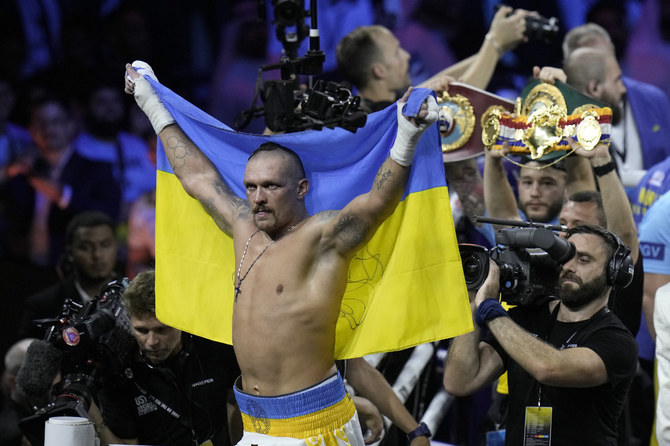
Ukraine's Oleksandr Usyk after beating Britain's Anthony Joshua to retain his world heavyweight title at King Abdullah Sports City  on Aug. 21, 2022.  Usyk took to social media on Friday to accept Tyson Fury’s terms for a fight for the undisputed world heavyweight title. (AP/file photo)
Short Url
Updated 11 March 2023
Follow

Usyk accepts Fury’s terms for fight to be undisputed champ

  • Usyk accepted the 70-30 split and included a caveat about Fury making a donation of £1 million ($1.2 million) to those affected by the war in Ukraine

LONDON: Oleksandr Usyk took to social media on Friday to accept Tyson Fury’s terms for a fight to become undisputed world heavyweight champion.

Time appeared to be running out to arrange a deal between the titleholders for a proposed April 29 fight in London, with Usyk’s promoter, Alex Krassyuk, saying their latest offer — a 60-40 split to the winner — was rejected by Fury and his camp.

That prompted Fury, the WBC champion, to publish a video on Instagram on Friday, saying he would fight only if there was a 70-30 split of earnings from the bout in his favor.

“I see all this talk about boxing fights, that they want 50 percent, Tyson being greedy,” Fury said. “Where I’m standing: Usyk, you and your team are worth 30 percent.

“You either take it or leave it.”

Usyk, a Ukrainian former cruiserweight champion who owns the WBA, IBF and WBO belts at heavyweight, responded with his own video on Twitter. He accepted that split and included a caveat about Fury making a donation of £1 million ($1.2 million) to those affected by the war in Ukraine.

“Hey, greedy belly,” Usyk said. “I accept your offer — 70-30 split the fight with you on April 29 at Wembley (Stadium).

“But you will promise to donate to Ukraine immediately after the fight, 1 million pounds. And for every day of your delay you will pay 1 percent from your purse to Ukrainian people. Deal?”

That appeared to be a riposte to Fury saying he would deduct 1 percent of the 30 percent offered to Usyk for every day the Ukrainian boxer doesn’t commit to the fight.

Krassyuk had said Usyk could instead fight British boxer Daniel Dubois, who holds the WBA regular title and is a mandatory challenger for Usyk.

“If you don’t want it, go and fight Daniel Dubois in the Copper Box (in London) and get a few million dollars,” Fury said on Instagram. “If you want to make some real money, come and fight the Gypsy King.”

The last heavyweight to be the undisputed world champion was Lennox Lewis in 1999-2000.


Arab Cup 2025 attendance surpasses recent AFCON and AFC Asian Cup

Updated 5 sec ago
Follow

Arab Cup 2025 attendance surpasses recent AFCON and AFC Asian Cup

  • The tournament, held under FIFA jurisdiction for the second time, achieved a record average attendance of 38,644 fans per match
  • Total attendance more than doubled since 2021, with Algeria vs. UAE quarter-final pushing it past one million spectators

RIYADH: For a tournament often dismissed by critics as little more than a friendly or “B-team” competition, the 2025 Arab Cup delivered a compelling response.

A total of 1,236,600 people attended the 32 matches across the tournament, an average of 38,644 spectators per game, as the Arab Cup returned to Qatar for a second consecutive time after its successful staging in 2021. That earlier tournament, initially launched as a Confederations Cup-like test event ahead of the World Cup, drew 571,605 spectators in total.

Despite those figures, the Arab Cup has faced persistent criticism. Questions have been raised around the quality of play and refereeing standards, with some supporters – both within and beyond the Arab world – branding the tournament “meaningless.”

Yet when placed alongside recent continental competitions, the attendance figures tell a different story.

The 2023 African Cup of Nations in Ivory Coast attracted 1,109,593 fans across 52 matches, an average of 21,338 per game. Meanwhile, the 2023 AFC Asian Cup, also hosted in Qatar, recorded 1,507,790 spectators over 51 matches — roughly 29,565 per game, the highest average in the competition’s history.

Direct comparisons, however, require context. Continental — as opposed to regional — competitions draw support from across vast geographies, while the Arab Cup benefits from strong expatriate communities based in the host nation. Expecting the same travel patterns from fans in East Asia or West Asia would be, to say the least, unrealistic.

Even so, the attendance of more than 38,000 fans per game is significant. The Arab Cup was not always popular, with the attendance in 2021 struggling to rise above an average of 17,000 per game. Only four games at the 2025 edition fell below the 20,000 mark.

Historical context further underlines this shift. The 2011 AFC Asian Cup in Qatar, along with multiple editions of the West Asian Football Federation Championship held across the region, struggled to surpass a figure of 13,000 fans per game.

While Morocco will bask in the glory of the 2025 Arab Cup, the tournament itself has shown a broader shift in football engagement across the Arab World — one no longer driven solely by interest in European leagues, but by growing confidence in domestic teams, national projects and regional competitions.

From Saudi Arabia’s ambitions in club football to Morocco’s recent international success and Qatar’s continued role as a host, momentum continues to build across the Middle East and North Africa, with the Arab Cup one of the latest competitions offering tangible evidence of that change.