

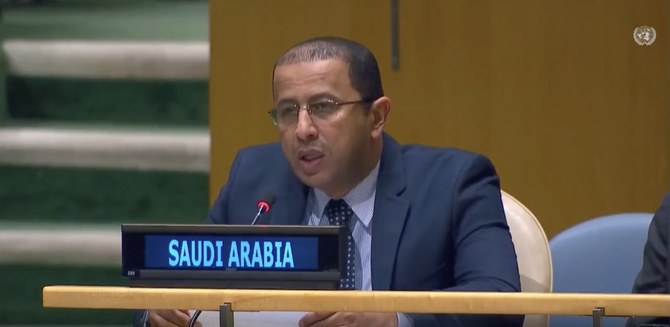

NEW YORK CITY: Saudi Arabia on Friday called on all UN member states to condemn violence against Muslims, and to promote a culture of peace that rejects discrimination and extremism and fosters the mutual respect required for peace and understanding.
Mohammed Alateek, the Kingdom’s deputy permanent representative to the UN was speaking at a high-level UN General Assembly event ahead of the first International Day to Combat Islamophobia, on March 15.
The UN event was organized by Pakistan, which currently holds the rotating presidency of the Organization of Islamic Cooperation, and General Assembly President Csaba Korosi.
It called for international cooperation in efforts to combat discrimination, xenophobia, intolerance and violence against peoples based on their religion or beliefs, including rhetoric that “leads to racial profiling, discrimination, negative stereotyping and stigmatization of Muslims,” organizers said.
Another aim was to promote international action to encourage global dialogue that promotes a culture of tolerance that is rooted in respect for human rights, they added.
Speaking on behalf of members of the Arab Group at the UN, Alateek said the large turnout in the Assembly Hall for the event on Friday reflected the solidarity that exists between the wider international community and Muslims in the fight against Islamophobia.
The Arab Group believes observance of an International Day to Combat Islamophobia will help to strengthen dialogue, promote a culture of peace and enhance respect for human rights, said Alateek.
“This is an important occasion that allows us to highlight all of the manifestations of hatred and Islamophobia against Muslims, which sometimes lead to abominable acts, the (most recent) of which were (those) perpetrated in Sweden (by) a group of extremists,” he added.
In January, a far-right activist from Denmark was granted permission by Swedish police to stage a protest outside the Turkish Embassy in Stockholm, during which he burned a copy of the Qur’an and made disparaging remarks about immigrants and Islam.
Alateek urged the international community to condemn such extremist acts, to “serve as a basis for the promotion of a culture of peace to combat discrimination and extremism and to strengthen dialogue between cultures and religions in order to establish peace and security and mutual respect.”
This is a prerequisite, he added, for an environment that is conducive to peace and understanding at the regional and international levels.
In his opening statement at the event, Pakistani Foreign Minister Bilawal Bhutto Zardari, who is the current chair of the Organization of Islamic Cooperation’s Council of Ministers, highlighted some of the ways in which Islamophobia persists and often goes unreported.
“The dangers of Islamophobia often gain international attention when a heinous act of violence and terrorism strikes innocent Muslims, while the daily, silent drip of discrimination, hatred and hostility against Muslims remains largely ignored and underreported,” said Bhutto Zardari.
He called for the appointment of a UN special envoy for combating Islamophobia, along with “the adoption of international measures for the protection of holy sites; the adoption of laws to outlaw hate speech; the provision of legal assistance and appropriate compensation; and the establishment of national and international judicial mechanisms and laws to hold those responsible for acts of Islamophobia accountable.”
A UN resolution proclaiming March 15 as International Day to Combat Islamophobia was unanimously adopted by the General Assembly on that date in 2022. It was chosen because it is the anniversary of the attacks on two mosques by a lone gunman in Christchurch, New Zealand, in 2019 that left 51 people dead and 40 injured.
When the resolution was introduced, the representative from Pakistan said that Islamophobia has emerged as a new form of racism that includes, among other things, discriminatory travel bans, hate speech, and the targeting of girls and women for the ways in which they dress.
The text of the resolution called on the international community to encourage tolerance and peace that is rooted in respect for human rights and the diversity of religions and beliefs.
Alateek said the resolution illustrated the need “to pool our efforts, at the international level, to take serious measures to bring an end to discrimination and hatred and Islamophobia.”
He reiterated, in the name of Arab Group members, the call for all UN member states to ensure the resolution is implemented “in its entirety, because it is a question of our shared civilization and we have the obligation to combat discrimination based on religion.”
UN Secretary-General Antonio Guterres said during Friday’s event that the nearly 2 billion Muslims in the world reflect humanity in all its magnificent diversity but they often face bigotry and prejudice “for no other reason than their faith.”
He added that the connection between anti-Muslim hatred and gender inequality is undeniable.
“We see some of the worst impacts in the triple discrimination against, mostly, women because of their gender, ethnicity and faith,” Guterres told the gathering.
“The growing hate that Muslims face is not an isolated development. It is an inexorable part of the resurgence of ethno-nationalism, neo-Nazi white supremacist ideologies, and violence targeting vulnerable populations including Muslims, Jews, some minority-Christian communities, and others.”
He added that discrimination “diminishes us all and it is incumbent on all of us to stand up against it.”
Alateek commended the efforts of the president of the General Assembly “to strengthen the values of religious tolerance,” along with those of the secretary-general, and the office of the UN’s Alliance of Civilizations.
He concluded by pointing out the need to combat Islamophobia is part and parcel of the purpose and principles of the UN, beginning with the pursuit of peace, security and the protection of human rights.


