

‘Major breakthrough’ in UN effort to salvage oil tanker in Yemen and prevent environmental disaster

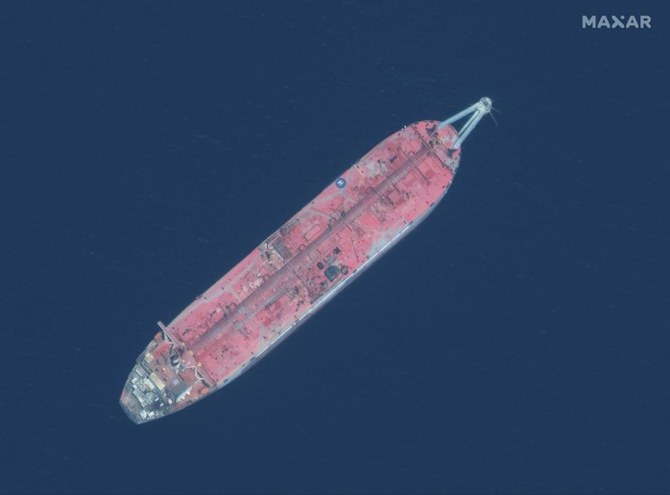
The Safer contains 1.1 million barrels of oil — four times as much as that spilled in the 1989 Exxon Valdez disaster, one of the world’s worst ecological catastrophes. (File/AFP)
Short Url
Updated 10 March 2023
Follow

‘Major breakthrough’ in UN effort to salvage oil tanker in Yemen and prevent environmental disaster

  • UN Development Program chief told Arab News it cost “a painful” $55m to buy a vessel to hold the 48m gallons of oil; renews appeal for cash to fund rest of the operation 
  • The new ship is in dry dock for regular maintenance and is expected to set sail for Yemen within a month; ship-to-ship transfer of oil could begin as early as May

NEW YORK CITY: The UN on Thursday announced it has signed an agreement with Belgian shipping company Euronav for the purchase of a Very Large Crude Carrier to use in its salvage operation to remove more than a million barrels of oil from the Safer, a derelict storage vessel moored in the Red Sea off the Yemeni coast, and avoid a massive environmental disaster.

The 47-year-old Safer has had little or no maintenance since the war in Yemen began in 2015 and has deteriorated to the point where experts warn it is in danger of springing a leak, exploding or catching fire.

It contains about 48 million gallons of oil, and the UN has warned that a spill could be four times bigger than the 1989 Exxon Valdez disaster off the coast of Alaska, which is considered the world’s worst oil spill in terms of environmental damage. 

Achim Steiner, administrator of the UN Development Program, told Arab News that the vessel purchased by the UN cost “a painful $55 million,” after the agency searched in vain for a donated vessel or one that could be leased.

“The market clearly is so hot that, in the end, we had to conclude that the only way that we could advance rather than wait for someone’s generosity was to take the decision to not just charter the vessel but actually purchase it,” he said.

Experts estimate a major leak from the Safer could severely damage Red Sea ecosystems upon which about 30 million people depend for a living, including 1.6 million Yemenis, according to the UN. It would, for example, devastate fisheries along Yemen’s west coast and destroy livelihoods in fishing communities, many of which are already dependent on humanitarian aid to survive because of the war. If a fire broke out, more than 8.4 million people could be exposed to toxic pollutants.

A spill could also disrupt commercial shipping on the Red Sea, one of the world’s busiest waterways, which accounts for 10 percent of all global trade. It could also adversely affect littoral countries such as Saudi Arabia, Djibouti and Eritrea.

Steiner said the 15-year-old vessel purchased by the UN is in dry dock for regular maintenance and will sail within the next month to Yemen. Ship-to-ship transfer of oil could begin as soon as May.

The UNDP, which is organizing the operation as part of a UN-coordinated initiative, has contracted marine salvage company Smit to safely remove the oil and prepare the Safer for towing to a green salvage yard.

The salvage operation has been split into two phases: The oil will be transferred to the new vessel and then moved to a permanent storage facility until the political situation in Yemen allows for it to be sold or moved elsewhere.

David Gressly, the UN’s resident coordinator for Yemen, told Arab News that the original plan was to lease a salvage vessel but no supplier was willing to venture into an area that is “still in the midst of a civil war, even though the situation has calmed down considerably over the last year. That’s the primary reason. We had no choice, frankly, but to buy a vessel.”

The estimated cost of the salvage operation is $129 million, of which $75million has been secured so far.

Gressly made an urgent appeal for donors to provide the remaining cash.

“We’ve got almost all of the pieces together,” he said. “Let us have the last bit of funding and save hundreds of thousands of communities from the harm that this vessel could ultimately cause us.”


Trump warns Iran of ‘very traumatic’ outcome if no nuclear deal

Updated 5 sec ago
Follow

Trump warns Iran of ‘very traumatic’ outcome if no nuclear deal

WASHINGTON: US President Donald Trump threatened Iran Thursday with “very traumatic” consequences if it fails to make a nuclear deal — but Israeli Prime Minister Benjamin Netanyahu said he was skeptical about the quality of any such agreement.
Speaking a day after he hosted Netanyahu at the White House, Trump said he hoped for a result “over the next month” from Washington’s negotiations with Tehran over its nuclear program.
“We have to make a deal, otherwise it’s going to be very traumatic, very traumatic. I don’t want that to happen, but we have to make a deal,” Trump told reporters.
“This will be very traumatic for Iran if they don’t make a deal.”
Trump — who is considering sending a second aircraft carrier to the Middle East to pressure Iran — recalled the US military strikes he ordered on Tehran’s nuclear facilities during Israel’s 12-day war with Iran in July last year.
“We’ll see if we can get a deal with them, and if we can’t, we’ll have to go to phase two. Phase two will be very tough for them,” Trump said.
Netanyahu had traveled to Washington to push Trump to take a harder line in the Iran nuclear talks, particularly on including the Islamic Republic’s arsenal of ballistic missiles.
But the Israeli and US leaders apparently remained at odds, with Trump saying after their meeting at the White House on Wednesday that he had insisted the negotiations should continue.

- ‘General skepticism’ -

Netanyahu said in Washington on Thursday before departing for Israel that Trump believed he was laying the ground for a deal.
“He believes that the conditions he is creating, combined with the fact that they surely understand they made a mistake last time when they didn’t reach an agreement, may create the conditions for achieving a good deal,” Netanyahu said, according to a video statement from his office.
But the Israeli premier added: “I will not hide from you that I expressed general skepticism regarding the quality of any agreement with Iran.”
Any deal “must include the elements that are very important from our perspective,” Netanyahu continued, listing Iran’s ballistic missile program and its support for armed groups such as the Palestinian movement Hamas, Yemen’s Houthi rebels and Hezbollah in Lebanon.
“It’s not just the nuclear issue,” he said.
Despite their differences on Iran, Trump signaled his strong personal support for Netanyahu as he criticized Israeli President Isaac Herzog for rejecting his request to pardon the prime minister on corruption charges.
“You have a president that refuses to give him a pardon. I think that man should be ashamed of himself,” Trump said on Thursday.
Trump has repeatedly hinted at potential US military action against Iran following its deadly crackdown on protests last month, even as Washington and Tehran restarted talks last week with a meeting in Oman.
The last round of talks between the two foes was cut short by Israel’s war with Iran and the US strikes.
So far, Iran has rejected expanding the new talks beyond the issue of its nuclear program. Tehran denies seeking a nuclear weapon, and has said it will not give in to “excessive demands” on the subject.