

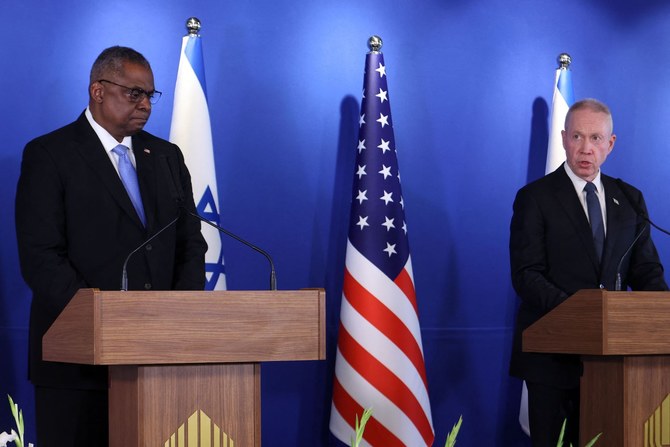

RAMALLAH: US Secretary of Defense Lloyd Austin told Israeli leaders on Thursday to take steps to reduce tensions in the occupied West Bank, amid growing worries in Washington that the situation could distract the allies from their efforts to counter threats from Iran.
The Pentagon chief, who is on a regional tour, landed at Ben Gurion Airport for a visit that had been hastily rescheduled due to a surge in street protests against Israeli Prime Minister Benjamin Netanyahu’s plan to overhaul the judiciary.
Hours earlier, Israeli forces killed three Palestinian militants in the West Bank in the latest outbreak of violence in the region.
A Pentagon statement about Austin’s meeting with Netanyahu said: “Secretary Austin called for a halt in unilateral actions that undermine the enduring goal of two states, with Palestinians and Israelis enjoying equal measures of freedom, security, opportunity, justice, and dignity.”
Austin and Netanyahu’s meeting at the airport lasted for more than an hour.
“Secretary Austin is perfectly capable of having conversations about both issues [West Bank and Iran],” a senior US defense official, preferring anonymity, told Reuters.
However, the official added that Israel’s preoccupation with the West Bank “detracts from our ability to focus on what the strategic threat is right now, and that is Iran’s dangerous nuclear advances and continuing regional and global aggression.”
Palestinians in Jenin expressed outrage over the killing of three Palestinians in the village of Jaba, south of Jenin, early on Thursday.
The killings brought the number of Palestinians killed by Israelis since the beginning of the year to 78, including 14 children and a woman, 33 of them from the Jenin area.
Palestinian Authority officials and leaders strongly condemned Israel’s belligerence, and vowed retaliation.
Jenin Gov. Maj. Gen. Akram Rajoub told Arab News that the aim of the disproportionate use of force against Jenin was to break Palestinian will and to intimidate residents in the rest of the cities so that they would not resist the occupation.
Rajoub said the Israeli military measures constituted a collective punishment for Palestinians.
He added: “The Israelis must realize that no matter how much terror they use against the Palestinian people, they will not be able to break their will.”
Meanwhile, Saudi Foreign Minister Prince Faisal bin Farhan has stressed the importance of reaching a just solution to the Palestinian cause to achieve stability in the Middle East.
During a joint press conference with his Russian counterpart in Moscow, the Saudi minister praised the Russian position on the Palestinian cause and its continued support for international resolutions and the Arab peace initiative.
He said the situation in Palestine was worrying due to the dangerous escalation by Israel, which made it imperative to search for a way to restore the path of dialogue to achieve peace.
Palestinian activists have posted a video of gunmen shooting down a Thor drone during the Jenin operation.
Palestinian fighters target Israeli drones in the West Bank, and the Thor flies at low altitudes to photograph potential target areas.
Israeli forces last October used more than 20 drones in Al-Yasmina neighborhood, in the old city of Nablus, to target the Lions’ Den group, resulting in several casualties.
Separately, an internal debate is going on among Palestinians about the effectiveness of their protests against Israel.
Abdul-Muneim Wahdan, assistant vice president of the Fatah movement, told Arab News that strikes were an ancient method of protest and no longer effective.
He said: “It is indeed important to express our anger at the fall of martyrs, but if these martyrs were alive, they would not be happy to see that we declare a strike to express our respect for them.
“When we close the city, we protest against whom? We only punish Palestinian society and add to its burdens. A strike is no longer an appropriate form of expressing our anger at the fall of the martyrs.
“Perhaps the strike method would be more effective if used in East Jerusalem and Palestinian cities and towns inside Israel, but not in Ramallah because the closed shops are to serve the Palestinian community.”


