

4 kidnapped Americans crossed into Mexico to buy medicine

1 / 4
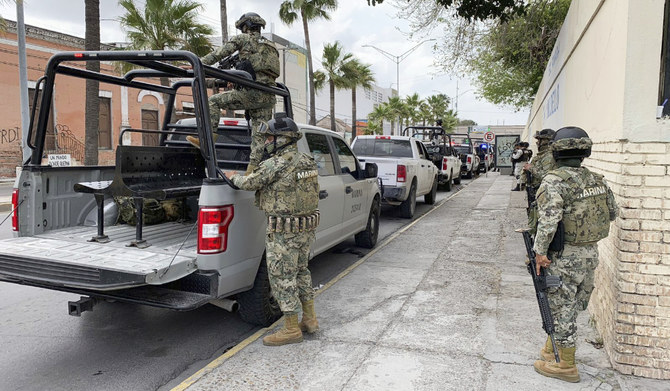
Mexican army soldiers prepare a search mission for four U.S. citizens kidnapped by gunmen at Matamoros, Mexico, Monday, March 6, 2023. (AP)
2 / 4
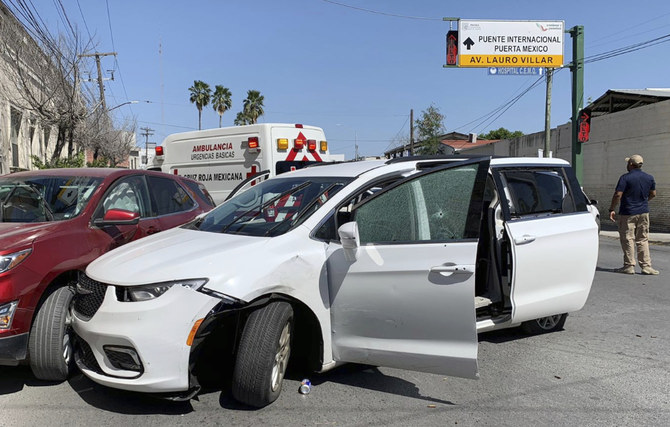
A member of the Mexican security forces stands next to a white minivan with North Carolina plates and several bullet holes, at the crime scene where gunmen kidnapped four U.S. citizens who crossed into Mexico from Texas, Friday, March 3, 2023. (AP)
3 / 4
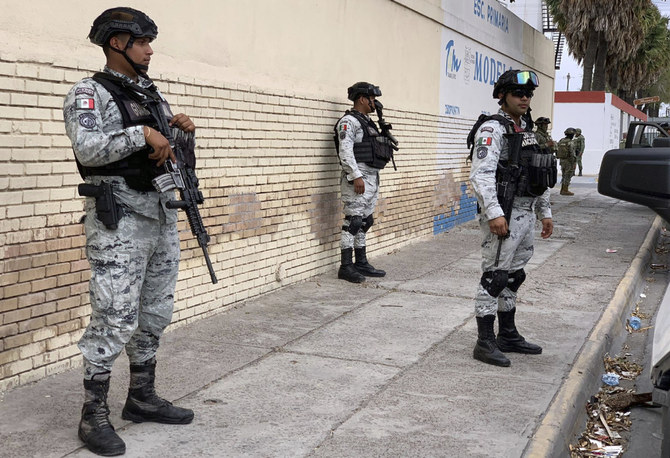
Mexican Natioanla Guard prepare a search mission for four U.S. citizens kidnapped by gunmen at Matamoros, Mexico, Monday, March 6, 2023. (AP)
4 / 4
Mexican army soldiers prepare a search mission for four U.S. citizens kidnapped by gunmen at Matamoros, Mexico, Monday, March 6, 2023. (AP)
Short Url
Updated 07 March 2023
Follow

4 kidnapped Americans crossed into Mexico to buy medicine

  • Mexican President Andrés Manuel López Obrador said Monday the four were going to buy medicine, “there was a confrontation between groups, and they were detained,” without offering details

CIUDAD VICTORIA, Mexico: Gunmen kidnapped four US citizens who crossed into Mexico from Texas last week to buy medicine but were caught in a shootout that killed at least one Mexican citizen, US and Mexican officials said Monday.
The four were in a white minivan with North Carolina license plates. They came under fire on Friday shortly after entering the city of Matamoros from Brownsville, the southernmost tip of Texas near the Gulf coast, the FBI said in a statement Sunday.
“All four Americans were placed in a vehicle and taken from the scene by armed men,” the FBI said. The bureau is offering a $50,000 reward for the victims’ return and the arrest of the kidnappers.
Mexican President Andrés Manuel López Obrador said Monday the four were going to buy medicine, “there was a confrontation between groups, and they were detained,” without offering details.
A woman driving in Matamoros witnessed what appeared to be the shooting and abduction in broad daylight. She asked not to be identified for fear of reprisal.
The scene illustrates the terror that has prevailed for years in Matamoros, a city dominated by factions of the Gulf cartel who often fight among themselves. Amid the violence, thousands of Mexicans have disappeared just in Tamaulipas state, where Matamoros is located.
The woman said she saw the white minivan get hit by another vehicle near an intersection, then gunfire rang out.
Another SUV rolled up and several armed men hopped out.
“All of a sudden they (the gunmen) were in front of us,” she said. “I entered a state of shock, nobody honked their horn, nobody moved. Everybody must have been thinking the same thing, ‘if we move they will see us, or they might shoot us.’”
She said the gunmen forced a woman, who was able to walk, into the back of a pickup truck. Another person was carried to the truck but could still move his head.
“The other two they dragged across the pavement, we don’t know if they were alive or dead,” she said.
Mexican authorities arrived minutes later.
A video posted to social media Friday shows men with assault rifles and tan body armor loading the four people into the bed of a white pickup. One is alive and sitting up, but the others seemed either dead or wounded. At least one person appeared to lift his head from the pavement before being dragged to the truck.
Shootouts in Matamoros were so bad on Friday that the US Consulate issued an alert about the danger. Local authorities warned people to shelter in place. It was not immediately clear how the abductions may have been connected to that violence.
US Ambassador to Mexico Ken Salazar said in a statement Monday the Americans were kidnapped at gunpoint and an “innocent” Mexican citizen died in the attack. He said various US justice agencies were working with their Mexican counterparts to recover the missing persons.
Authorities have provided no other details about who the victims were or where they were from.
President Joe Biden had been informed of the situation, White House press secretary Karine Jean-Pierre said Monday. She declined to answer other questions, citing privacy concerns.
Tamaulipas’ chief prosecutor, Irving Barrios, told reporters that a Mexican woman died in Friday’s shootings. He gave no details about her death and did not specify whether she was killed in the same gunfight where the kidnapping took place.
Tamaulipas state police said on social media there were “two armed incidents between unidentified civilians” on Friday.
Victims of violence in Matamoros and other large border cities of Tamaulipas often go uncounted because the cartels have a history taking bodies of their own with them. Local media often avoid reporting on such episodes out of safety concerns, creating an information vacuum.
Photographs from the scene viewed by The Associated Press show a white minivan with the driver’s side window shot out and all of the doors open, sitting on the side of a street after apparently colliding with a red SUV.
The State Department warns US citizens not to travel to Tamaulipas. However, being a border city, US citizens who live in Brownsville or elsewhere in Texas frequently cross to visit family, attend medical appointments or shop. It’s also a crossing point for people traveling deeper into Mexico.
As the headquarters of the powerful Gulf cartel, Matamoros was once relatively calm. For years, a night out in the city was part of the “two-nation vacation” for spring breakers flocking to Texas’ South Padre Island.
But increased cartel violence over the past 10 to 15 years frightened away much of that business. Sometimes US citizens are swept up in the fighting.
Three US siblings disappeared near Matamoros in October 2014 while visiting their father and were later found shot to death and burned. Their parents said they had been abducted by men dressed in police gear identifying themselves as “Hercules,” a tactical security unit in the city.


India joins US-led initiative to build secure technology supply chains powering AI 

Updated 5 sec ago
Follow

India joins US-led initiative to build secure technology supply chains powering AI 

  • Pax Silica was launched in December by the US Department of State
  • Joining initiative gives Delhi opportunity to help shape global AI order, says expert 

NEW DELHI: India joined a US-led initiative on Friday which will strengthen technology and supply chain cooperation and further boost the development of artificial intelligence infrastructure, making New Delhi the latest member alongside countries including Japan, South Korea, Qatar and the UAE.

The US Department of State launched the Pax Silica Declaration in December, with the aim of securing the global supply chain for silicon-based technologies that are crucial for AI infrastructure and deepen partnerships on artificial intelligence. 

India, represented by S. Krishnan, secretary at the Ministry of Electronics and Information, signed the declaration on the sidelines of the AI Impact Summit in New Delhi. 

“The signing at the India AI Impact Summit underscored a clear message: The future of artificial intelligence and advanced technologies will not be left to chance. It will be built deliberately, by nations committed to freedom, partnership, and long-term resilience,” the ministry said in a statement. 

India’s entry into Pax Silica was both “strategic and essential,” said US Ambassador to India Sergio Gor. 

“Pax Silica is the coalition that will define the 21st century economic and technological order,” he said during the signing ceremony. 

“It is designed to secure the entire silicon stack, from the mines where we extract critical minerals, to the fabs where we manufacture chips, to the data centers where we deploy frontier AI.”

In 2024, the Indian government launched the IndiaAI Mission, an initiative worth in excess of $1 billion to develop the AI ecosystem in the country. 

This week saw it host the five-day India AI Impact Summit 2026, which saw participation from more than 60 countries and the attendance of 20 heads of state, including French President Emmanuel Macron, Finnish Prime Minister Petteri Orpo, and Sheikh Khaled bin Mohamed bin Zayed Al-Nahyan, Abu Dhabi’s crown prince.

Joining Pax Silica gives India a “seat at the table in shaping the global AI order, better access to semiconductors and critical minerals it currently lacks, legitimacy as a trusted technology partner, and deeper economic-security cooperation with the US,” Subimal Bhattacharjee, a policy advisor in cyber security and high-end technology, told Arab News. 

The writer of “The Digital Decades,” a book chronicling India’s digital transformation since the early 1990s, said that the South Asian nation brings several assets to the alliance, including a massive pool of AI and software talent, a large domestic data market and a growing manufacturing capacity. 

As such, by hosting the first global AI summit in the Global South this week, Delhi is underlining “its ambition to be not just a consumer but a rule setter” for AI governance, he added. 

With Pax Silica aiming to become “a technology alliance for the AI age” that encompasses critical minerals and energy to chips, compute, AI infrastructure and digital networks, it serves as a potential platform to establish “coordinated action among trusted partners,” said Pranay Kotasthane, deputy director at the Takshashila Institution. 

Indians already make up around 20 percent of the world’s chip design talent, with around 30,000 engineers designing about 3,000 chips annually, he added. 

“Indian firms are positioned to be the global deployment engine for enterprise AI,” Kotasthane told Arab News. 

“Pax Silica membership could help them get preferential access to the trusted ecosystem of compute, models and markets. India was always going to capture value from this stack. Membership ensures it also captures influence.”