Pakistan advances $1.1 billion Thar coal-to-urea project to cut fertilizer imports

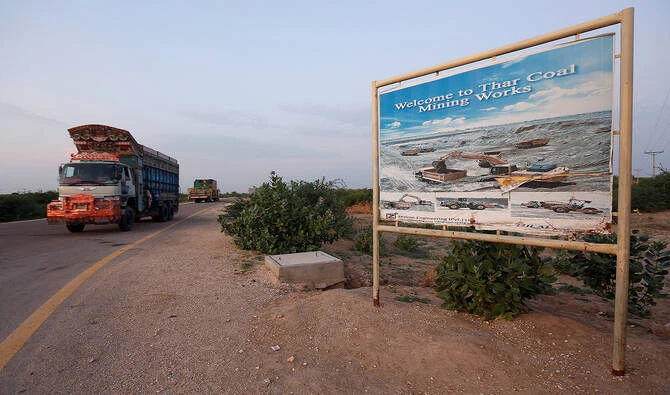
A truck drives past a sign depicting a coal-mining site in Islamkot, Tharparkar, Pakistan, on September 20, 2017. (Reuters/File)
Short Url
Updated 20 February 2026
Follow

Pakistan advances $1.1 billion Thar coal-to-urea project to cut fertilizer imports

  • Thar lignite to be converted into urea under Pakistan’s flagship Coal-to-Fertilizer plan
  • Sindh administration says the initiative will create thousands of jobs, generate exports

ISLAMABAD: Pakistan has moved forward with a $1.12 billion coal-to-fertilizer project in the desert region of Thar, an official statement said on Friday, as it aims to use domestic coal to produce urea and reduce reliance on imported fertilizer and costly natural gas.

The initiative is part of Pakistan’s broader push to tap the vast coal reserves in Tharparkar district in southern Sindh province. Thar is home to one of the world’s largest untapped lignite coal deposits, discovered in the 1990s, and has in recent years become central to the country’s coal-based power generation expansion.

“This project is of immense importance not only for Sindh but for the entire country,” Shah said, according to the statement. “It will reduce reliance on imported fertilizer, create jobs, generate exports and add value to our indigenous coal resources.”

Pakistan traditionally produces urea using natural gas as feedstock. However, declining domestic gas reserves and rising liquefied natural gas (LNG) imports have increased production costs and placed pressure on foreign exchange reserves.

Under the Coal-to-Fertilizer (C2F) initiative, Thar coal will be converted into synthesis gas through a process known as coal gasification. The hydrogen extracted from that gas will then be used to produce ammonia, which is combined with carbon dioxide to manufacture urea.

The project is designed to produce around 717,000 tons of urea annually, with roughly half intended for domestic use and the remainder for export. Officials estimate annual export revenues of up to $260 million.

Once operational, the statement said, the project could create more than 3,500 direct jobs and about 7,000 indirect jobs, while generating royalties for the provincial government through coal extraction.



Italy to grant 10,500 work visas, waive entry requirement for Pakistani diplomats — ministry

Updated 9 sec ago
Follow

Italy to grant 10,500 work visas, waive entry requirement for Pakistani diplomats — ministry

  • Interior minister meets Italian counterpart to review measures preventing illegal immigration
  • Pakistan says it achieved a 47 percent drop in illegal immigration to European states in 2025

KARACHI: Italy has announced to grant 10,500 visas to Pakistani nationals to promote legal migration and exempt diplomatic passport holders from visa requirements, Pakistan’s interior ministry said on Wednesday.

The development took place during a meeting between Pakistan’s Interior Minister Mohsin Naqvi and his Italian counterpart Matteo Piantedosi to review internal security relations and measures to prevent illegal immigration.

Pakistan intensified action against illegal migration in 2023 after hundreds of migrants, including many Pakistanis, drowned when an overcrowded vessel sank off the Greek town of Pylos, making it one of the deadliest boat disasters in the Mediterranean.

Authorities continue to target smuggling networks sending citizens abroad through dangerous routes, following heightened scrutiny at airports and a series of arrests involving forged documents.

“10,500 work visas will be issued for Pakistan’s skilled labor force to promote legal migration,” Piantedosi was quoted as saying by the ministry in its statement. “On the demand of Interior Minister Mohsin Naqvi, Pakistani diplomatic passport holders will be exempted from Italian visas.”

The ministry said the discussions also focused on strengthening cooperation to more effectively combat drug trafficking, human smuggling and militancy.

It quoted Naqvi as saying that strict airport and sea borders surveillance had helped reduce illegal immigration.

“The achievements of Pakistani institutions in preventing human trafficking and drugs are commendable,” the ministry quoted Piantedosi as saying. “We will increase mutual cooperation to promote legal migration.”

Pakistan said last year it had achieved a 47 percent drop in illegal immigration to Europe in 2025, with more than 1,700 human smugglers arrested as part of an expanded nationwide crackdown.

The country also announced in December plans to roll out an artificial intelligence-based immigration screening system in Islamabad to detect forged travel documents and prevent illegal departures.

Pakistan’s Federal Investigation Agency released a list of more than 100 of the country’s “most wanted” human smugglers in September while identifying major hubs of trafficking activity in the country.