
JEDDAH: Ten startups were recently awarded a funding pool of $1 million by TAQADAM, one of the longest-running accelerator programs in the Middle East.
The award ceremony was held at the program’s annual accelerator showcase, and marked the sixth year of the initiative launched by King Abdullah University of Science and Technology in partnership with the Saudi British Bank.
A total of 150 startup teams have graduated so far from the accelerator, raising more than $58 million in funding.

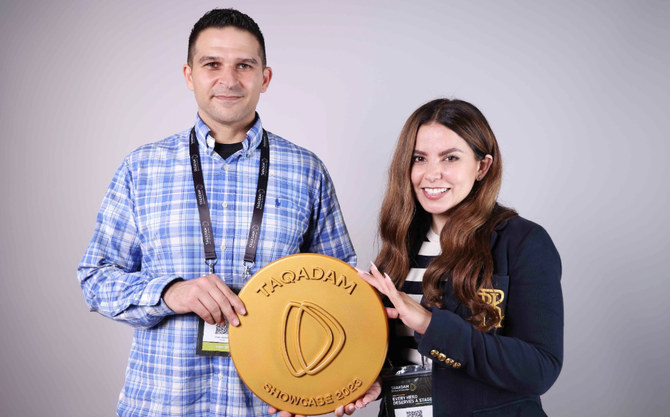
Ten startups each received $100,000 of non-dilutive funding to advance their businesses and will also have the opportunity to join the KAUST Entrepreneurship Center’s runway program. (Supplied)
Graduates of the sixth cohort pitched their projects before a judging panel of 24 global and regional investors, including Amal Dokhan of 500 Startups, Dalal Al-Mutlaq of Iliad Partners and Ian Witkopp of Sino Global Capital.
Speaking at the event, SABB’s Chief Digital Officer Saeed Assiri said: “This accelerator is an extension of the social and innovative initiatives adopted by SABB in line with its strategy and strong belief in its social responsibility toward the community.
“TAQADAM represents an example of major initiatives in support of the Kingdom’s Vision 2030 and is a great illustration of the SABB’s ambitions to support the SMEs sector, entrepreneurship and innovation, all of which are key tributaries of the sustainable development of the Kingdom’s economy.”

SABB's Chief Digital Officer, Saeed Assiri, speaking at the event. (Supplied)
The latest accelerator cohort includes 47 startups and 132 founders from 11 countries that are pushing the boundaries of science and technology. Ten startups each received $100,000 of non-dilutive funding to advance their businesses and will also have the opportunity to join the KAUST Entrepreneurship Center’s runway program.
The funded startups include Plastus, a biotech company that converts organic waste into bioplastics; Kitchefy, a B2B that grows food brands through virtual kitchens; Tamawal, a marketplace for personalized loans; DESAISIV, a B2B for optimizing insurance underwriting; Terraxy, a startup that boosts plant survivability under desert conditions; Barakah, a commercial food-waste tackling startup; BRIDGR, a SaaS platform automating consultancy operations; Beekeeper, a startup to improve honeybee health through software, IoT and biotech; SuperCommerce, another startup aiming to enable large-scale, self-managed e-commerce; and Lisan, a generative artificial intelligence for Arabic language grammar and writing.
Saudi entrepreneur Omar Shabaan said that TAQADAM is sourcing some of the best startups in the MENA region and the world. “Having access to them and being able to look at future opportunities of investment is something that is invaluable,” he said.
Abdulrahman Al-Jiffry, startup accelerator manager at KAUST Entrepreneurship, said that his team work as advisers, not just investors.
“Our funding is non-dilutive because we care about sustainable impact first and foremost. This means we can look beyond immediate profitability and take risks on the founders who are focused on solving some of our biggest global challenges,” he said.
Saudi Arabia’s support for entrepreneurship and innovative technology is driving the growth of startups at a rapid pace, with a 72 percent investment growth in 2022.
KAUST said that the applications for the next cohort of TAQADAM Accelerator is now open. The six-month program offers opportunities for mentorship, workshops, non-dilutive funding up to $140,000 per startup, and access to an international network of startups, investors and partners.
Founders can apply at taqadam.kaust.edu.sa.