

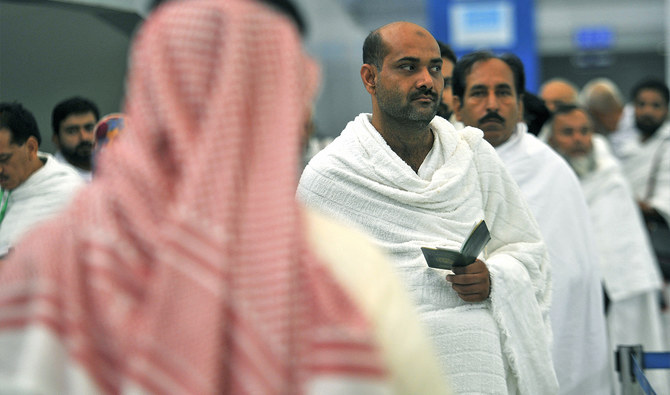

ISLAMABAD: Pakistan’s religious affairs ministry has decided in principle to allocate 50 percent Hajj sponsorship quota for overseas Pakistanis and their local relatives who plan to bear the expense of the journey in US dollars, confirmed an official source on Saturday.
The Hajj is an obligatory religious ritual for adult Muslims with physical and financial means, requiring them to visit the holy cities of Makkah and Madinah at least once in their lifetime to perform pilgrimage rites in Dhu al-Hijjah, the last month of the Islamic lunar calendar.
Earlier this year, Saudi Arabia announced restoration of Pakistan’s pre-pandemic Hajj quota of 179,210 pilgrims and removed the upper age limit of 65.
Pakistani officials also maintained in recent weeks that people paying in US dollars for the spiritual journey will not have to undergo the usual balloting process.
“Religious affairs minister Mufti Abdul Shakoor met with finance minister Ishaq Dar to discuss the Hajj policy, sponsorship scheme and payment of funds in the kingdom,” a senior ministry official told Arab News on condition of anonymity.
“It was decided in principle to fix the quota of sponsorship Hajj scheme at 50 percent, instead of the previously proposed 25 percent, to meet the requirements of foreign exchange during the Hajj this year,” he continued.
The official informed the finance minister said the government would try to arrange foreign exchange required for the Hajj season despite tough economic circumstances.
State-owned Associated Press of Pakistan (APP) news agency also confirmed the meeting between the two ministers on Saturday, saying Dar “expressed a firm commitment to extend maximum support and cooperation” to facilitate the pilgrims.
“Hajj is a sacred religious obligation to be performed by every Muslim and we have to contribute our part for the blessings of Almighty Allah,” the APP quoted him as saying.
Pakistan is facing a grave financial crisis amid depleting forex reserves and rapidly depreciating national currency, making its administration introduce the sponsorship scheme on such a massive scale for the first time in history.
The senior ministry official said the scheme would only benefit overseas Pakistanis or their relatives.
“Pakistanis remitting foreign exchange from abroad to the designated accounts will be able to benefit from the scheme,” he added. “People with Pakistani passports will be eligible to join the scheme.”
He informed the final decision on the issue, along with the Hajj policy, would be announced after the approval of federal cabinet next week.
Under the regular Hajj scheme, applications from aspiring pilgrims will be collected by designated Pakistani banks as per the past practice.
“Estimated Hajj expense at the current dollar rate is likely to range from Rs1.1 million to Rs1.2 million,” said the ministry official, adding the government was expected to start receiving pilgrims' applications from March 13.


