

Pakistani PM directs all government buildings in Islamabad to go solar within 7 weeks

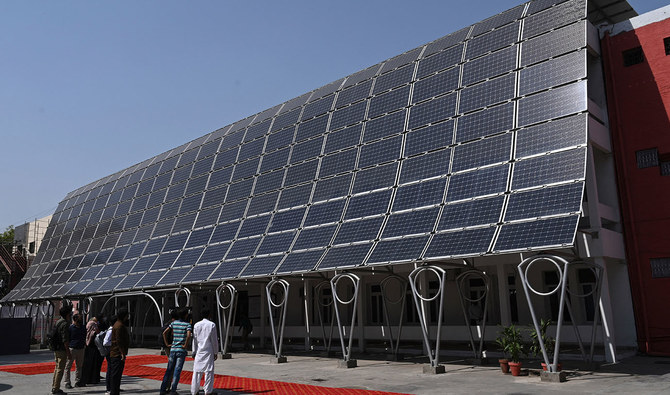
Students look at the facade of a building made with solar panels producing some 148 Kilowatts during its inauguration at the University of Engineering and Technology in Lahore on October 12, 2020. (Photo courtesy: AFP/FILE)
Short Url
Updated 01 March 2023
Follow

Pakistani PM directs all government buildings in Islamabad to go solar within 7 weeks

  • Solar panels to be installed across 496 government buildings in Islamabad, officials tell PM
  • PM Sharif says won’t tolerate delay in steps to reduce dependency on imported fuel

ISLAMABAD: Prime Minister Shehbaz Sharif directed authorities on Wednesday to ensure solar systems are installed in all government buildings in Pakistan’s capital city Islamabad within seven weeks, as the South Asian country attempts to reduce its dependence on imported fuel. 

In December last year, the prime minister announced Pakistan’s plan to solarize government buildings and departments by April 2023 to slash the country’s sizeable fuel import bill. 

With a little over $3billion in reserves, Pakistan is desperately trying to shore up its foreign reserves by reaching an agreement with the International Monetary Fund (IMF) over the past couple of months. With prospects of default looming large and a fast-depreciating currency, Islamabad is actively trying to stave off a balance of payments crisis. 

Pakistan’s energy imports during the last fiscal year were $23.3 billion, 29 percent of the country’s total imports. During the current fiscal year, the country imported energy products worth $7.7 billion, according to the Pakistan Bureau of Statistics (PBS).

Sharif has described solar energy as a “low-hanging fruit” that can be used to relieve pressure on Pakistan’s forex reserves. The premier chaired a meeting on Wednesday to review progress on solarizing government buildings, with the ministers of finance, defense and special assistants in attendance. 

“The prime minister has directed [authorities] to install solar systems in Islamabad’s government buildings within the next seven weeks,” the Prime Minister’s Office (PMO) said in a statement. It added that the premier had directed “relevant institutions” to ensure the work was completed within the seven-week timeframe. 

“Will not tolerate any delay in implementation of steps to reduce dependency on imported fuel,” Sharif said, directing authorities to start work on solarization of federal government buildings in other parts of the country. 

“The government is trying to reduce the burden on people’s pockets with low-cost and environment-friendly electricity,” he added. 

Sharif was told by officials that solar panels would be installed in 496 buildings in Islamabad, 340 in the country’s large cities including Karachi, Lahore, Quetta, and Faisalabad, and 1,255 buildings in other parts of the country.

To cut reliance on imported fossil fuel, Pakistan plans to increase the share of clean energy to 60 percent in its energy mix by 2030 to save the foreign exchange. Currently, the share of renewable energy is only about 4 percent, according to official data.


Pakistan depart for T20 World Cup while waiting for ICC reaction to India game boycott

Updated 02 February 2026
Follow

Pakistan depart for T20 World Cup while waiting for ICC reaction to India game boycott

  • Pakistan shook cricketing world when their government approved participation in World Cup, but asked team to boycott India match on Feb. 15
  • The ICC has said Pakistan’s ‘position of selective participation is difficult to reconcile with the fundamental premises of a global sporting event’

ISLAMABAD: Pakistan departed for the T20 World Cup in Sri Lanka on Monday and awaited any sanction from the International Cricket Council for refusing to play India in the tournament.

In video footage released by the Pakistan Cricket Board, the cricketers were dressed in their new World Cup kit as they boarded a bus from a hotel to the airport in Lahore.

India is co-hosting the World Cup but Pakistan will play all of its games in Sri Lanka — including any in the knockout stage — because of political tensions with India.

Pakistan shook the cricketing world when its government instructed the team on Sunday to compete in the World Cup but boycott the group game against India in Colombo on Feb. 15. The government did not give a reason on its X account.

The PCB has reportedly not given official notice to the ICC.

The ICC warned Pakistan there will be consequences.

The ICC said “the position of selective participation is difficult to reconcile with the fundamental premises of a global sporting event.” The ICC added Pakistan’s decision was “not in the interest of the global game or the welfare of fans worldwide, including millions in Pakistan.”

Pakistan and India have fought four wars and frequently clash on their border, so their cricket matchups often attract the highest audience and are therefore a significant source of income for broadcasters, sponsors, and the ICC.

They are regularly grouped at ICC tournaments because they have not played a bilateral cricket series for 14 years.

The T20 World Cup starts on Saturday when Pakistan is scheduled to open against the Netherlands.

Pakistan will play a final warmup game against Ireland on Wednesday in Colombo.

After Pakistan wrapped up a 3-0 Twenty20 series win over Australia on Sunday in Lahore, Pakistan captain Salman Ali Agha said he will follow the government’s instructions.

“It’s not our decision (to boycott the India game), we can’t do anything about it,” Agha said. “We will do whatever our government and the (PCB) chairman say.”

PCB chairman Mohsin Naqvi has criticized the ICC for “double standards” by refusing to shift Bangladesh’s games to Sri Lanka after the Bangladesh government didn’t allow its team to travel to India due to security concerns. The ICC axed Bangladesh and replaced it with Scotland for the tournament.

The strained political relations between India and Pakistan spilled onto the cricket field last year when India players refused to shake hands with Pakistan players during three Asia Cup games, including the final, in the United Arab Emirates. Later, India left without the trophy after it refused to accept it from Naqvi, who is the president of the Asian Cricket Council.