

Death toll keeps rising in Greece’s deadliest train crash

1 / 4
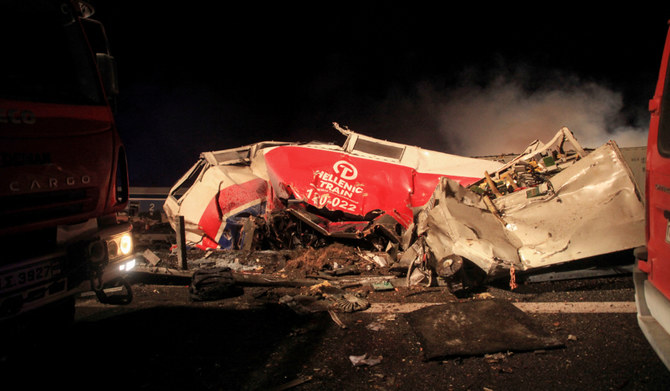
The site of a crash, where two trains collided, is seen near the city of Larissa, Greece, March 1, 2023. (Reuters)
2 / 4
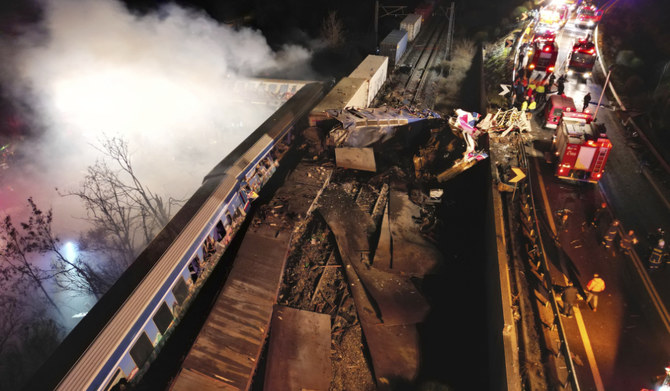
Smoke rises from trains as rescue crews work train smash scene near Larissa city, Greece, early Wednesday, March 1, 2023. (AP)
3 / 4
Smoke rises from trains as firefighters and rescuers operate after a collision near Larissa city, Greece, early Wednesday, March 1, 2023. (AP)
4 / 4
A medic treats a passenger, after two trains collided, near the city of Larissa, in Thessaloniki, Greece, March 1, 2023. (REUTERS)
Short Url
Updated 02 March 2023
Follow

Death toll keeps rising in Greece’s deadliest train crash

  • Greek Prime Minister Kyriakos Mitsotakis called the collision of the passenger train and a freight train “a horrific rail accident without precedent in our country”
  • The train from Athens to Thessaloniki was carrying 350 passengers, many of them students returning from raucous Carnival celebrations

TEMPE, Greece: Rescuers searched for survivors Wednesday in the mangled, burned-out wreckage of two trains that slammed into each other in northern Greece, killing at least 43 people and crumpling carriages into twisted steel knots in the country’s worst-ever rail crash.
The impact just before midnight Tuesday threw some passengers into ceilings and out the windows.
“My head hit the roof of the carriage with the jolt,” Stefanos Gogakos, who was in a rear car, told state broadcaster ERT. He said windows shattered, showering riders with glass.
Greek Prime Minister Kyriakos Mitsotakis called the collision of the passenger train and a freight train “a horrific rail accident without precedent in our country,” and pledged a full, independent investigation.
He said it appears the crash was “mainly due to a tragic human error.”
The train from Athens to Thessaloniki was carrying 350 passengers, many of them students returning from raucous Carnival celebrations. While the track is double, both trains were traveling in opposite directions on the same line near the Vale of Tempe, a river valley about 380 kilometers (235 miles) north of Athens.

STATIONMASTER ARRESTED; MINISTER RESIGNS
Authorities arrested the stationmaster at the train’s last stop, in the city of Larissa. They did not release the man’s name or the reason for the arrest, but the stationmaster is responsible for rail traffic on that stretch of the tracks.
Transportation Minister Kostas Karamanlis resigned, saying he was stepping down “as a basic indication of respect for the memory of the people who died so unfairly.”
Karamanlis said he had made “every effort” to improve a railway system that had been “in a state that doesn’t befit the 21st century.”
But, he added, “When something this tragic happens it’s impossible to continue as if nothing has happened.”
WRECKAGE MAKES RESCUE EFFORTS DIFFICULT
On Wednesday, rescuers turned to cranes and other heavy machinery to start moving large pieces of the trains, revealing more bodies and dismembered remains.
Larissa’s chief coroner, Roubini Leondari, said so far 43 bodies had been brought to her for examination, and would require DNA identification as they were largely disfigured.

“Most (of the bodies) are young people,” she told ERT. “They are in very bad condition.”
Vassilis Polyzos, a local resident who said he was one of the first people on the scene, said both trains “were completely destroyed.”
“There were many big pieces of steel,” he said.
Rescuer Lazaros Sarianidis told ERT that crews were “very carefully” trying to disentangle steel, sheet metal and other material that was twisted together by the crash. “It will take a long time,” said Sarianidis.
Greece’s firefighting service said 57 people remained hospitalized late Wednesday, including six in intensive care. More than 15 others were discharged after receiving initial treatment.

More than 200 people who were unharmed or suffered minor injuries were taken by bus to Thessaloniki, 130 kilometers (80 miles) to the north. Police took their names as they arrived, in an effort to track anyone who may be missing.
Eight rail employees were among those killed in the crash, including the two drivers of the freight train and the two drivers of the passenger train, according to Greek Railroad Workers Union President Yannis Nitsas.
Emergency workers found several bodies dozens of meters (feet) away from the cars, ERT reported.
PASSENGERS SAY TRAIN CRASH WAS LIKE AN EXPLOSION
A teenage survivor who did not give his name to reporters said that just before the crash he felt sudden braking and saw sparks — and then there was a sudden stop.
“Our carriage didn’t derail, but the ones in front did and were smashed,” he said, visibly shaken. He used a bag to break the window of his car, the fourth, and escape.
Gogakos said the crash felt like an explosion, and some smoke entered the carriage. He said some passengers escaped through windows but that after a few minutes, crew members were able to open the doors and let people out.
Multiple cars derailed and at least one burst into flames.
“Temperatures reached 1,300 degrees Celsius (2,372 Fahrenheit), which makes it even more difficult to identify the people who were in it,” fire service spokesperson Vassilis Varthakoyiannis said.
A man who was trying to ascertain the fate of his daughter, who was on the train, saying he had a harrowing phone conversation with her before she was cut off.
“She told me ‘we’re on fire. ... My hair is burning,’” he told ERT, without giving his name.
GREECE GOES FROM CARNIVAL TO MOURNING
Many of the passengers were students returning to Thessaloniki from Carnival, but officials said but no detailed passenger list was available. This year was the first time the festival, which precedes Lent, was celebrated in full since the start of the pandemic in 2020.
The government declared three days of national mourning from Wednesday, while flags flew at half-staff outside all European Commission buildings in Brussels.
Visiting the accident scene, Prime Minister Mitsotakis said the government must help the injured recover and identify the dead.
“I can guarantee one thing: We will find out the causes of this tragedy and we will do all that’s in our power so that something like this never happens again,” Mitsotakis said.
Tuesday’s was Greece’s worst rail crash since 1968, when 34 people were killed in a crash in the southern Peloponnese region.
Greek President Katerina Sakellaropoulou broke off an official visit to Moldova to visit the scene, laying flowers beside the wreckage.
Pope Francis offered his condolences to the families of the dead, in a message sent to the president of the Greek bishops conference on his behalf by the Vatican’s secretary of state,
The pontiff “sends the assurance of his prayers to everyone affected by this tragedy,” the message said.
Condolences poured in from all over the world, including neighboring Turkiye, Greece’s historic regional rival. Turkish President Recep Tayyip Erdogan expressed his sorrow and his wishes for a speedy recovery for those injured, a statement from his office said.
Despite the frosty relations between the two NATO nations, Greece’s leadership had called Erdogan last month following a massive earthquake that killed tens of thousands in Turkiye last month.
In Athens, several hundred members of left-wing groups marched late Wednesday to protest the train deaths. Minor clashes broke out as some protesters threw stones at the offices of Greece’s rail operator and riot police, and set dumpsters on fire. No arrests or injuries were reported.


House votes to slap back Trump’s tariffs on Canada in rare bipartisan rebuke

Updated 12 February 2026
Follow

House votes to slap back Trump’s tariffs on Canada in rare bipartisan rebuke

WASHINGTON: The House voted Wednesday to slap back President Donald Trump’s tariffs on Canada, a rare if largely symbolic rebuke of the White House agenda as Republicans joined Democrats over the objections of GOP leadership.
The tally, 219-211, was among the first times the House, controlled by Republicans, has confronted the president over a signature policy, and drew instant recrimination from Trump himself. The resolution seeks to end the national emergency Trump declared to impose the tariffs, though actually undoing the policy would require support from the president, which is highly unlikely. It next goes to the Senate.
Trump believes in the power of tariffs to force US trade partners to the negotiating table. But lawmakers are facing unrest back home from businesses caught in the trade wars and constituents navigating pocketbook issues and high prices.
“Today’s vote is simple, very simple: Will you vote to lower the cost of living for the American family or will you keep prices high out of loyalty to one person — Donald J. Trump?” said Rep. Gregory Meeks of New York, the top Democrat on the House Foreign Affairs Committee, who authored the resolution.
Within minutes, as the gavel struck, Trump fired off a stern warning to those in the Republican Party who would dare to cross him.
“Any Republican, in the House or the Senate, that votes against TARIFFS will seriously suffer the consequences come Election time, and that includes Primaries!” the president posted on social media.
The high-stakes moment provides a snapshot of the House’s unease with the president’s direction, especially ahead of the midterm elections as economic issues resonate among voters. The Senate has already voted to reject Trump’s tariffs on Canada and other countries in a show of displeasure. But both chambers would have to approve the tariff rollbacks, and send the resolution to Trump for the president’s signature — or veto.
Six House Republicans voted for the resolution, and one Democrat voted against it.
From Canada, Ontario, Premier Doug Ford on social media called the vote “an important victory with more work ahead.” He thanked lawmakers from both parties “who stood up in support of free trade and economic growth between our two great countries. Let’s end the tariffs and together build a more prosperous and secure future.”
Trump recently threatened to impose a 100 percent tariff on goods imported from Canada over that country’s proposed China trade deal, intensifying a feud with the longtime US ally and Prime Minister Mark Carney.
GOP defections forced the vote
House Speaker Mike Johnson tried to prevent this showdown.
Johnson insisted lawmakers wait for a pending Supreme Court ruling in a lawsuit about the tariffs. He engineered a complicated rules change to prevent floor action. But Johnson’s strategy collapsed late Tuesday, as Republicans peeled off during a procedural vote to ensure the Democratic measure was able to advance.
“The president’s trade policies have been of great benefit,” Johnson, R-Louisiana, had said. “And I think the sentiment is that we allow a little more runway for this to be worked out between the executive branch and the judicial branch.”
Late Tuesday evening, Johnson could be seen speaking to holdout Republican lawmakers as the GOP leadership team struggled to shore up support during a lengthy procedural vote, but the numbers lined up against him.
“We’re disappointed,” Kevin Hassett, the director of the White House’s National Economic Council, told reporters at the White House on Wednesday morning. “The president will make sure they don’t repeal his tariffs.”
Terminating Trump’s emergency
The resolution put forward by Meeks would terminate the national emergency that Trump declared a year ago as one of his executive orders.
The administration claimed illicit drug flow from Canada constitutes an unusual and extraordinary threat that allows the president to slap tariffs on imported goods outside the terms of the US-Mexico-Canada trade agreement.
The Republican chairman of the House Foreign Affairs Committee, Rep. Brian Mast of Florida, said the flow of fentanyl into the US is a dire national emergency and the policy must be left in place.
“Let’s be clear again about what this resolution is and what it’s not. It’s not a debate about tariffs. You can talk about those, but that’s not really what it is,” Mast said. “This is Democrats trying to ignore that there is a fentanyl crisis.”
Experts say fentanyl produced by cartels in Mexico is largely smuggled into the US from land crossings in California and Arizona. Fentanyl is also made in Canada and smuggled into the US, but to a much lesser extent.
Torn between Trump and tariffs
Ahead of voting, some rank-and-file Republican lawmakers expressed unease over the choices ahead as Democrats — and a few renegade Republicans — impressed on their colleagues the need to flex their power as the legislative branch rather than ceding so much power to the president to take authority over trade and tariff policy.
Rep. Don Bacon, R-Nebraska, said he was unpersuaded by Johnson’s call to wait until the Supreme Court makes its decision about the legality of Trump’s tariffs. He voted for passage.
“Why doesn’t the Congress stand on its own two feet and say that we’re an independent branch?” Bacon said. “We should defend our authorities. I hope the Supreme Court does, but if we don’t do it, shame on us.”
Bacon, who is retiring rather than facing reelection, also argued that tariffs are bad economic policy.
Other Republicans had to swiftly make up their minds after Johnson’s gambit — which would have paused the calendar days to prevent the measure from coming forward — was turned back.
“At the end of the day, we’re going to have to support our president,” said Rep. Keith Self, R-Texas.
Rep. Darrell Issa, R-Calif., said he doesn’t want to tie the president’s hands on trade and would support the tariffs on Canada “at this time.”