


KYIV, Ukraine: Drones that the Kremlin said were launched by Ukraine flew deep inside Russian territory, including one that got within 100 kilometers (60 miles) of Moscow, signaling breaches in Russian defenses as President Vladimir Putin ordered stepped-up protection at the border.
Officials said the drones caused no injuries and did not inflict any significant damage, but the attacks on Monday night and Tuesday morning raised questions about Russian defense capabilities more than a year after the country’s full-scale invasion of its neighbor.
Moscow blamed Kyiv for the assaults. Ukrainian officials did not immediately claim responsibility, but they similarly avoided directly acknowledging responsibility for past strikes and sabotage while emphasizing Ukraine’s right to hit any target in Russia.
Although Putin did not refer to any specific attacks in a speech in the Russian capital, his comments came hours after the drones targeted several areas in southern and western Russia. Authorities closed the airspace over St. Petersburg in response to what some reports said was a drone.
Also Tuesday, several Russian television stations aired a missile attack warning that officials blamed on a hacking attack.
The drone attacks targeted regions inside Russia along the border with Ukraine and deeper into the country, according to local Russian authorities.
A drone fell near the village of Gubastovo, less than 100 kilometers (60 miles) from Moscow, Andrei Vorobyov, governor of the region surrounding the Russian capital, said in an online statement.
The drone did not inflict any damage, Vorobyov said, but it likely targeted “a civilian infrastructure object.”
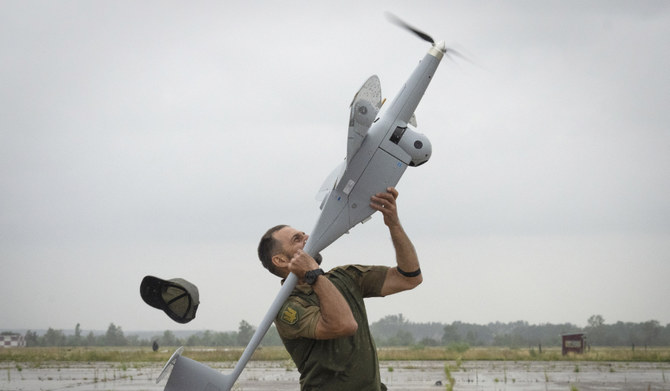
Pictures of the drone showed it was a small Ukrainian-made model with a reported range of up to 800 kilometers (nearly 500 miles) but no capacity to carry a large load of explosives.
Russian forces early Tuesday shot down another Ukrainian drone over the Bryansk region, local Gov. Aleksandr Bogomaz said in a Telegram post.
Three drones also targeted Russia’s Belgorod region on Monday night, with one flying through an apartment window in its namesake capital, local authorities reported. Regional Gov. Vyacheslav Gladkov said the drones caused minor damage to buildings and cars.
The Russian Defense Ministry said Ukraine used drones to attack facilities in the Krasnodar region and neighboring Adygea. It said the drones were brought down by electronic warfare assets, adding that one of them crashed into a field and another diverted from its flight path and missed an infrastructure facility it was supposed to attack.
Russia’s state RIA Novosti news agency reported a fire at the oil facility, and some other Russian reports said that two drones exploded nearby.
While Ukrainian drone strikes on the Russian border regions of Bryansk and Belgorod have become a regular occurrence, other strikes reflected a more ambitious effort.
Some Russian commentators described the drone attacks as an attempt by Ukraine to showcase its capability to strike areas deep behind the lines, foment tensions in Russia and rally the Ukrainian public. Some Russian war bloggers described the raids as a possible rehearsal for a bigger, more ambitious attack.
Russia hawks called for a strong retaliation. Igor Korotchenko, a retired Russian army colonel turned military commentator, called for a punishing strike on the Ukrainian presidential office in Kyiv.
Another retired military officer, Viktor Alksnis, noted that the drone attacks marked the expansion of the conflict and criticized Putin for failing to deliver a strong response.
Also on Tuesday, the authorities reported that airspace around St. Petersburg, Russia’s second-largest city, was temporarily closed, halting all departures and arrivals at the city’s main airport, Pulkovo. It did not give a reason for the move, but some Russian reports claimed that the move was triggered by an unidentified drone.
The Russian Defense Ministry said it was conducting air defense drills in western Russia.
Last year, Russian authorities repeatedly reported shooting down Ukrainian drones over annexed Crimea. In December, the Russian military said Ukraine used drones to hit two bases for long-range bombers deep inside Russian territory.
Speaking at Russia’s main security agency, the FSB, Putin urged the service to tighten security on the Ukraine border.
In another development that fueled tensions across Russia on Tuesday, an air raid alarm interrupted the programming of several TV channels and radio stations in several regions. Russia’s Emergency Ministry said in an online statement that the announcement was a hoax “resulting from a hacking of the servers of radio stations and TV channels in some regions of the country.”
Meanwhile, satellite photos analyzed by The Associated Press appeared to show a Russian warplane in Belarus that Belarusian guerrillas claimed to have targeted as largely intact.
Tuesday’s high-resolution images from Planet Labs PBC showed no immediate signs of damage to the Russian A-50 early warning and control aircraft after what Belarusian opposition activists described as an attack on the Machulishchy air base Sunday outside the Belarusian capital of Minsk.
Belarusian activists supporting Ukraine alleged that the aicraft was seriously damaged, but Russian and Belarusian officials did not comment on the claims.
In Ukraine, four people were killed and five others wounded Tuesday by renewed Russian shelling of the southern Ukrainian city of Kherson, regional Gov. Oleksandr Prokudin said in a Telegram.
A 68-year-old man was also killed as Russian forces shelled Kupiansk, a town in Ukraine’s northeastern Kharkiv region, its Gov. Oleh Syniehubov said.
The fiercest fighting continued to be in eastern areas of Ukraine, where Russia wants control over all four of the provinces it illegally annexed in September.
Ukrainian officials said Russian forces have deployed additional troops and equipment, including the latest T-90 battle tanks, in those areas.
In a video address, Ukraine’s President Volodymyr Zelensky thanked US industrialists for supporting Ukraine and voiced hope for their support in rebuilding the country after the war. Zelensky noted that the country faces a “colossal task” to restore hundreds of thousands of damaged sites, including “whole cities, industries, productions.”


