

ICC’s top prosecutor in Ukraine to probe Russian attacks on power grid

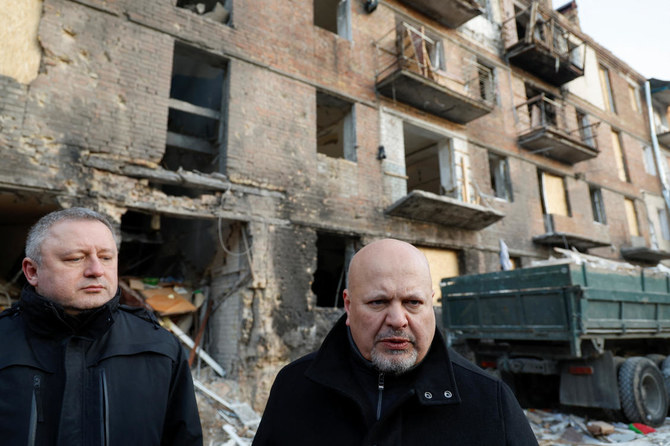
ICC Prosecutor Karim Khan and Ukrainian Prosecutor General Andriy Kostin speak to journalists as they visit the site of a residential building damaged by a Russian missile strike late November, in the town of Vyshhorod, outside Kyiv on Feb. 28, 2023. (Reuters)
Short Url
Updated 28 February 2023
Follow

ICC’s top prosecutor in Ukraine to probe Russian attacks on power grid

  • International courts say parties involved in a military conflict must distinguish between "civilian objects and military objectives"
  • "We need to look at why that's taking place; are they legitimate targets or not?" ICC Prosecutor Karim Khan said

VYSHHOROD, Ukraine: The International Criminal Court’s top prosecutor was in Ukraine on Tuesday to investigate Russia’s campaign of missile and drone attacks on power and other infrastructure that killed hundreds of civilians and left millions with no electricity or water.
Russia says they are legitimate strikes aimed at weakening the enemy’s military, but Ukraine casts them as a means of intimidating ordinary people.
The Geneva conventions and additional protocols shaped by international courts say parties involved in a military conflict must distinguish between “civilian objects and military objectives” and that attacks on civilian objects are forbidden.
“Generally we see clearly a pattern, I think, in terms of the number, scale and breadth of attacks against the power grids of Ukraine and we need to look at why that’s taking place; are they legitimate targets or not?” ICC Prosecutor Karim Khan said.
Khan was speaking to a small group of reporters in front of a badly damaged apartment block in the satellite town of Vyshhorod just north of Kyiv, where a Russian missile fell in late November killing eight civilians and wounding many more.
It was not clear whether the missile was aimed at a power installation nearby and missed its target.
“We need to find out what pattern, if any, is demonstrated by that because these are not isolated occurrences.”
The job of the ICC and Ukraine’s own legal system in pursuing justice after Russia launched a full-scale invasion just over a year go is vast.
More than 70,000 alleged war crimes have been reported, the vast majority of which would be dealt with in domestic courts.

’TWO TO TANGO’
The ICC in The Hague has jurisdiction to prosecute war crimes, crimes against humanity and genocide on the territory of Ukraine committed by either side, and is expected to focus on high-profile suspects. Such cases could take years to build.
Khan, who earlier met President Volodymyr Zelensky in Kyiv, said there had not yet been any arrest warrants issued by the ICC resulting from the past year’s work in Ukraine, but he defended the court and its Ukrainian partners.
“What people want are not Pyrrhic victories,” he said when asked whether the process may be too slow to satisfy the desire for justice shared by many Ukrainians.
“As a prosecutor we are officers of the court. We are not here to get a round of applause by a conjuring trick. Whenever we do move, (people) should have confidence that this is not a political process.”
Andriy Kostin, Ukraine’s Prosecutor General who accompanied Khan to the bomb site, praised the cooperation between his offices and those of the ICC.
“We are really united in our joint aim ... to deliver justice for all Ukrainians, for Ukraine as a country,” Kostin said, standing before a large, litter-strewn bomb crater.
“Ninety-nine-plus percent of them will be prosecuted and will be tried in Ukrainian courts.”
Kostin’s office said that tens of thousands of Russian attacks had been launched on infrastructure and civilians which had no military justification.
Evidence gathered so far by Western and Ukrainian authorities, particularly in areas occupied by Russian forces that have been liberated, points to widespread abuses, including torture, execution, forced deportation and sexual violence.
Russia denies such accusations and says some of the evidence cited has been fabricated.
Moscow has also accused Ukraine’s military of abuses, including killing prisoners of war and shelling civilians in Russian-held territory in the east.
Khan told Reuters that he had tried to contact the Russian government on several occasions to discuss his work in Ukraine.
“I’ve got evidence from the Ukrainians. I have not got evidence from the Russians,” he said. “If you’ve got something, give it. I stand ready to receive it and engage with them, but it takes two to tango.”


Pope names veteran Vatican diplomat as ambassador to the US to manage relations with Trump

Updated 4 sec ago
Follow

Pope names veteran Vatican diplomat as ambassador to the US to manage relations with Trump

  • Italian Archbishop Gabriele Caccia, 68, is currently the Holy See’s ambassador to the UN
  • He replaces French-born Cardinal Christophe Pierre

ROME: Pope Leo XIV on Saturday named a veteran Vatican diplomat as his new ambassador to the United States to manage one of the Holy See’s most important bilateral relationships at a crucial time, with ties strained over the Trump administration’s war in Iran and immigration crackdown.
Italian Archbishop Gabriele Caccia, 68, is currently the Holy See’s ambassador to the United Nations in New York. He replaces French-born Cardinal Christophe Pierre, who at age 80 is retiring as apostolic nuncio in Washington.
Caccia served as the Holy See’s ambassador to Lebanon and the Philippines before being posted to the UN in 2019. Ordained a priest in Milan in 1983, Caccia later served as “assessor” in the Vatican secretariat of state, a key administrative post in the Holy See’s most important office.
He inherits a complicated and consequential dossier on both the US church and state fronts at a time of global turmoil.
Pierre’s tenure as ambassador was notable for clear signs of friction between the leadership of the US Conference of Catholic Bishops, which tends to skew conservative, and the more progressive priorities of Pope Francis’ pontificate.
The relationship with the US and its church is crucial for the Holy See, not least because US Catholics are the most generous donors to the Holy See’s coffers.
Leo, history’s first US-born pope, is well aware of the dynamic, having served as Francis’ point man on bishop nominations for two years before his 2025 election. Leo has emphasized a message of pacification and unity in the church.
The first Trump administration clashed with Francis especially on migration, and that tension has continued in Leo’s pontificate and the second Trump term. Leo has repeatedly insisted that the Trump administration respect the human dignity of migrants, while acknowledging its right to its borders.
More recently, Leo has expressed “profound concern” about the US-Israeli war in Iran and urged both sides to “stop the spiral of violence before it becomes an irreparable abyss.”
In comments last Sunday, Leo called for the resumption of diplomacy. Weapons, he said, only sow “destruction, pain and death.”
In a major foreign policy speech earlier this year, Leo also made clear he opposed the US aggressive use of military power, in an apparent reference to Washington’s incursion in Venezuela and threats to take Greenland. He denounced how nations were using force to assert their dominion worldwide and “completely undermine” peace and the post-World War II international legal order.
Caccia said in a statement Saturday he was humbled by Leo’s appointment and faith in naming him ambassador to his native country.
“I receive this mission with both joy and a sense of trepidation,” according to a statement reported by Vatican News. He said his was a mission “at the service of communion and peace,” recalling that this year marks the 250th anniversary of the US independence.
The current president of the US conference, Archbishop Paul S. Coakley, welcomed Caccia’s appointment and offered the US hierarchy’s “warmest welcome and our prayerful support.”
The Holy See has a tradition of diplomatic neutrality, though Leo has spoken out strongly against the humanitarian toll of Israel’s military action in Gaza and Russia’s invasion of Ukraine.