

French Daesh midwife faces 30 years’ imprisonment

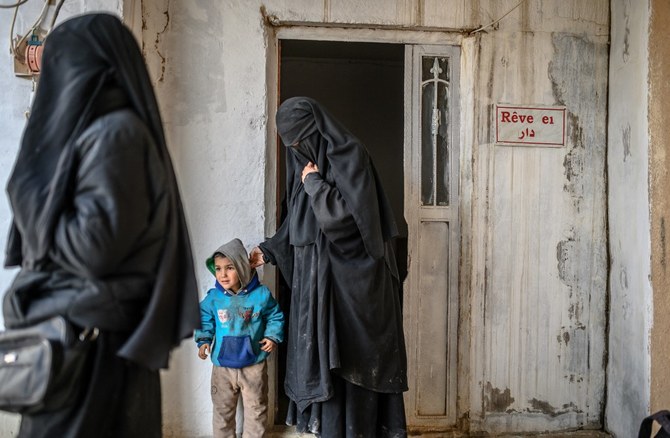
Above, two detained French women, reportedly wives and members of the Daesh, at the Al-Hol camp in Al-Hasakeh governorate in northeastern Syria on Feb. 17, 2019. (AFP file photo)
Short Url
Updated 28 February 2023
Follow

French Daesh midwife faces 30 years’ imprisonment

  • Douha Mounib, 32, delivered 12 babies while living in Raqqa, Syria
  • Former midwifery student left France to join caliphate in 2014

LONDON: A French woman accused of acting as a midwife for Daesh is facing more than 30 years’ imprisonment, The Times reported.

Douha Mounib, 32, is on trial in Paris after having spent several years in a French prison following her arrest in Turkiye in 2017 and subsequent repatriation.

She is one of more than 30 women from France alleged to be former members of Daesh, with many having returned to the country from Syria or Turkiye following the collapse of the terror group.

Mounib, who was completing her third year of midwifery studies at the time she first traveled to Syria in 2014, returned to the caliphate a second time a year later.

Declaring that she “wanted to fight for Islam and Allah,” Mounib delivered 12 babies and produced online Islamist propaganda during her time in Syria, French prosecutors said.

In a tweet at the time, Mounib said: “The man fights but it is the wife who raises the future mujahedeen.”

However, she told French authorities: “I never intended to turn my children into future mujahedeen.

“In the same way, when I was delivering babies, I was never doing it with the aim of delivering future fighters.”

While living in Syria, Mounib gave birth to a daughter, who is now in the care of social services.

Two years ago, while imprisoned in France, Mounib escaped her cell by creating a hole in a wall using a spoon. She escaped to the outer area of the prison before being captured.

If convicted in her trial, she faces a maximum sentence of 30 years’ imprisonment for associating with a terrorist group.


Supreme Court wades into US-Cuba business disputes, with billions at stake

Updated 3 sec ago
Follow

Supreme Court wades into US-Cuba business disputes, with billions at stake

  • Exxon oil and gas assets in Cuba were seized in 1960
  • Energy giant seeks compensation from Cuban entities
WASHINGTON: The US Supreme Court is set to explore legal questions arising from the fraught history of US-Cuban relations when it considers the scope of a 1996 law that lets US nationals seek compensation for property confiscated by the communist-led Cuban government. The justices hear ​arguments on Monday in two cases centered on the federal law called the Helms-Burton Act, one involving US oil major ExxonMobil and the other involving the cruise lines Carnival, Royal Caribbean, Norwegian Cruise Line and MSC Cruises. One of the law’s provisions, called Title III, allows for lawsuits in US courts against entities that “traffic” in property confiscated by the Cuban government after the revolution that brought Fidel Castro to power in 1959.
While the two cases focus on distinct legal issues, both raise the question of just how powerful a remedy Congress intended Title III to be. In both cases, the Supreme Court has the opportunity to eliminate barriers that claimants face in bringing Helms-Burton Act lawsuits.
The justices have never before interpreted Title III, which Congress authorized the US president to suspend if deemed “necessary to the national interests of the United States.” Title III was long dormant due to presidential decisions to suspend it. But President Donald Trump, who has taken a ‌hard line toward Cuba, ‌lifted that suspension during his first term in office, unleashing a wave of about 40 lawsuits filed ​in ‌2019 and ⁠2020 that ​have ⁠slowly made their way through the courts. Trump’s administration has declared Cuba “an unusual and extraordinary threat” to US national security, cutting off the flow of Venezuelan oil to the Caribbean island nation and threatening to slap tariffs on any country supplying it with fuel.
BILLIONS OF DOLLARS IN CLAIMS
Following the revolution, Cuba’s new communist government nationalized US property that now is worth billions of dollars, including factories, sugar mills, oil refineries and power plants.
The Helms-Burton Act formalized the US trade embargo against Cuba that had been in effect by presidential order since President John Kennedy’s administration in the 1960s.
Title III created a legal remedy for US nationals whose property was confiscated. Such plaintiffs can seek enhanced damages in federal courts from entities that knowingly use the property, including both Cuban state-owned entities and multinational companies.
Presidents Bill Clinton, George W. Bush and Barack Obama all suspended ⁠Title III, seeking to avoid diplomatic conflicts with allies like Canada and Spain whose companies have invested in Cuba, ‌before Trump lifted the suspension in 2019. The State Department said at the time that Trump’s move ‌would “ratchet up pressure on the Cuban government” and “penalize those who benefit from the rightful property of Americans.”
In ​one of the Supreme Court cases, Exxon is seeking more than $1 billion ‌in compensation from CIMEX, a Cuban state-owned firm, for oil and gas assets seized in 1960. In the other case, a small company that built ‌docks in Havana’s port prior to the revolution is seeking compensation from the four cruise lines, whose ships have used the terminal.
Exxon, which filed its suit in Washington in 2019, has asked the justices to reverse a lower court’s 2024 decision finding that Cuban state-owned enterprises facing Helms-Burton Act claims can raise the defense of foreign sovereign immunity. That legal doctrine generally shields foreign governments and their agents from being sued in US courts.
The lower court’s decision “imposes yet another in a long line of barriers to recovery for victims ‌of the Castro government’s illegal confiscations,” Exxon’s lawyers said in a 2024 court filing.
CIMEX has argued in court filings that the 2024 decision should be upheld because it “both respects and safeguards congressional judgment in this sensitive area.”
Legal experts ⁠said the 2024 decision and other ⁠rulings interpreting Helms-Burton have made it costly and time-consuming for US businesses to seek compensation from Cuban entities.
“The amount of time and resources that has been required is overwhelming for a lot of claimants,” said Washington lawyer Jared Butcher, who represents clients in commercial litigation.
CRUISE SHIP DISPUTE
The other case being argued on Monday does not implicate sovereign immunity because the cruise company defendants are private companies, rather than state-owned entities. At issue in that case is whether a Helms-Burton Act claimant must establish that it would have a present-day property interest in the assets at issue if they had not been nationalized.
Havana Docks Corporation, a US firm that built docks in Havana’s port prior to the revolution, sued the cruise lines in federal court in Florida in 2019. Castro revoked the company’s legal right to the docks shortly after coming to power.
The four cruise operators used the docks from 2016 to 2019, after Obama eased travel restrictions on Cuba. In a joint court filing, the companies said it defies common sense that they “should pay hundreds of millions of dollars for following the executive branch’s lead in reopening travel to Cuba.”
A federal judge found the cruise companies liable for a combined $440 million, saying they had trafficked in confiscated property. An appeals court threw ​out those judgments last year, highlighting the difficulties Helms-Burton Act claimants face.
“Plaintiffs ​are having a hard time recovering under the Helms-Burton Act for a wide variety of reasons, and it’s probably more difficult to recover than Congress had anticipated when it passed the act in 1996,” said Vanderbilt Law School professor Ingrid Brunk. “But that’s not an argument that means every plaintiff should win.”