

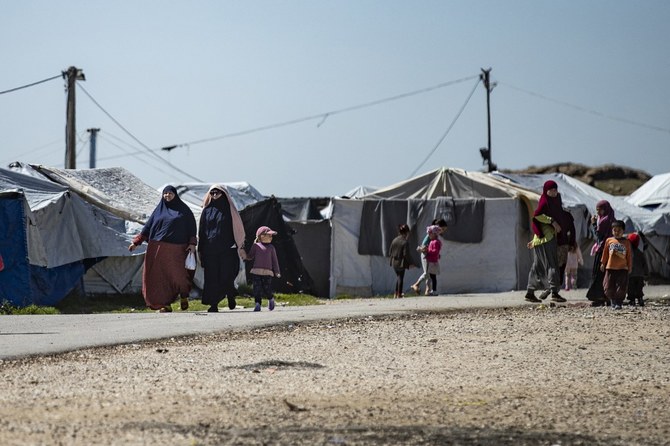

London: The prison camp hosting thousands of former Daesh fighters and their families in northeast Syria risks becoming the British “Guantanamo Bay” if the UK fails to repatriate women and children from the site, the government’s terrorism reviewer has warned, according to The Telegraph.
Al-Roj camp in Syria, overseen by Kurdish authorities, is home to dozens of Britons who traveled to the region to join Daesh following the rise of the terror group.
But Britain’s failure to repatriate its citizens — instead pursuing a strategy of citizenship stripping — risks creating a source of “exploitable grievance” among dangerous organizations, Jonathan Hall, the independent reviewer of terrorism law, said on Monday.
He added that the dozens of British children in the camp could become “cubs of the caliphate” if they remain exploitable to radicalization from other detainees and are not repatriated to the UK.
The potential backlash against Britain choosing to leave its citizens in Syrian prison camps would echo that of the outcry against the US’ Guantanamo Bay detention center in Cuba, which housed hundreds of suspected terrorists during the War on Terror, Hall said.
He noted that the UK’s strategy was out of line with European partners and the US, with other Western countries successfully repatriating citizens.
Many of the British detainees, including 23-year-old Shamima Begum, who left the UK as a schoolgirl, have already had their citizenship stripped by the government.
But others who still retain citizenship lack the travel documents to leave Syria and require UK intervention, Hall said.
He questioned the potential risk of repatriating former Daesh members and children, arguing that the UK’s “world-leading” security partnerships would allow “disruptive prosecutions,” enabling curfews, movement restrictions, and surveillance on returnees.
Hall said: “It is eminently foreseeable from the language that is already being used by NGOs and campaigning organizations, that the non-return of UK-linked individuals may become a source of exploitable grievance amongst those who wish us harm.
“If the UK stood alone, then Europe’s Guantanamo would soon become Britain’s Guantanamo. This is a factor that cannot, I think, be discounted, when talking about longer-term risk to the UK.
“For UK-linked children, the less time spent being incubated as cubs of the caliphate, the better.
“Allied to this, managed return, with proper preparation, reception committees, police with risk-management plans in place, local authorities primed to undertake safeguarding, wider family members engaged, is better than chaotic return.
“It is notable that no successful attack on the UK has come from a returner, despite the 400 or so who traveled out and then returned,” he added.
Former British Home Secretary Priti Patel on Monday pushed back against Hall’s claims. She said: “As long as an individual is a threat to our country and citizens, it’s right that they cannot be brought back.”


