

Two senior Daesh members killed in Afghanistan, say Taliban

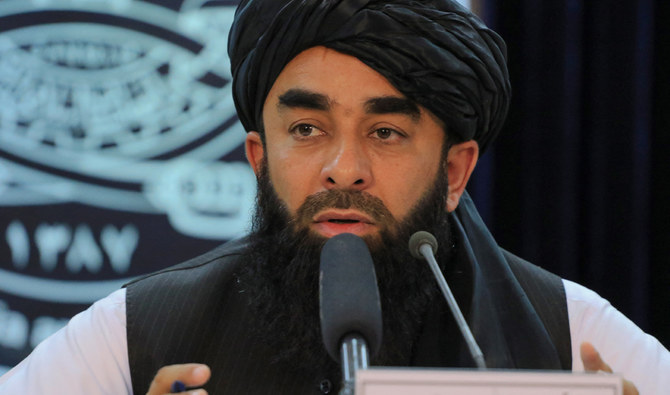
This file photo, taken on November 5, 2022, shows Taliban spokesman Zabihullah Mujahid speaking during a press conference in Kabul. (Photo courtesy: AFP/File)
Short Url
Updated 28 February 2023
Follow

Two senior Daesh members killed in Afghanistan, say Taliban

  • Taliban forces kill Qari Fateh, regional Daesh intelligence and operations chief, during a raid in Kabul over the weekend
  • Taliban say a number of other Daesh members, including foreign nationals planning attacks, have also been detained

ISLAMABAD: Two senior regional members of the Daesh group have been killed in Afghanistan in recent weeks in separate operations by the Taliban security forces, a Taliban spokesman said Tuesday.

Taliban forces killed Qari Fateh, the regional Daesh intelligence and operations chief, during a raid in Kabul over the weekend, Zabihullah Mujahid, the main spokesman for the Taliban government, said in a statement.

Earlier this month in a separate operation in Kabul, three Daesh members — including senior leader Ijaz Amin Ahingar — were killed.

Mujahid said that a number of other Daesh members, including foreign nationals planning deadly attacks, also have been detained in recent days.

The regional affiliate of Daesh in Khorasan Province, is a key rival of the Taliban. The militant group has increased its attacks in Afghanistan since the Taliban takeover of the country in August 2021. Targets have included Taliban patrols and members of Afghanistan’s Shiite people.

In January, eight Daesh militants were killed and nine others arrested in a series of raids targeting key figures.

The raids in the capital city and western Nimroz province targeted Daesh militants who organized attacks on Kabul’s Longan Hotel, Pakistan embassy and the military airport.

The Daesh group claimed responsibility for a deadly bombing near a checkpoint at the Afghan capital’s military airport. Daesh said that attack was carried out by the same militant who took part in the Longan Hotel assault in mid-December.

Daesh claimed the attack on a Chinese-owned hotel in the heart of Kabul, causing China to advise its citizens to leave Afghanistan “as soon as possible.”

Earlier, Daesh also claimed a shooting attack targeting the Pakistani Embassy in Kabul. Shots were fired at the embassy from a nearby building, triggering anger in Pakistan and raising tensions between the two South Asian neighbors.

Pakistan’s top diplomat in Kabul was walking across the lawn inside the embassy compound at the time of the attack. He was unharmed, but one of his Pakistani guards was wounded.

The Taliban swept across the country in mid-August 2021, seizing power as U.S. and NATO forces were withdrawing from Afghanistan after 20 years of war.

The international community has not recognized the Taliban government, wary of the harsh measures they have imposed since their takeover — including restricting rights and freedoms, especially for of women and minorities.


Greek court to deliver verdict on 2022 spyware scandal

Updated 7 sec ago
Follow

Greek court to deliver verdict on 2022 spyware scandal

  • Predator is sophisticated software that makes it possible to infiltrate mobile phones, access messages and photos, and even remotely activate the microphone and camera

Athens: A Greek court was due Thursday to deliver its verdict on an illegal wiretapping scandal targeting politicians, journalists, business leaders and senior military officials that shook the conservative government in 2022.
Dubbed the "Greek Watergate" by local media, it forced the resignation of senior officials in Prime Minister Kyriakos Mitsotakis's administration.
Four defendants -- two Israelis including a former soldier and two Greeks -- face up to five years in prison for violating the confidentiality of telephone communications. They deny involvement.
The sentences are expected to be suspended, to the outrage of lawyers for the victims. The defendants could benefit from a 2019 law under which breaches of the confidentiality of communications are classed as a misdemeanour.
The defendants include Tal Dilian, a former Israeli soldier and founder of Intellexa, a company specialising in the supply of spyware, which marketed the Predator software in Greece.
His partner, as well as two former Greek executives of the company, are also on trial.
According to Greek media reports, Dilian, who remains free pending judgement, is not expected to be in court for the verdict.

Politicians, journalists monitored 

The affair broke in early 2022 when a Greek investigative journalist, Thanassis Koukakis, discovered he had been wiretapped by the intelligence services (EYP) and that his phone had also been infected with the Predator spyware.
Predator is sophisticated software that makes it possible to infiltrate mobile phones, access messages and photos, and even remotely activate the microphone and camera.
"The government initially played down the affair to cover for the real political culprits," Koukakis told AFP in an interview a few months ago.
According to the Greek Authority for Communication Security and Privacy watchdog (ADAE) however, it was used against more than 90 people.
It snowballed into a political scandal in July 2022, when the soon-to-be leader of the socialist Pasok-Kinal party, Nikos Androulakis, revealed that his mobile phone had also been tapped.
At the time, Androulakis was a member of the European Parliament.
Facing mounting pressure, Mitsotakis insisted that the government had "never purchased or used" Predator.
The prosecutor in the case however made it clear he found that difficult to accept in his closing arguments earlier this month.
"Predator is not accessible to private individuals; it is only offered for sale to state services," he told the court.

High-level resignations

The "Greek Watergate" led to the resignation of one of the prime minister's closest aides, his nephew Grigoris Dimitriadis.
The head of the EYP intelligence service also stepped down.
Mitsotakis later weathered a motion of no confidence in parliament.
In July 2024, the Supreme Court cleared the intelligence services and political officials of wrongdoing, angering victims and human rights bodies.
Paris-based media rights campaigners Reporters Without Borders (RSF) has described this case as "a fresh blow to media freedom" in Greece.
Only two proven victims of Predator were questioned by the Supreme Court, and the prosecutor did not request access to the bank accounts of the company that marketed the software.
The Greek employees who, in December 2021, hurriedly moved the servers out of their office were not questioned either.
"One may wonder whether the case was really investigated or whether everything was done to bury it," Androulakis's lawyer, Christos Kaklamanis, told the court.
The socialist leader has filed an appeal with the European Court of Human Rights (ECHR).