‘Doomsday’ Arctic seed vault gets boost as efforts to secure food supplies ramp up

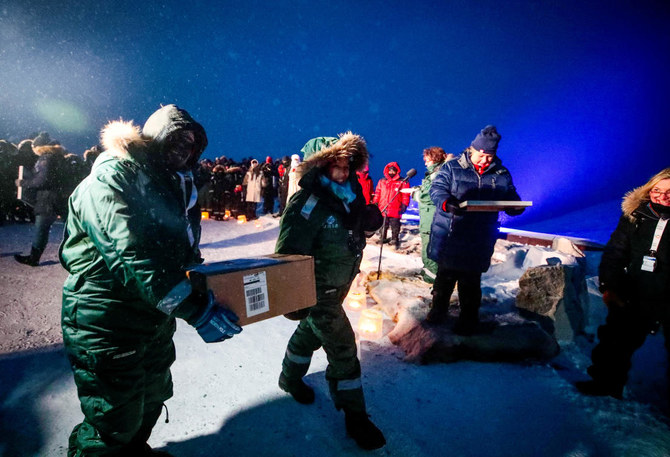
The Svalbard Global Seed Vault was launched in 2008 as a backup for the world’s national and regional gene banks that store the genetic code for thousands of plant species. NTB Scanpix via Reuters
Short Url
Updated 28 February 2023
Follow

‘Doomsday’ Arctic seed vault gets boost as efforts to secure food supplies ramp up

  • The Svalbard Global Seed Vault will add 19,500 rare seed variety samples from across the world to its collection on Tuesday
  • Its subterranean seed chambers are only opened three times a year to limit the seeds’ exposure to the outside world

LONDON: A ‘doomsday’ Arctic seed vault on Norway’s Spitsbergen island is set to receive its most diverse batch of seed donations yet as efforts to secure the world’s food supplies ramp up amid rising climate concerns.
The Svalbard Global Seed Vault, built to protect the world’s food stock from disasters ranging from nuclear war to global warming, will add 19,500 rare seed variety samples from across the world to its collection on Tuesday, taking its total stash to more than 1.2 million.
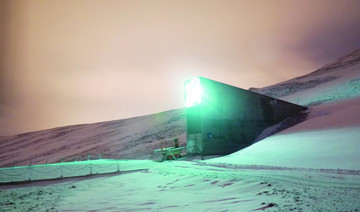
The vault, set in permafrost caves on an arctic mountainside halfway between mainland Europe and the North Pole, was launched in 2008 as a backup for the world’s national and regional gene banks that store the genetic code for thousands of plant species.
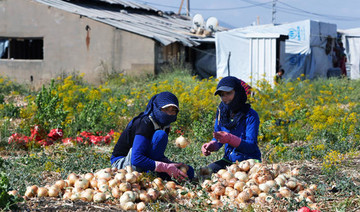
It has seed samples from nearly every country in the world, and played an essential role between 2015 and 2019 in rebuilding seed collections damaged during the war in Syria.
“The whole of humanity relies on the genetic diversity of crops maintained in the world’s gene banks, and the Seed Vault is the last line of defense against the loss of that diversity,” said Sandra Borch, Minister of Agriculture and Food for Norway.
Svalbard, which also serves as a backup for plant breeders to develop new crop varieties more resistant to climate change, opened its doors to public at large for the first time on Tuesday by launching a free virtual tour of its subterranean seed chambers.
The chambers, which are only opened three times a year to limit the seeds’ exposure to the outside world, boast temperatures of around -18 degrees Celsius.
The virtual tour launch, as well as the seed deposits from some 20 gene banks, were timed to mark Svalbard’s 15-year anniversary.
“From here in Svalbard, the world looks different. This Seed Vault represents hope, unity and security,” said Stefan Schmitz, executive director of the Crop Trust, an international non profit that operates Svalbard along with the Norwegian authorities.
“In a world where the climate crisis, biodiversity loss, natural catastrophes and conflicts increasingly destabilize our food systems, it has never been more important to prioritize safeguarding these tiny seeds.”
The world used to cultivate over 6,000 different plants but UN experts say we now get about 40 percent of our calories from three main crops — maize, wheat and rice — making food supplies vulnerable if climate change causes harvests to fail.


Ukraine toils to restore power and heat, Zelensky warns of new attack

Updated 8 sec ago
Follow

Ukraine toils to restore power and heat, Zelensky warns of new attack

  • Russia has systematically attacked Ukraine’s energy system since it invaded its neighbor in 2022 and the air strikes have intensified in recent months

KYIV: Emergency crews toiled to restore heat and power to beleaguered Kyiv residents on Monday, more than ​three days after Russian strikes on energy targets, and President Volodymyr Zelensky warned that new air attacks could be imminent.
Officials said hundreds of apartment blocks in the capital remained without heat despite round-the-clock efforts by the crews. Humanitarian centers, dubbed “resilience points,” were open for people to keep warm and charge electronic devices.
Russia has systematically attacked Ukraine’s energy system since it invaded its neighbor in 2022 and the air strikes have intensified in recent months.
Zelensky, speaking in ‌his nightly video ‌address, said a program was being launched to ‌raise ⁠wages ​and provide ‌support for participants in emergency work brigades.
He issued a new warning to heed air raid alerts as night-time temperatures sank to minus 15 Celsius (5 F) or lower.
“There is intelligence information. The Russians are preparing a new massive strike,” he said.
“Drones to exhaust air defense systems and missiles. They want to take advantage of the cold. The strike may occur in the coming days. Please take care of ⁠yourselves. Protect Ukraine.”
Deputy Prime Minister Oleksiy Kuleba, writing on Telegram, said 90 percent of Kyiv’s apartment buildings ‌have had heating restored, leaving fewer than 500 dwellings ‍still to be connected.
Mayor Vitali Klitschko ‍put the number with no heating at 800, most on the west ‍bank of the Dnipro River. He said a meeting of the Kyiv city council would be convened on Thursday to debate the most pressing issues facing residents.
Prime Minister Yulia Svyrydenko, presenting the program for bonus payments, said the work conducted by emergency ​crews stood “at the very limit of human endurance, often involving life-threatening risks across the entire country.
“This applies to specialists who, in freezing ⁠conditions, go directly to the sites of strikes and restore supplies of heat, electricity, water and gas.”
Residents made their way to one of the humanitarian centers on the east bank of the river in the evening — two tents pitched on a small area of open ground.
They charged their devices and chatted, while outside, the din of whining generators filled the air.
“It’s dark in the apartment. I have an electric stove, so it’s impossible to heat up lunch or dinner, or make tea,” said Kateryna Zubko, 67, an engineer who has lived without power, heating and water since the latest attack.
“We support each other. Ukrainians are such ‌resilient people, I think that this war will end someday, it can’t go on forever.”