

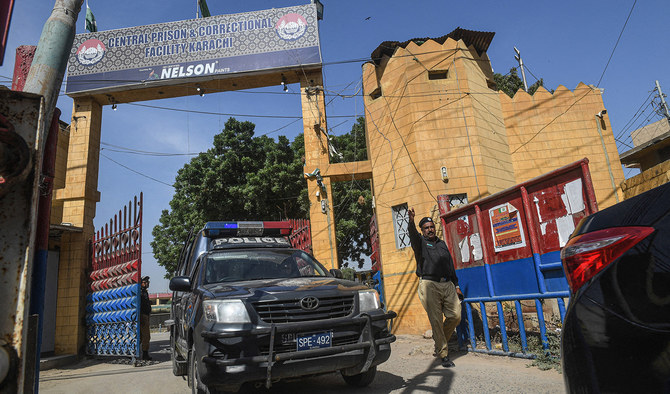

KARACHI: Last month, Faiz Muhammad borrowed from neighbors in his village in Afghanistan's Paktika province and managed to scrape together Rs15,000 ($58) to cover travel expenses to the Pakistani port city of Karachi where he hoped to get his sister-in law treated for chronic kidney disease.
But like dozens of others, Muhammad, who was traveling without a visa, was arrested soon after entering Pakistan and sent on judicial remand on January 26. He was held at Karachi’s Malir Jail until Feb 21 when he was taken to Jinnah Hospital after he "suddenly" fell ill, according to jail officials and court documents.
The 60-year-old died the following day, the fourth death since October 2022 of an Afghan jailed for entering Pakistan without valid travel documents.
“My father had no illness,” Muhammad’s son Baz told Arab News via phone from Afghanistan, his voice cracking. “He took my aunt for kidney treatment but lost his own life.”
Afghans have for decades been traveling to neighboring Pakistan to escape war and persecution in their country and to seek employment and medical treatment as Afghanistan's own health system, understaffed, under-equipped and underfunded for years is at the brink of collapse.
Many of the travelers cannot afford visas and many have no travel documents at all.
Pakistan is home to around 2.8 million Afghan refugees, including 1.5 million registered and 1.3 million unregistered Afghan nationals, according to the United Nations refugee agency, the UNHCR. After the Taliban takeover of the war-battered country in August 2021, some 250,000 additional Afghans took shelter in neighboring Pakistan.
But since last year, Pakistan has intensified its crackdown on Afghans crossing the border without valid documents.
Court documents seen by Arab News said Muhammad had no “significant” history of illnesses but had been diagnosed with hypertension, diabetes and depression a year earlier. At Malir Jail, he developed a severe ear infection and was advised hospital care.
Malir jail official Muhammad Asif also said the Afghan did not have any registered serious illnesses but was taken to hospital after his health "deteriorated suddenly." He said all inmates were either provided medical help at the jail premises or taken to hospital if their condition required it.
But a letter by Afghanistan's consul general, which Arab News can confirm was received by the office of the Sindh home secretary on February 17, showed that the envoy had requested provincial authorities to grant Muhammad “special remission” on “humanitarian grounds” due to a “critical health condition.”
The letter also mentioned three other Afghan inmates who died due to “unavailability of proper medication" in January.
Speaking to Arab News, Syed Abdul Jabbar Takhari, Afghanistan’s acting consul general in Karachi, said Pakistani authorities were informed “on time” about Muhammad's deteriorating health and his life could have been saved if he was provided timely medical help.
"We informed the home secretary well in time but instead of taking him for treatment, we were informed on February 24 that he had died two days ago,” Takhari said. “There are many like him who are being denied medical treatment. We urge the government of Pakistan to be kind with these people who come here for treatment.”
Last month, under-trial Afghan prisoners Taj Muhammad, Abdul Khalil, and Wali Khan also died while at a correctional facility in Karachi’s Malir district.
“These people died because they didn’t get treatment,” Takhari told Arab News at the time, adding that his mission had informed Sindh authorities about the inmates’ health problems in advance.
However, Arshad Shah, superintendent of Malir Prison, had rejected Takhari’s allegations, saying all inmates, including the three Afghan nationals, were given treatment.
“We have medical facilities,” Shah said, “but the ones with serious conditions are sent to hospital, either to the Jinnah Hospital or the Civil Hospital.”
Takhari has said almost 870 Afghan nationals, many struggling with health issues, are currently being held in Sindh prisons.
Muhammad's son Baz said his father, the primary carer of his aunt Saira Bibi since her husband died in a landmine explosion nine years ago, took her to the Ariana hospital in Kabul where doctors said she needed to go to Pakistan in order to receive adequate treatment.
Muhammad, like most Afghans, opted to cross the border illegally as the family couldn’t afford to pay the visa fee to enter Pakistan, but he was caught and offloaded from a bus at Hub Chowki in Pakistan's southwestern Balochistan province while attempting to enter Karachi.
“She [Bibi] is coming home without being cured,” Baz said on the phone, sobbing uncontrollably, "and my father is left behind, dead and alone."


