


ISLAMABAD: An alliance of civil rights groups on Tuesday called off a protest that had lasted for several days across Azad Kashmir and led to serious clashes with police and paramilitary Rangers after the government met its demand to reduce electricity and wheat prices in the region.
The Jammu Kashmir Joint Awami Action Committee (JAAC) organized the protests that started on May 11, seeking subsidized wheat flour and a reduction in electricity tariffs to bring them in line with the hydropower generation cost in Azad Kashmir.
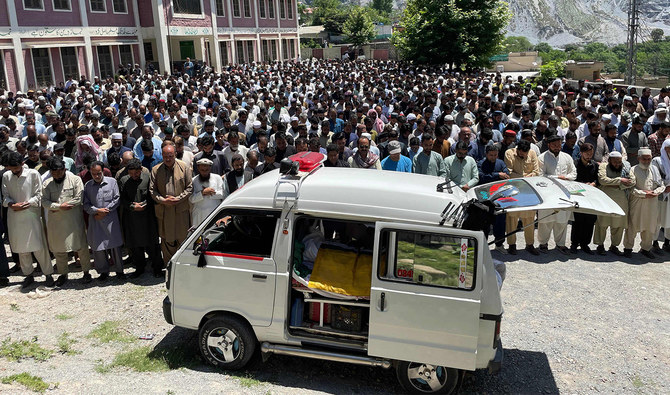
The demonstrations led to four deaths, including one police officer who was reportedly killed by protesters in gunfire, while three demonstrators lost their lives in clashes with Rangers in Muzaffarabad.
Azad Jammu and Kashmir (AJK) Prime Minister Anwar-ul-Haq Chaudhry said at a news conference on Monday his government had notified reduced wheat and electricity prices after the Pakistani government approved Rs23 billion ($83 million) in subsidies.
“On the appeal of the Awami Action Committee, it has been decided to end the ongoing lockdown and wheel-jam strike across Azad Kashmir,” Amjad Ali Khan, a member of the JAAC core committee, told Arab News on Tuesday.
He said JAAC demanded compensation for the three young demonstrators killed in clashes with Rangers. He also informed that a day of mourning and a shutter-down strike would be held today across Kashmir to honor the three demonstrators.
Speaking about the details of JAAC’s agreement with the government, Khan said the authorities had agreed to drop all the cases and release the arrested individuals.
“The Awami Action Committee demanded the formation of a judicial commission to investigate police violence in the Mirpur Division and Muzaffarabad,” he added, saying the judicial commission’s investigation should be made public and those responsible should be punished.
Abdul Majid Khan, a spokesperson for the AJK government, said the authorities had shown utmost restraint to pacify the situation.
“All the demands of the protesters have been fulfilled, and the situation will hopefully return to normalcy now,” he told Arab News.
Pakistan’s information minister, Attaullah Tarar, said the situation in Azad Kashmir had been addressed after the federal government approved the grant to deal with people’s concerns.
“With the grant given by Prime Minister Shehbaz Sharif, the issue has been resolved to meet the people’s demands,” he told the media in Islamabad.
He mentioned Azad Kashmir’s special status, pointing out that its affairs were managed with the grants of Pakistan’s federal government.
“The government will look after the police personnel who fell victims of the protests,” he added.
The Himalayan territory of Kashmir has been divided between India and Pakistan since their independence from Britain in 1947, with both countries ruling part of the territory but claiming it in full.
The western portion of the larger Kashmir region is administered by Pakistan as a nominally self-governing entity, while India rules the southern portion as a union territory.
While the Indian portion has faced an ongoing insurgency for decades and multiple armed attempts by the state to quell it, the Pakistani side has remained relatively calm over the decades, though it is also highly militarized.


