

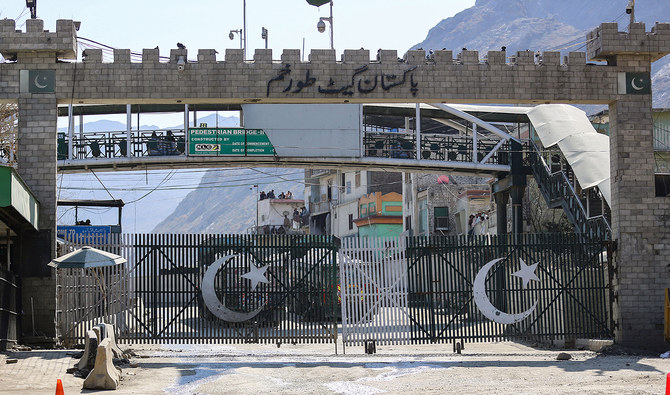

PESHAWAR: Pakistan shut down a key border crossing with Afghanistan just hours after it was reopened on Thursday, officials said, the latest twist in the controversial closure of the Torkham junction that started earlier this week.
The issue of the crossing, a key trade route for both Afghanistan and Pakistan, has added to increasing tensions between the two countries, which share a troubled and volatile boundary.
Afghanistan’s Taliban rulers on Sunday closed the crossing, claiming Islamabad was not abiding by an agreement with Kabul to allow Afghan patients and their caretakers to cross into Pakistan without travel documents for medical care. On Monday, Afghan Taliban forces and Pakistani border guards exchanged fire, which wounded a Pakistani soldier.
On Wednesday, Pakistan’s defense minister, Khawaja Mohammad Asif, and secret service chief, Lt. Gen. Anjum Nadeem, traveled to Kabul and met senior Taliban officials to discuss the border issue.
On Thursday morning, Torkham was reopened by Afghan Taliban forces, allowing some of the thousands of trucks that had lined up for days at the border — many with vegetables, fruits and other perishable food items — to cross over and ease the backlog.
The Afghan Embassy in Pakistan tweeted the news of the reopening and on the Pakistani side, truck drivers rejoiced as their vehicles began moving along the Khyber Pass.
However, the crossing closed hours later. Ziaul Haq Sarhadi, director of the Pakistan-Afghanistan joint Chamber of Commerce and Industry, said that Pakistan was unable to make the border crossing “fully functional because of administrative issues.” He did not explain.
Other officials in Islamabad were not immediately available for comment.
“The Torkham gate has been closed by the Pakistani side after it was opened today by the officials of the Islamic Emirate,” the media center in Afghanistan’s Nangarhar Province said on Twitter.
For Pakistan, the Torkham border crossing is a vital commercial artery and a trade route to Central Asian countries. But Islamabad has also accused the Afghan Taliban of providing sanctuary for Pakistani militants whose cross-border attacks have led to a spike in violence in Pakistan.
The Afghan Taliban administration has said the Pakistani delegation was told during Wednesday’s meeting that it was up to Pakistan to provide all the “necessary facilities” for travelers at Torkham and also at Spin Boldak, another crossing further south, as well as special facilities for the transportation of patients needing emergency medical care. The Pakistani side promised to resolve these matters quickly, Kabul said.
Closures, cross-border fire and shootouts are common along the Afghan-Pakistan border.
Pakistan’s Foreign Ministry said its delegation to Kabul also raised during Wednesday’s talks “the growing threat of terrorism in the region,” particularly by the Pakistani Taliban, known as Tahreek-e Taliban-Pakistan or TTP, and the Daesh group.
On Thursday, senior security officials told The Associated Press that the Pakistani delegation demanded the Taliban prevent Pakistani Taliban militants from launching cross-border attacks on Pakistan from within Afghanistan.
The demand, the officials said, is urgent as the Pakistani Taliban allegedly plan to launch their “spring offensive” in March. The officials spoke on the condition of anonymity because they were not authorized to speak to the media.
Pakistan has recently warned that it has the right to target TTP sanctuaries in Afghanistan if the Taliban administration fails to rein in the militants, increasing the prospect of more cross-border violence.
The Pakistani Taliban are a separate group, but allied with the Afghan Taliban, who seized power more than a year ago as the US and NATO troops withdrew from the country after 20 years of war.
The Taliban takeover in Afghanistan has emboldened the TTP, which in recent months stepped up attacks in Pakistan, where security forces often raid their hideouts. In the latest raid in the northwestern district of Lakki Marwat, security forces on Thursday killed six Pakistani Taliban militants, police said.
Also Thursday, troops in Pakistan’s volatile southwestern Baluchistan province, in the district of Kech, raided a militant hideout, killing eight insurgents, the military said. Baluchistan has for years witnessed a low-level insurgency by small groups demanding independence. Although the government says it has quelled the insurgency, violence in the province has persisted.


