Ukraine ‘will prevail’, Zelensky says ahead of invasion anniversary

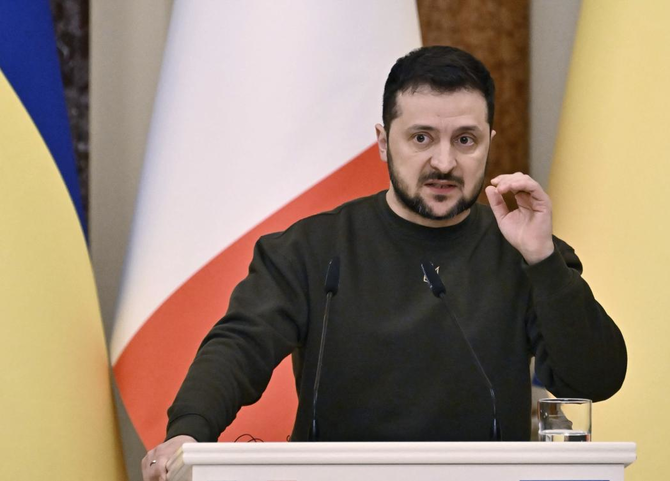
Ukrainian President Volodymyr Zelensky gestures as he speaks during a joint press conference with Italian Prime Minister after their meeting in Kyiv on February 21, 2023, amid the Russian invasion of Ukraine. (AFP)
Short Url
Updated 24 February 2023
Follow

Ukraine ‘will prevail’, Zelensky says ahead of invasion anniversary

  • Ahead of the war’s first anniversary on February 24, Ukraine’s military intelligence chief said Russia was planning a missile attack to mark the day

KYIV: Ukrainian President Volodymyr Zelensky on Thursday expressed confidence in his country’s victory over invading Russian forces with fears mounting of strikes on the war’s first anniversary.
The nearly year-long conflict has seen Western leaders step up their support for Kyiv, and on Thursday G7 ministers discussed new sanctions on Russia as the UN General Assembly prepared to vote on a motion calling for “lasting” peace.
“We have not broken down, we have overcome many ordeals and we will prevail. We will hold to account all those who brought this evil, this war to our land,” Zelensky said on social media.
In the capital Kyiv, which saw Russian troops at its doorstep at the start of the invasion last February and relentless attacks on energy infrastructure since, residents remained defiant.
“This has been the most difficult year of my life and that of all Ukrainians,” said Diana Shestakova, 23, who works for a publishing house and whose boyfriend has spent the last year away in the army.
“I am sure that we will be victorious, but we don’t know how long we will have to wait and how many victims there are still to come.”
In the western city of Lviv, a Swiss artist projected images in honor of Ukraine on public buildings on Wednesday night, covering them in blue and yellow peace doves and Ukrainian tridents.
Ahead of the war’s first anniversary on February 24, Ukraine’s military intelligence chief said Russia was planning a missile attack to mark the day.
“February 23-24, they have two dates,” Kyrylo Budanov said in an interview to newspaper Ukrainskaya Pravda, adding: “Believe me, we have survived this more than 20 times already.”
The year-long conflict has devastated swathes of Ukraine, turned Russia into a pariah in the West and according to Western sources, has caused 150,000 casualties on each side.
In India, Group of Seven finance ministers met in the city of Bengaluru to discuss further sanctions and more financial help for Ukraine.
They urged the International Monetary Fund on Thursday to deliver a new aid package to Ukraine by the end of March.
A senior US official has said that the United States and its G7 allies planned to unveil “a big new package of sanctions” around the anniversary, including measures to crack down on the evasion of existing sanctions.
US Treasury Secretary Janet Yellen told the G7 meeting that the unprecedented Western sanctions imposed on Moscow over the last 12 months “had a very significant negative effect on Russia so far.”
The latest Western leader to visit the Ukrainian capital, Spanish Prime Minister Pedro Sanchez, tweeted that Madrid would “stand with Ukraine and its people until peace returns to Europe” after arriving in Kyiv by train and before meeting President Zelensky.
In New York, the UN General Assembly was on Thursday to bring to a vote a motion backed by Kyiv and its allies calling for a “just and lasting peace.”
“Never in recent history has the line between good and evil been so clear. One country merely wants to live. The other wants to kill and destroy,” Ukrainian Foreign Minister Dmytro Kuleba told the world body on Wednesday.
The Kremlin’s UN ambassador accused the West of being “ready to plunge the entire world into the abyss of war” to defeat Russia.
And Russian leader Vladimir Putin vowed to strengthen his country’s defense capabilities as he laid flowers at the Tomb of the Unknown Soldier in Moscow before meeting soldiers in Red Square under blue skies and brisk temperatures.
Russia will equip troops with “new strike systems, reconnaissance and communication equipment, drones and artillery systems,” he said, hailing Russian soldiers fighting “heroically” in Ukraine and defending “our historical lands.”
Russia’s “unbreakable unity is the key to our victory,” he said.
While US President Joe Biden paid a hugely symbolic trip to Kyiv to show support this week, strengthened Russo-Chinese ties were on display in Moscow as Putin met Beijing’s top diplomat, Wang Yi.
Their meeting, during which Beijing presented its views toward a “political settlement” in Ukraine, came after Washington and NATO voiced concern that China could be preparing to supply Russia with weapons.


Pushed to margins, women vanish from Bangladesh’s political arena

Updated 3 sec ago
Follow

Pushed to margins, women vanish from Bangladesh’s political arena

DHAKA: For more than three decades, Bangladesh was one of the few countries in the world to be led by women, yet there are almost none on the February 12 ballots.
Despite helping to spearhead the uprising that led to this vote, women are poised to be largely excluded from the South Asian country’s political arena.
Regardless of which parties win next week, the outcome will see Bangladesh governed almost exclusively by men.
“I used to be proud that even though my country is not the most liberal, we still had two women figureheads at the top,” first-time voter Ariana Rahman, 20. told AFP.
“Whoever won, the prime minister would be a woman.”
Women make up less than four percent of the candidates for this election: just 76 among the 1,981 contestants vying for 300 parliamentary seats.
And most of the parties put only men on their tickets.
Women’s political representation has always been limited in the conservative South Asian nation. Since independence, the highest number elected was 22 in 2018.
But from 1991 until the 2024 revolution, Bangladesh was helmed, represented abroad and politically defined by two women: Sheikh Hasina and Khaleda Zia.
Zia died in December after leading the Bangladesh Nationalist Party (BNP) for four decades and serving three terms as premier.
Hasina, the five-time prime minister overthrown in the July 2024 uprising, is hiding in India and sentenced to death in absentia for crimes against humanity.

- ‘Censored, vilified, judged’ -

Many rights campaigners had hoped the revolution that ended Hasina’s autocratic rule would usher in a period of greater equality, including for women.
While the caretaker government of Nobel Peace Prize winner Muhammad Yunus set up a Women’s Affairs Reform Commission, his interim administration has also been criticized for sidelining the body and making unilateral decisions without consulting women officials.
And there has been a surge of open support for Islamist groups, which want to limit women’s participation in public life.
After years of being suppressed, emboldened hard-liners have demanded organizers of religious commemorations and other public events remove women from the line-up, as well as calling for restrictions on activities like women’s football matches.
“Historically, women’s participation has always been low in our country, but there was an expectation for change after the uprising, which never happened,” said Mahrukh Mohiuddin, the spokesperson for women’s political rights organization Narir Rajnoitik Odhikar Forum (Women’s Political Rights Forum).
An entrenched patriarchal mindset means women are often relegated to household duties, she added.
Those who dare to speak out often face hostility.
“Women are censored, vilified... judged for simply being part of a political party,” said uprising leader Umama Fatema. “That is the reality.”
Even the group formed by student leaders of the revolution, the National Citizen Party (NCP), is fielding just two women among its 30 candidates.
“I don’t take part in any decision?making of my party, (and) the biggest and most important decisions are not taken in our presence,” said NCP member Samantha Sharmeen.
The NCP has allied with Jamaat-e-Islami, the largest Islamist party and one of 30 parties to have failed to nominate a single woman.

- ‘Can’t be any women leaders’ -

Jamaat’s assistant secretary general, Ahsanul Mahboob Zubair, said society was not yet “ready and safe” for women in politics.
Nurunnesa Siddiqa of its women’s wing added: “In an Islamic organization, there can’t be any women leaders, we have accepted that.”
One of the few women running in this election, Manisha Chakraborty, said women’s participation in Bangladesh’s politics has long been limited to tokenization.
The nation of 170 million people directly elects 300 lawmakers to its parliament, while another 50 are selected on a separate women’s list.
“The concept of reserved seats is insulting,” said Chakraborty, whose Bangladesh Socialist Party has nominated 10 women among it 29 candidates — the highest share in this poll.
“Lobbying, internal preference, nepotism — all play a role in making women’s participation in parliament just a formality,” she told AFP.
Former minister Abdul Moyeen Khan said the reserved seats “were meant to help women establish a foothold,” but “the opposite happened.”
Selima Rahman, the only woman on the BNP’s standing committee, said promising women leaders often “fade away” due to a lack of party support.
And while Zia and Hasina served important symbolic roles, she pointed to how both had been elevated to the pinnacle of power through family connections.
Student voter Ariana Rahman fears a long struggle lies ahead.
“More women in this election would have made me feel better represented,” she said. “The next few years are likely to be more hostile toward women.”